Blog Posts
LNG Plant Maintenance Safety Protocols: The 2026 Comprehensive Guide
Effective hot work safety in LNG facilities requires more than just reactive gas detection; it demands the absolute isolation of ignition sources within a pressurized environment. As U.S. LNG export capacity reaches 24 billion cubic feet per day in 2026, the margin for error during maintenance has vanished. You understand that a single spark near a vapor cloud can lead to catastrophic consequences, yet the pressure to minimize downtime during turnarounds is relentless. This high-stakes environment requires a shift from passive monitoring to active protection of human life and high-value assets.
We agree that the current regulatory lag between the 2026 edition of NFPA 59A and the older 49 CFR Part 193 standards creates a complex compliance landscape for safety engineers. This guide provides the technical roadmap to master these protocols, ensuring zero-incident maintenance cycles and full regulatory alignment. We will examine how PetroHab Hot Work Safety Enclosures (HWSE) utilize modular Quadra-Lock panels and the Safe-Stop automatic shutdown system to maintain operational integrity. You’ll gain the expertise needed to implement pressurized habitats that protect your facility while significantly reducing turnaround duration.
Key Takeaways
- Identify the layered defense-in-depth strategies required to manage the critical 5% to 15% flammable range of methane during maintenance.
- Navigate the regulatory intersection of OSHA 1910.119 and the 2026 NFPA 59A standards to ensure total plant compliance.
- Master the use of pressurized habitats as a definitive technological remedy for hot work safety in LNG facilities.
- Deploy modular Quadra-Lock panels and Safe-Stop systems to isolate ignition sources and protect high-value assets.
- Optimize turnaround workflows by performing essential maintenance without the economic burden of full plant depressurization.
Understanding the Unique Hazards of LNG Plant Maintenance
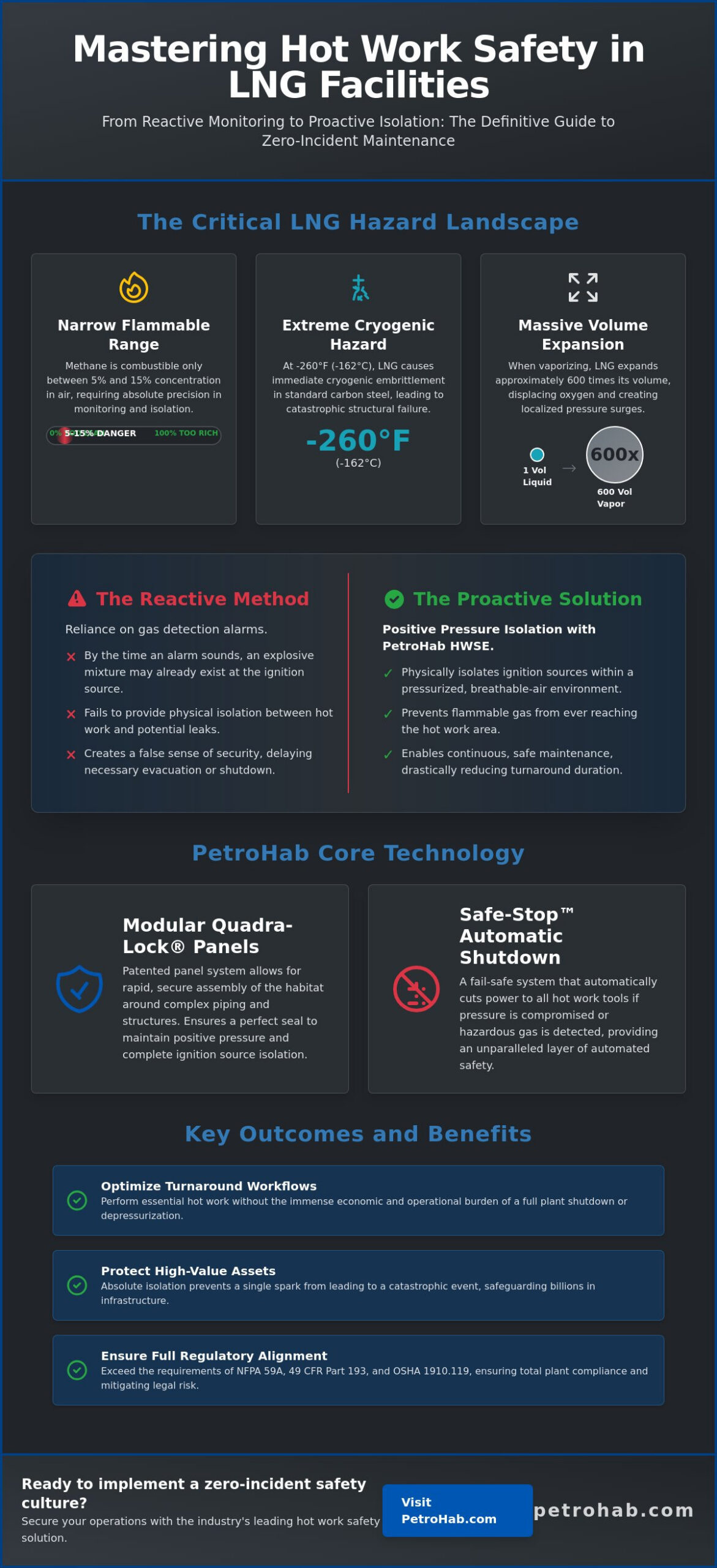
Maintenance in an LNG environment is a high-stakes operation where safety protocols function as a multi-layered defense-in-depth strategy. Unlike traditional oil and gas facilities, LNG plants present a specific flammable range challenge. Methane becomes combustible when it reaches a concentration of 5% to 15% in air. This narrow window requires absolute precision in monitoring and isolation. Maintaining hot work safety in LNG facilities means accounting for the fact that even small leaks can quickly reach this ignition threshold.
The physical state of the product adds another layer of complexity. Understanding LNG Hazards is essential for recognizing how cryogenic liquids behave during a release. At -260°F (-162°C), LNG is extremely cold. If this liquid contacts standard carbon steel tools or structural components, it can cause immediate cryogenic embrittlement and catastrophic structural failure. While methane is lighter than air at ambient temperatures, cold vapors can stay low to the ground initially, creating unpredictable dispersion patterns during maintenance leaks.
To better understand the fundamental principles of managing these risks, watch this helpful video:
The Critical Nature of Ignition Source Control
Routine maintenance often introduces high-energy ignition sources, such as welding arcs, grinding sparks, and hot surfaces. Traditional gas detection systems provide a vital alert, but they’re inherently reactive. By the time a sensor triggers an alarm, the flammable mixture may already surround the ignition source. Modern protocols prioritize active isolation. Thermal imaging has become a standard pre-maintenance inspection tool. This allows engineers to identify heat signatures and potential hot spots before work begins. This proactive approach ensures that hot work safety in LNG facilities doesn’t rely solely on the absence of gas.
Cryogenic Liquid vs. Gaseous Methane Risks
Managing leaks at -260°F requires specialized material selection and rigorous personnel training. Standard PPE is insufficient for direct cryogenic contact; specialized thermal protection is mandatory. Tools used in these zones must be rated for extreme temperature fluctuations to prevent snapping under stress. Workers must also understand high-pressure vaporization scenarios. When LNG vaporizes, it expands approximately 600 times in volume. This rapid expansion can displace oxygen and create localized pressure surges. Utilizing a PetroHab HWSE with modular Quadra-Lock panels provides a definitive technological remedy by maintaining positive pressure, effectively preventing methane ingress during these volatile phases.
Regulatory Frameworks: Compliance with NFPA 59A and 49 CFR Part 193
Compliance in 2026 is a moving target. The Pipeline and Hazardous Materials Safety Administration (PHMSA) continues its effort to align 49 CFR Part 193 with modern standards. Although the federal code was last amended on May 5, 2026, it often lags behind the latest industry consensus. The 2026 edition of NFPA 59A now serves as the technical anchor for the sector. It introduces expanded electrical area classifications and revised spill containment requirements. Relying on outdated federal minimums isn’t a defensible strategy for risk mitigation. Hot work safety in LNG facilities demands adherence to the most current standards to protect high-value assets and personnel.
The intersection of these rules with OSHA 1910.119 ensures that Process Safety Management (PSM) remains central to all maintenance activities. Effective hot work safety in LNG facilities requires protocols that are documented and strictly enforced to prevent catastrophic releases. You can find detailed guidance on managing these risks in our standard for Hot Work Safety. For operators with a global footprint, implementing hazardous environment standards across all sites ensures operational consistency. This global alignment simplifies audits and reduces the risk of non-compliance during cross-border turnarounds. Accurate record-keeping is essential; all maintenance audits and safety inspections must be archived to demonstrate due diligence during regulatory reviews.
Maintenance Subpart G Requirements
Subpart G of 49 CFR Part 193 mandates specific maintenance intervals that safety managers can’t ignore. Documentation is the cornerstone of regulatory integrity. Key requirements include:
- Testing emergency shutdown (ESD) systems every 6 months to ensure functional reliability.
- Regular relief valve inspections and testing to verify set points.
- Technical logging of all safety-critical component repairs to provide a transparent audit trail.
These protocols ensure that the facility remains within its designed safety envelope during active operations.
Hot Work Permits and Fire Protection Standards
Integrating NFPA 51B into LNG facility protocols provides a structured approach to fire prevention. A dedicated fire watch is mandatory in LNG maintenance zones. They must maintain vigilance for at least 30 minutes after work concludes to monitor for smoldering fires. Safety managers often integrate the Safe-Stop automatic shutdown system into their permit-to-work process. This establishes definitive triggers for immediate work cessation if gas is detected. To ensure your facility meets these rigorous requirements, consider reviewing our modular safety solutions for your next turnaround.
Ignition Source Control: The Critical Role of Pressurized Enclosures
Administrative controls alone cannot guarantee hot work safety in LNG facilities if a methane leak occurs during live maintenance. Tactical execution requires the physical isolation of the ignition source. A pressurized welding habitat provides this isolation by creating a differential pressure barrier. This positive pressure ensures that the internal atmosphere remains free of flammable gases, even if the external environment reaches the combustible range. By maintaining a pressure higher than the surrounding atmosphere, the system effectively blocks methane ingress at the source.
The structural integrity of the enclosure is paramount. Coastal LNG facilities often face high-wind conditions that can compromise temporary structures. Our Quadra-Lock panels are engineered to withstand these lateral forces, ensuring the habitat remains secure and pressurized. Adhering to OSHA Hot Work Precautions requires maintaining fire hazard-free conditions, a task made possible by the modular and interlocking nature of these panels. This hardware-driven approach moves beyond the reactive nature of portable gas detectors. It provides a definitive technological remedy for high-stakes environments.
Modular Enclosure Design for LNG Facilities
Modular design allows for rapid deployment in congested pipe racks where space is at a premium. Each Quadra-Lock panel is manufactured from fire-resistant materials that comply with rigorous international safety codes. This ensures the enclosure can withstand sparks and slag without becoming a hazard itself. Ventilation protocols are equally critical. High-volume air exchangers manage heat stress for personnel inside the enclosure while continuously refreshing the internal atmosphere to maintain safety. This dual-focus on worker comfort and asset protection is a hallmark of operational excellence.
Integrating Gas Detection with Habitat Control
True hot work safety in LNG facilities integrates detection with active control systems. We strategically place LEL (Lower Explosive Limit) sensors at the air intake and within the habitat. These sensors link directly to the Safe-Stop automatic shutdown system. If the system detects gas or senses a loss of internal pressure, Safe-Stop immediately cuts power to all welding and grinding equipment. This automated redundancy eliminates human error and ensures that the ignition source is neutralized before it can interact with a hazardous atmosphere. Redundant pressure monitoring provides continuous verification of HWSE integrity throughout the maintenance cycle.
Operational Best Practices for Safe LNG Maintenance Workflows
Operational excellence in LNG maintenance requires a transition from high-level safety concepts to disciplined, tactical execution. Every workflow begins with a Job Safety Analysis (JSA) tailored to the unique vapor hazards of the site. This analysis must account for the 5% to 15% flammability range of methane and its dispersion characteristics under current atmospheric conditions. Before any equipment is energized, technicians must conduct pre-work atmospheric testing in Zone 1 and Zone 2 environments. This ensures that the immediate work area is free of combustible gases before the hot work safety in LNG facilities protocol is initiated.
Isolation and lockout/tagout (LOTO) procedures for cryogenic lines demand specialized attention. At -260°F, residual liquids in piping can vaporize rapidly if not properly drained and purged, creating localized pressure spikes. Verification of a zero energy state is not a one-time event; it requires continuous monitoring throughout the maintenance duration. This rigorous approach ensures that hot work safety in LNG facilities remains an active process rather than a static permit. To implement these standards at your facility, consult with our safety engineers to integrate our patented technologies into your workflow.
Step-by-Step Hot Work Execution in LNG Zones
A methodical approach to hot work eliminates the variables that lead to accidents. Follow this structured sequence for every maintenance cycle:
- Step 1: Establish the hot work safety enclosure and verify positive pressure. Use Quadra-Lock panels to ensure a tight, interlocking seal that prevents methane ingress.
- Step 2: Calibrate dual-gas detectors for methane and oxygen levels. Ensure all sensors are bump-tested and within their certified calibration window.
- Step 3: Perform a functional test of the Safe-Stop automatic shutdown interface. This ensures the system will successfully cut power to ignition sources if pressure drops or gas is detected.
- Step 4: Conduct a post-work inspection for smoldering materials and perform enclosure decommissioning once the area is declared safe.
Emergency Response and Contingency Planning
Contingency planning is the final layer of the defense-in-depth strategy. Evacuation protocols must be clearly defined for sudden depressurization or leak detection events. Habitat technicians must maintain a constant communication chain with the central control room via intrinsically safe radios. Finally, fire suppression teams must be stationed with equipment specific to LNG pool fires. These fires require specialized foam and application techniques that differ from standard hydrocarbon fire responses. Maintaining this state of readiness protects both the personnel and the high-value assets of the plant.
Optimizing LNG Plant Turnarounds with PetroHab HWSE Technology
Maximizing facility uptime is a primary objective for every plant manager. Traditional maintenance often requires full plant depressurization, a process that incurs significant revenue loss and operational strain. By utilizing hot work safety in LNG facilities, operators can execute critical repairs while maintaining production flow. This approach leverages pressurized enclosures to isolate ignition sources, allowing for live maintenance in areas that would otherwise be declared hazardous. The economic impact of integrating these hot work safety systems is substantial, as it eliminates the need for costly venting and purging cycles.
Quadra-Lock technology has established itself as the industry standard for habitat integrity. These modular panels provide an unrivaled seal, ensuring that positive pressure is maintained even in the complex geometries of an LNG terminal. PetroHab supports these operations globally, offering leasing options, direct sales, and on-site supervision. Our presence on-site ensures that every hot work safety in LNG facilities protocol is executed with technical precision. This comprehensive support model allows facilities to maintain their rigorous safety standards without sacrificing turnaround efficiency.
Case Study: Live Maintenance in High-Risk Zones
A recent project involved executing critical welding repairs on an active LNG pipe rack. In this high-risk environment, the proximity of flammable vapors made traditional welding impossible without a total shutdown. By deploying a PetroHab HWSE, the maintenance team achieved 100% safety compliance while the plant continued to meet its export obligations. The Safe-Stop system provided the necessary redundancy, monitoring the atmosphere continuously to prevent any risk of ignition. The implementation of HWSE technology delivers a measurable return on investment by reducing total turnaround duration by 20% compared to traditional depressurization methods.
Partnering with PetroHab for Global LNG Safety
Global LNG projects require a safety partner who understands the granular details of international compliance and terminal layouts. PetroHab provides access to certified technicians who specialize in habitat setup and atmospheric monitoring. We design custom enclosure configurations to fit the most congested and complex layouts, ensuring that no area of the plant is inaccessible for safe maintenance. Our commitment to protecting human life and high-value assets is unwavering. Consult with PetroHab for your next LNG maintenance turnaround to ensure your facility achieves zero-incident cycles and optimal operational performance.
Advancing Safety Standards for 2026 LNG Operations
Mastering hot work safety in LNG facilities requires a disciplined shift from reactive monitoring to proactive isolation. The technical precision of pressurized habitats, supported by the 2026 edition of NFPA 59A, provides the necessary defense-in-depth for high-consequence environments. By integrating modular Quadra-Lock technology and the Safe-Stop automatic shutdown system, operators effectively neutralize the 5% to 15% flammable range risk of methane. These protocols don’t just protect personnel; they optimize turnaround efficiency by maintaining production flow during critical repairs.
PetroHab brings over 15 years of oil and gas safety expertise to every project. Our ATEX and IECEx compliant systems ensure your facility meets the most rigorous international standards for ignition source control. Reliability is the cornerstone of operational excellence, and our patented engineering provides the unrivaled integrity required for hazardous site management. We invite you to Secure your LNG facility with PetroHab’s patented Quadra-Lock safety systems. With the right technical partner, your team can achieve zero-incident maintenance cycles and complete regulatory compliance with absolute confidence.
Frequently Asked Questions
What are the primary ignition sources to avoid during LNG maintenance?
Primary ignition sources include welding arcs, grinding sparks, and high-temperature surfaces exceeding the auto-ignition temperature of methane. These sources are strictly controlled through the use of pressurized welding enclosures. By isolating these hazards, operators mitigate the risk of igniting localized vapor clouds that may form during routine maintenance activities.
How does a pressurized habitat prevent methane from reaching a welding arc?
A pressurized habitat maintains an internal pressure higher than the surrounding atmosphere to create a physical barrier. This positive pressure forces internal air out through any gaps or openings, which effectively prevents methane from entering the enclosure. This mechanism is a foundational requirement for hot work safety in LNG facilities.
Is hot work allowed in a live LNG plant under 49 CFR Part 193?
Hot work is permitted in live facilities as long as operators comply with the fire protection and maintenance standards outlined in the federal code. This includes establishing a dedicated fire watch and implementing rigorous ignition source control. Utilizing an HWSE ensures these requirements are met without necessitating a full plant shutdown or depressurization.
What is the flammability range of natural gas in an LNG facility?
The flammability range of natural gas is between 5% and 15% concentration in air. Within this specific window, the mixture is highly combustible and prone to ignition. Effective safety protocols focus on keeping gas concentrations well below the lower explosive limit (LEL) through continuous monitoring and active ventilation.
How often should emergency shutdown (ESD) systems be tested in an LNG plant?
Emergency shutdown systems must be tested at intervals not exceeding 6 months according to 49 CFR Part 193 Subpart G. These tests verify the functional reliability of safety-critical components during an incident. Technical logs of these tests are mandatory for regulatory audits and ongoing facility integrity management.
What is the difference between Zone 1 and Zone 2 in an LNG environment?
Zone 1 defines an area where a flammable atmosphere is likely to occur during normal operations. Zone 2 is an environment where flammable mixtures are only expected under abnormal conditions, such as a localized leak. Both zones require specialized electrical area classifications and the use of pressurized habitats for hot work safety in LNG facilities.
Can PetroHab enclosures be used for cryogenic pipe welding?
PetroHab enclosures are engineered for welding on pipes in cryogenic zones. The modular Quadra-Lock panels provide the structural integrity needed to withstand harsh coastal or industrial environments. These enclosures allow technicians to perform precision welding while protecting the surrounding infrastructure from the high heat of the welding arc.
What happens if the pressure drops inside a hot work safety enclosure?
A drop in internal pressure triggers the Safe-Stop automatic shutdown system immediately. This technology cuts power to all welding and grinding equipment within the enclosure. This automated response ensures that the ignition source is neutralized before any external methane can bypass the compromised pressure barrier.