Blog Posts
Offshore Certified Welding Habitat Requirements: The 2026 Compliance Guide
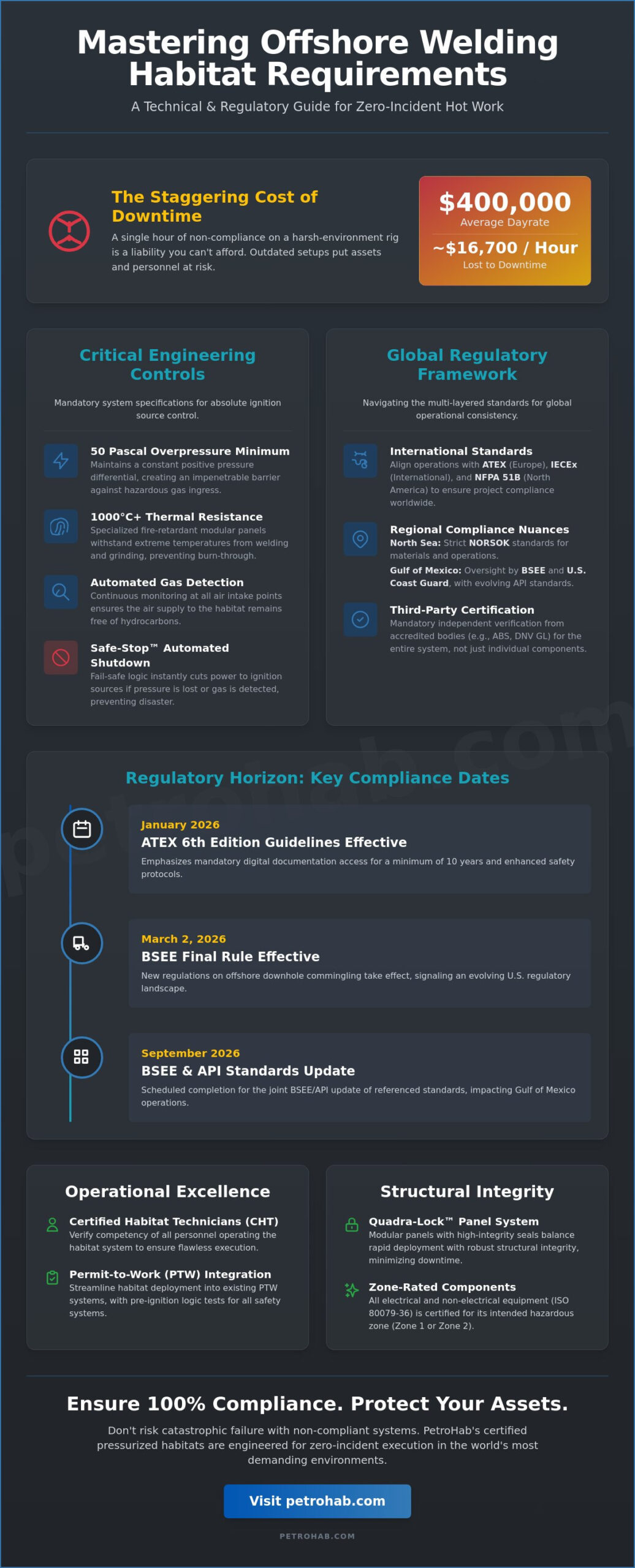
With average dayrates for harsh-environment semi-submersible rigs reaching $400,000 in 2026, a single hour of downtime due to non-compliant equipment is a liability no safety manager can afford. You understand that executing hot work in high-risk environments requires more than basic enclosures. It demands absolute adherence to offshore certified welding habitat requirements to prevent catastrophic ignition. Relying on outdated setups or partial certifications puts both your personnel and your high-value assets at unnecessary risk. Compliance isn’t a suggestion; it’s the foundation of operational integrity on any live offshore platform.
This guide ensures you master the technical and regulatory specifications necessary for zero-incident execution. We’ll detail how to achieve full compliance with the January 2026 ATEX 6th Edition Guidelines and the mandatory IEC 60079-13:2017 standards. You’ll learn the critical importance of maintaining the 50 Pascal overpressure minimum and how our Quadra-Lock and Safe-Stop systems provide unrivaled protection. We’ll also preview the BSEE regulatory updates scheduled for completion in September 2026. This technical roadmap provides the clarity needed to integrate pressurized habitats seamlessly into your existing Permit-to-Work systems.
Key Takeaways
- Navigate the multi-layered regulatory landscape by aligning operations with ATEX, IECEx, and NFPA 51B standards to ensure global project consistency.
- Ensure structural integrity by utilizing modular panels and specialized fire-retardant materials designed to resist temperatures exceeding 1000°C during hot work.
- Meet all offshore certified welding habitat requirements by maintaining a constant 50 Pascal overpressure and deploying automated gas detection systems at all intake points.
- Streamline Permit-to-Work integration by verifying the competency of Certified Habitat Technicians and testing Safe-Stop logic before any ignition source is introduced.
- Optimize your safety budget by selecting modular systems like Quadra-Lock, which balance high-integrity seals with rapid deployment to minimize operational downtime.
The Regulatory Framework for Offshore Hot Work Safety Enclosures
A certified Hot Work Safety Enclosure (HWSE) is a sophisticated, pressurized, ignition-controlled workspace designed to isolate potential ignition sources from explosive atmospheres. In the oil and gas industry, this Positive pressure enclosure serves as the primary defense against gas ingress during live-plant welding operations. Meeting offshore certified welding habitat requirements involves a synergistic integration of mechanical barriers and automated safety systems. These habitats must maintain a controlled environment where the risk of catastrophic ignition is systematically eliminated through engineering controls.
To better understand the fundamental operation of these systems, watch this technical overview:
Regulatory oversight is managed through a multi-layered framework. Global standards such as ATEX (Europe), IECEx (International), and NFPA 51B (North America) define the baseline for design and operation. As of January 2026, the 6th edition of the ATEX guidelines emphasizes digital documentation accessibility for a minimum of 10 years. Class societies like ABS and DNV GL further influence habitat specifications by requiring rigorous testing of structural integrity and system reliability. Zone 1 environments, where explosive atmospheres are likely to occur during normal operation, demand higher instrumentation redundancy than Zone 2 areas. This ensures that a single component failure doesn’t compromise the entire safety system.
ATEX and IECEx Certification for Habitats
Certification isn’t optional; it’s a legal mandate. Every electrical component within the habitat must meet specific explosive atmosphere ratings. Non-electrical equipment, such as fans or pneumatic tools, must comply with ISO 80079-36 standards. This includes the mechanical integrity of our Quadra-Lock modular panels, which are engineered to maintain a seal under constant pressure. While some manufacturers might attempt self-declaration, the high-stakes nature of offshore work requires third-party certification from an accredited body. This independent verification confirms that the entire system, not just individual parts, maintains safety in a hazardous area.
Regional Compliance Nuances: North Sea vs. Gulf of Mexico
Compliance strategies vary by region. In the Norwegian continental shelf, NORSOK standards dictate strict material and operational protocols. Conversely, in U.S. waters, the Bureau of Safety and Environmental Enforcement (BSEE) and the U.S. Coast Guard provide oversight. BSEE is currently updating its referenced standards in partnership with the American Petroleum Institute (API), a process scheduled for completion in September 2026. Understanding these hazardous environment standards is vital for global operators moving equipment between jurisdictions. The direct final rule on offshore downhole commingling, effective March 2, 2026, further demonstrates the evolving nature of these regional regulations and the need for offshore certified welding habitat requirements to remain current.
Structural Integrity and Material Requirements
The structural integrity of a hot work safety enclosure represents the primary physical barrier between a high-temperature ignition source and an explosive offshore atmosphere. To meet offshore certified welding habitat requirements, the materials used in construction must demonstrate extreme thermal resistance. Panels must exceed 1000°C resistance to ensure they don’t degrade or fail during heavy welding or grinding operations. This thermal threshold isn’t a suggestion; it’s a critical safety specification designed to prevent burn-through that could expose the external environment to sparks. Maintaining this barrier allows personnel assigned to Fire Watch Duties to focus on monitoring internal conditions rather than worrying about the physical failure of the enclosure walls.
Managing penetrations is another technical challenge that defines the habitat’s reliability. Offshore assets are cluttered with pipes, I-beams, and structural members that must pass through the habitat walls. We use specialized sealing systems that wrap around these irregular shapes to maintain a gastight seal. Without precise penetration management, the positive pressure required for safety would bleed out, rendering the habitat non-compliant. These seals must remain flexible enough to accommodate the vibration and movement typical of offshore rigs while maintaining their fire-retardant properties under load.
The Quadra-Lock Standard for Modular Panels
Our patented Quadra-Lock technology provides the mechanical foundation for modular panel integrity. Unlike traditional hook-and-loop or simple zipper systems, Quadra-Lock uses a robust interlocking mechanism that prevents panel separation, even when subjected to the high wind loads common in offshore environments. This system ensures that the seal integrity remains absolute under the internal positive pressure required by IEC 60079-13. The durability of these panels is specifically tested against high-salinity conditions to prevent the material degradation that often plagues inferior systems. You can explore the engineering behind these systems in our guide to pressurized welding habitats technology.
Ventilation and Air Exchange Specifications
Effective ventilation is a dual-purpose requirement. It removes hazardous welding fumes to protect the health of the technician and prevents the buildup of heat within the enclosure. Air exchange rates must be calculated based on the habitat’s volume to ensure a continuous supply of fresh air. Crucially, the intake air must be sourced from a verified non-hazardous area, often requiring long runs of high-integrity ducting. Every exhaust point is equipped with spark arrestors to ensure that no molten material escapes the system. If you need a system that meets these rigorous standards, consider how our modular habitat solutions can be tailored to your specific rig layout.
Mandatory Ignition Source Control and Monitoring
Active ignition source control is the technical core of offshore certified welding habitat requirements. While the physical integrity of the Quadra-Lock panels provides the necessary barrier, the electronic monitoring system serves as the active guardian of the site. A primary requirement under IEC 60079-13:2017 is the maintenance of a minimum overpressure of 50 Pascals (0.2 inches of water). This positive pressure ensures that air only flows from the inside out, preventing the ingress of flammable gases even if the enclosure’s seal is momentarily compromised. If this pressure threshold isn’t maintained, the risk of a catastrophic event increases exponentially.
Continuous gas monitoring must occur at both the air intake and the exhaust points to detect the presence of hydrocarbons. Sensors monitor the Lower Explosive Limit (LEL) of combustible gases in real-time. If gas is detected at 10% LEL at the intake or 25% LEL within the enclosure, the system triggers an immediate response. This protocol follows the safety architecture defined in API Recommended Practice 2009, which sets the standard for hot work in petroleum facilities. High-intensity visual and audible alarms must alert both the habitat occupants and the platform’s control room the moment a safety limit is breached.
Automatic Shutdown System (ASD) Components
The Safe-Stop system functions as the central nervous system for hot work safety. It processes data from high-precision manometers that track the pressure differential between the habitat interior and the hazardous external atmosphere. If the pressure drops below the mandatory 50 Pa or if gas is detected, the ASD isolates power to all welding leads and grinders within milliseconds. This system must interface seamlessly with the platform’s Emergency Shutdown (ESD) system. This ensures that a platform-wide emergency automatically terminates all hot work activities. Detailed technical specifications for these integrations are available in our guide to advanced hot work safety systems.
Redundancy in Gas Detection
System reliability depends on sensor redundancy and rigorous health checks. Habitats require multiple sensors to monitor for H2S, CH4, and O2 levels. Technicians must perform a bump test and a full calibration sequence prior to habitat deployment to verify sensor accuracy. The fail-safe logic is uncompromising: if any sensor fails or loses signal, the system defaults to a total power shutdown. This “fail-to-safe” design prevents operations from continuing when the monitoring capability is compromised. It’s this level of technical precision that differentiates a certified habitat from a simple welding enclosure.
Operational Requirements: Personnel and PTW Integration
The deployment of a pressurized enclosure is a complex operational task that requires precise coordination between technical personnel and platform management. Every Certified Habitat Technician (CHT) must undergo rigorous training and competency verification before overseeing live-plant hot work. These technicians are required to hold a valid Basic Offshore Safety Induction and Emergency Training (BOSIET) certificate, which remains the industry standard in 2026 and requires renewal every four years. A core component of offshore certified welding habitat requirements is the mandatory pre-work inspection. Before any ignition source is introduced, the CHT must physically trigger the Safe-Stop logic to confirm that power isolation occurs within specified millisecond parameters. This functional test ensures that the automated safety systems are active and responsive to potential gas ingress or pressure loss.
Communication protocols between the habitat occupants and the platform Control Room must be established and tested prior to the commencement of work. Technicians use dedicated, intrinsically safe communication devices to provide real-time status updates. Emergency egress remains a non-negotiable priority. Habitat designs must incorporate quick-release mechanisms that allow personnel to evacuate the enclosure in under 10 seconds during a platform-wide alarm. This rapid egress capability ensures that the habitat does not become an obstacle during emergency muster procedures. To ensure your team is prepared for these rigorous standards, you can consult with our technical safety advisors to review your specific operational needs.
Permit-to-Work (PTW) Coordination
The presence of a certified habitat fundamentally alters the Permit-to-Work (PTW) landscape. By isolating the ignition source within a pressurized environment, the habitat allows high-risk tasks to be reclassified. Depending on local regulations and the specific asset’s safety management system, this often moves a permit from ‘High-Risk Hot Work’ to ‘Controlled Hot Work’ status. Despite this reclassification, a continuous fire watch must remain stationed outside the enclosure to monitor the external environment. Detailed logbooks must be maintained for offshore audits, documenting every gas test, pressure reading, and personnel entry for the duration of the project.
Maintenance and Re-certification Schedules
Offshore climates are notoriously harsh on safety equipment. Daily integrity checks are mandatory to ensure that high-salinity air and high-wind loads haven’t compromised the Quadra-Lock seals or caused panel wear. Fire-resistant fabrics must be stored in climate-controlled environments when not in use to prevent material degradation. Beyond daily inspections, pressurized enclosures require annual third-party inspections to maintain their certification status. This rigorous maintenance schedule ensures that the system provides unrivaled protection throughout its operational lifecycle, preventing the downtime caused by equipment failure or regulatory non-compliance.
Procurement and Compliance Verification
Procurement isn’t just a financial transaction; it’s a critical safety audit. Safety managers must verify that every component and the integrated system meet offshore certified welding habitat requirements before the equipment reaches the rig. A failure in the procurement phase leads to hardware being rejected at the rig gate, causing expensive delays. In 2026, harsh-environment semi-submersible rigs command dayrates near $400,000. Any downtime resulting from non-compliant equipment is an unacceptable operational risk. You must prioritize systems that offer full system certification over those that only certify individual parts. Only a fully integrated certificate ensures the habitat operates safely as a single unit.
Total cost of ownership should guide your selection process. While lower rental fees are attractive, they often mask the costs of slow assembly or frequent maintenance. Modular designs, such as the Quadra-Lock system, allow for rapid deployment and reconfiguration. This flexibility directly minimizes the impact on your project schedule. Reliability in high-salinity environments prevents the material failures that lead to hot work suspension. By investing in high-integrity hardware, you protect both your personnel and your high-value assets from the risks of catastrophic ignition. PetroHab LLC remains the gold standard in offshore habitat engineering, providing the unrivaled safety and technical integrity required for the world’s most hazardous environments.
Key Questions for HWSE Manufacturers
When evaluating suppliers, technical precision is paramount. Ask if the system provides an automatic shutdown (ASD) or merely monitoring. Under IEC 60079-13, active ignition source control is mandatory for high-risk zones. You should also verify the certified wind load for the modular panel assembly. Offshore environments frequently subject structures to extreme forces; your habitat must maintain its seal integrity under these conditions. For a detailed breakdown of selection criteria, consult our HWSE procurement guide.
Final Audit Checklist for Offshore Deployment
The final check occurs on the rig floor before operations commence. Technicians must verify that intake air is sourced from a non-hazardous area and that ducting runs don’t compromise airflow or exceed static pressure limits. A functional test of the Safe-Stop system is mandatory. This test confirms that the power isolation logic is fully operational and integrated with the platform’s emergency systems. You can find a comprehensive checklist in the definitive guide to HWSE. Following these steps ensures offshore certified welding habitat requirements are met with 100% accuracy.
Securing Your 2026 Hot Work Operations
The evolution of offshore safety in 2026 demands a transition from simple containment to integrated risk management. By aligning your operations with the latest offshore certified welding habitat requirements, you transform a potential hazard into a controlled, high-integrity workspace. This shift isn’t merely about meeting a regulatory checklist; it’s about establishing a robust safety culture supported by engineered solutions that prevent catastrophic ignition. PetroHab LLC provides the technical foundation for this strategy, combining the mechanical strength of Quadra-Lock panels with the responsive intelligence of Safe-Stop automatic shutdown systems.
As global energy demand drives rig utilization toward 81% in 2026, the margin for error in maintenance activities continues to shrink. Your ability to execute hot work without interrupting live production is a significant competitive advantage. PetroHab LLC remains committed to your operational success, offering systems proven on live platforms worldwide. Ensure your next campaign is defined by technical precision rather than incident response. Request a technical consultation for your offshore project today to secure your infrastructure and protect your most valuable assets. This proactive approach ensures your site remains productive, compliant, and safe.
Frequently Asked Questions
What is the minimum positive pressure requirement for an offshore welding habitat?
The minimum overpressure requirement is 50 Pascals (Pa), equivalent to 0.2 inches of water, as mandated by the IEC 60079-13:2017 standard. This pressure differential ensures that air only moves from the internal workspace to the external environment. Maintaining this constant outward flow prevents the ingress of flammable hydrocarbons, which is a fundamental aspect of offshore certified welding habitat requirements in hazardous areas.
Can a welding habitat be used in ATEX Zone 0 environments?
No, welding habitats are strictly prohibited for use in ATEX Zone 0. These environments contain explosive atmospheres continuously or for long periods, making any form of hot work unacceptably dangerous. Habitats are engineered to provide a controlled environment within Zone 1 or Zone 2 areas. Deploying a habitat in Zone 0 would violate international safety protocols and bypass the primary intent of ignition source control systems.
Why is an automatic shutdown system mandatory for offshore habitats?
An automatic shutdown system, such as Safe-Stop, is mandatory because it removes the risk of human error during a gas ingress event. If the internal pressure drops below 50 Pa or gas is detected at 10% LEL, the system isolates power to all ignition sources within milliseconds. This fail-safe logic is a core part of offshore certified welding habitat requirements, ensuring that hot work cannot continue if the environment is compromised.
How do Quadra-Lock panels differ from standard velcro or zipper seals?
Quadra-Lock panels utilize a patented interlocking mechanical seal that provides unrivaled structural integrity. Standard velcro or zipper systems are prone to pressure leakage and can fail when subjected to the high wind loads typical of offshore rigs. The Quadra-Lock design ensures a high-integrity seal that maintains positive pressure even under mechanical stress, providing a superior barrier against spark escape and gas ingress compared to non-mechanical fastening methods.
What certifications should I look for when renting an offshore habitat?
You must verify that the entire habitat has full system certification to IEC 60079-13:2017 and complies with the January 2026 ATEX 6th Edition Guidelines. It’s insufficient for individual components like fans or gas detectors to be certified on their own. The assembly must be tested as an integrated unit by an accredited third party to ensure all safety loops and structural components function together as a single, reliable safety system.
Does the use of a habitat eliminate the need for a fire watch?
No, the use of a pressurized enclosure does not eliminate the requirement for a dedicated fire watch. According to API RP 2009 and OSHA standards, a fire watch must remain stationed outside the habitat to monitor the external environment and the integrity of the enclosure walls. Their role is critical for detecting external gas leaks or structural issues that automated sensors might not immediately capture, providing an essential layer of human oversight.
What happens to the habitat during a platform-wide emergency shutdown (ESD)?
During a platform-wide ESD, the habitat’s Safe-Stop system triggers an immediate and total power isolation. The habitat’s control system is physically integrated with the platform’s emergency logic. This ensures that any rig-level alarm or emergency event automatically terminates all hot work activities within the enclosure. This synchronization is vital for maintaining the safety of the entire asset and ensures that the habitat doesn’t operate in isolation during a broader emergency.
How often must the gas sensors in an HWSE be calibrated?
Gas sensors require a bump test before every shift or every 24 hours of operation to verify sensor health and response times. A full calibration must be performed according to the manufacturer’s specifications and documented in the project logbook for audit purposes. Regular verification ensures that sensors for LEL, H2S, and Oxygen levels remain 100% accurate, preventing false readings that could lead to either unnecessary downtime or dangerous operational conditions.