Blog Posts
Factors Affecting Pressurized Habitat Price: A 2026 Procurement Guide
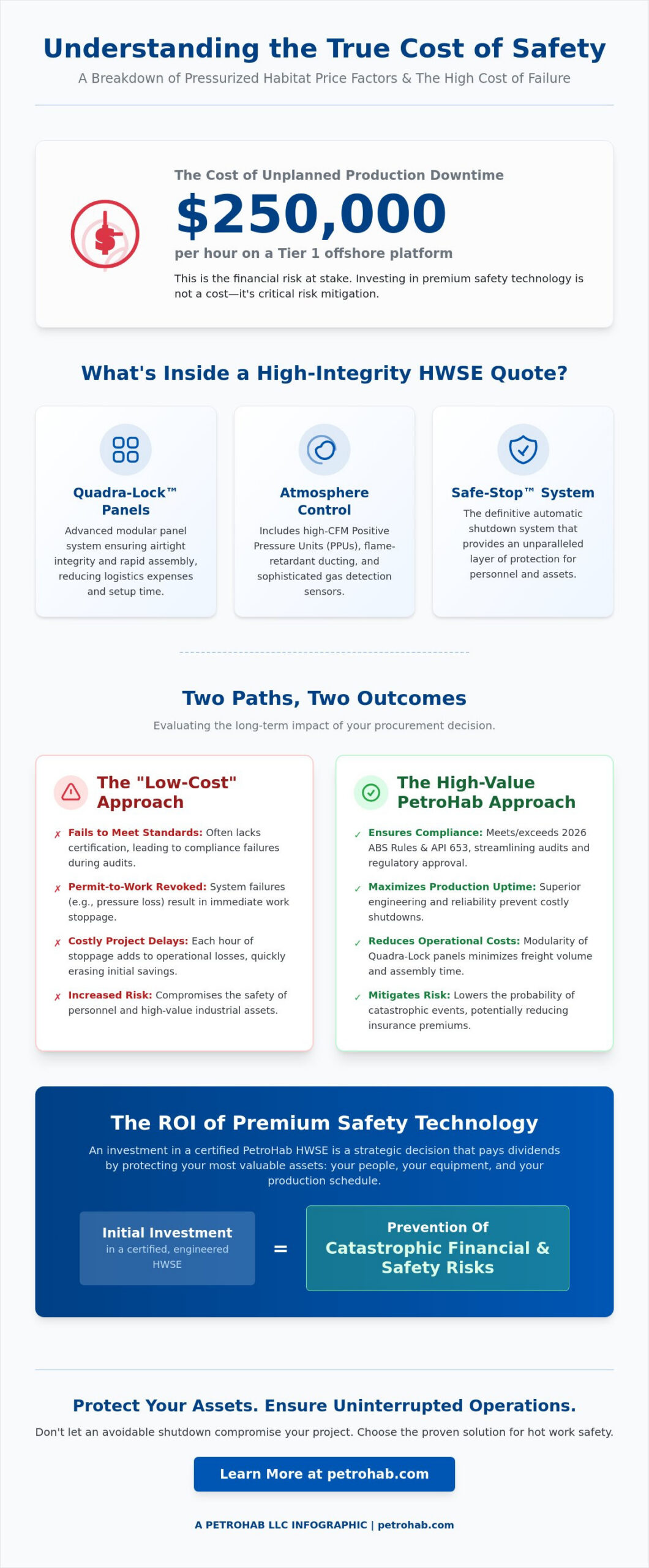
In 2026, one hour of unplanned production downtime on a Tier 1 offshore platform costs an average of $250,000. When the financial stakes are this high, understanding the factors affecting pressurized habitat price becomes a critical exercise in risk mitigation rather than a simple budgeting task. You likely feel the pressure of balancing tightening project margins against the uncompromising need for ignition prevention in hazardous areas. It’s frustrating to manage unforeseen logistics costs or the threat of compliance failures caused by hardware that doesn’t meet the latest standards.
This guide provides a comprehensive framework for evaluating HWSE quotes so you can justify the investment in premium safety technology. We’ll examine how the 2026 ABS Rules for Offshore Units and the latest API 653 updates influence procurement requirements for Quadra-Lock panels and the Safe-Stop Automatic Shutdown System. By the end of this article, you’ll have the technical data needed to reduce project downtime through efficient assembly and superior engineering.
Key Takeaways
- Differentiate between initial expenditure and long-term operational costs to forecast safety procurement budgets accurately.
- Identify the critical factors affecting pressurized habitat price, including technical engineering and international certifications required for hazardous zone compliance.
- Evaluate how modularity and specialized Quadra-Lock panels minimize logistics expenses by reducing freight volume and assembly time.
- Analyze the return on investment by weighing habitat costs against the extreme financial penalties of unplanned production shutdowns.
- Understand why the Safe-Stop Automatic Shutdown System is critical for protecting personnel and high-value industrial assets.
Understanding the Cost Structure of Pressurized Welding Habitats
A pressurized habitat serves as a modular safety system, engineered specifically to isolate ignition sources from potentially explosive atmospheres. In high-stakes heavy industry, the factors affecting pressurized habitat price are often viewed through the lens of comprehensive risk management. Procurement teams must distinguish between initial capital expenditure (CAPEX) and long-term operational expenditure (OPEX). While a basic fire-resistant enclosure might seem cost-effective initially, it doesn’t provide the active protection and pressure-maintaining capabilities required for Tier 1 offshore platforms or petrochemical refineries.
High-integrity systems often correlate with reduced insurance premiums and streamlined regulatory audits. Insurers and safety inspectors recognize that a certified hot work safety enclosure (HWSE) significantly lowers the probability of a catastrophic event. This proactive risk mitigation transforms the habitat from a simple line item into a strategic asset. It’s vital when downtime costs can exceed $250,000 per hour on offshore assets, making the reliability of the enclosure a primary concern for any safety manager.
To visualize the technical principles of containment and how they influence system requirements, watch this detailed explanation of pressure dynamics:
The Core Components of a HWSE Quote
A comprehensive quote encompasses several critical modules beyond the physical structure. Pricing reflects the engineering behind Quadra-Lock panels, which utilize advanced materials to ensure airtight integrity under harsh conditions. These systems rely on positive pressure enclosure technology to maintain a higher internal pressure than the surrounding environment. This mechanism effectively prevents flammable gases from entering the workspace. The quote also includes positive pressure units (PPUs), flame-retardant air ducting, and sophisticated gas detection sensors. Integrating the Safe-Stop Automatic Shutdown System into the hardware package adds to the price but provides the definitive technological remedy for ignition prevention.
Why Safety is Not a Commodity
Attempting to treat safety equipment as a commodity in Zone 1 environments is a dangerous oversight. Low-cost alternatives often fail to meet stringent international standards, leading to hardware malfunctions during critical operations. If a system fails to maintain pressure or detect hazardous gases, the facility manager will immediately revoke the permit-to-work (PTW). This results in costly project delays and potential safety stand-downs. When evaluating the factors affecting pressurized habitat price, the manufacturer’s global track record and commitment to regulatory compliance are paramount. Investing in a PetroHab Hot Work Safety Enclosure ensures that site safety remains uncompromised. This commitment to meticulousness and duty defines the brand as a critical safety partner for hazardous environments.
Technical Specifications and Engineering Factors Impacting Price
Technical integrity isn’t a byproduct of assembly; it’s a result of deliberate material selection and engineering. The choice of textiles represents one of the primary factors affecting pressurized habitat price. While generic silicone-coated fiberglass is common, advanced composite textiles provide superior thermal resistance and durability in high-heat applications. These materials must withstand molten slag and grinding sparks without degrading. Engineering for extreme environments like the North Sea or arctic regions adds complexity. Habitats must maintain structural stability against high wind loads and frigid temperatures, necessitating reinforced framing and specialized insulation.
Customization for complex pipework also influences the final quote. Standard rectangular builds are rarely sufficient for offshore manifolds or refinery deck space. Bespoke configurations require precise CAD modeling to ensure the enclosure fits around existing infrastructure while maintaining an airtight seal. This level of engineering prevents gas ingress and ensures the system functions as an active guardian of the site. Adherence to OSHA pressure vessel standards is non-negotiable when designing these pressurized environments.
Proprietary Technology: The Quadra-Lock Advantage
Most low-cost competitors rely on hook-and-loop fasteners to join habitat panels. This method is prone to degradation and leakage, especially in oily or salt-heavy environments. The patented Quadra-Lock system replaces these unreliable closures with a mechanical interlocking mechanism. It ensures superior seal integrity and structural rigidity. While precision-engineered components like Quadra-Lock Panels command a higher initial price, they offer lower long-term costs. Modularity allows operators to replace individual damaged panels rather than the entire enclosure, extending the system’s service life.
Certification and Regulatory Compliance Costs
Achieving international certifications like ATEX and IECEx involves rigorous, third-party testing that increases manufacturing overhead. These certifications prove the equipment can operate safely in Zone 1 or Zone 2 hazardous areas without becoming an ignition source. The financial weight of international certifications is one of the key factors affecting pressurized habitat price in 2026. Compliance with hazardous environment standards is a prerequisite for any legitimate safety procurement guide. These standards provide the regulatory assurance needed to proceed with hot work on live assets. If you’re managing a high-stakes project, you can request a technical consultation to discuss specific certification requirements.
Operational and Logistics Variables in Pricing
Logistics and mobilization represent significant factors affecting pressurized habitat price that procurement teams often overlook during initial budgeting. Shipping specialized safety equipment to remote offshore locations or international refineries involves complex customs protocols and specialized handling requirements. Geographic distance from the manufacturer’s distribution hubs directly impacts the final landed cost. Regional availability ensures that equipment arrives within tight operational windows, preventing costly delays in project commencement. When a mid-sized offshore asset faces deferred production, losses can exceed $750,000 per day, making mobilization speed a critical financial variable.
The engineering of the equipment also dictates freight expenses. Traditional, bulky enclosures require extensive cargo space, increasing sea and air freight rates. In contrast, the modular design of the PetroHab Hot Work Safety Enclosure (HWSE) prioritizes compact transport. Quadra-Lock panels are engineered to fold and stack efficiently, minimizing total freight volume. This modularity doesn’t just reduce shipping costs; it also simplifies on-site handling. Smaller, lighter components allow for faster manual transport across congested decks, reducing the man-hours required for initial staging.
Rental vs. Purchase: A Financial Comparison
Choosing between a permanent acquisition and a pressurized welding habitat rental depends on the project’s duration and frequency. Rental models are typically the preferred choice for short-term maintenance turnarounds or one-off repairs. This approach converts a major capital expenditure into an operational expense, providing access to the latest certified technology without long-term ownership burdens. Conversely, purchasing equipment may be the more logical solution for facilities with continuous hot work requirements. Organizations must calculate the break-even point by accounting for the costs of climate-controlled storage, periodic maintenance, and mandatory recertification of gas detection hardware.
The Cost of Human Expertise
The deployment of a pressurized habitat is only as effective as the personnel managing it. While some organizations opt to train their own staff, many rely on full-service on-site supervision by certified technicians. These experts ensure that the Safe-Stop Automatic Shutdown System is calibrated to site-specific parameters and that positive pressure integrity is maintained throughout the work shift. Technical supervision acts as a safeguard against safety stand-downs. If an enclosure is improperly assembled, the permit-to-work is revoked, resulting in immediate project paralysis. Investing in expert setup and monitoring eliminates the risk of re-work and provides a definitive layer of liability protection for the asset owner.
The True Cost of Downtime and Risk Mitigation
Procurement decisions based solely on sticker price ignore the catastrophic financial impact of operational delays. When evaluating the factors affecting pressurized habitat price, the delta between a low-cost rental and a premium system is often recovered within the first twelve hours of operation. As established, one hour of unplanned production downtime on a Tier 1 offshore platform costs an average of $250,000. For mid-sized assets, a single day of deferred production results in losses exceeding $750,000. These figures dictate that uptime must be the primary KPI when selecting hot work safety systems.
A premium PetroHab Hot Work Safety Enclosure (HWSE) generates what industry experts call a ‘Safety Dividend.’ This refers to the tangible insurance and regulatory benefits accrued by using top-tier hardware. Insurers frequently offer lower premiums or more favorable coverage terms for projects utilizing certified ignition prevention technology. Regulatory bodies also view the use of high-integrity habitats as a sign of rigorous safety culture, which can lead to faster permit approvals and fewer administrative hold-ups.
Safe-Stop and Monitoring Technology
The integration of the Safe-Stop Automatic Shutdown System represents a significant shift from manual fire watch labor to automated precision. While manual monitoring is subject to human error and fatigue, automated gas detection provides constant, unblinking surveillance. Precision sensors reduce the frequency of false alarms that trigger unnecessary shutdowns, a common issue with inferior hardware. These systems also facilitate automated data logging. This creates a digital audit trail that simplifies compliance reporting for OSHA or ABS inspections. The initial investment in this technology is offset by the reduction in specialized labor costs and the prevention of accidental ignition events.
Assembly Speed and Labor Efficiency
Labor costs for setup and teardown are often hidden factors affecting pressurized habitat price. Time is money during a shutdown or turnaround. Traditional habitats utilizing complex frame systems or hook-and-loop fasteners can take twice as long to assemble as modular alternatives. The Quadra-Lock system minimizes the man-hours required for setup through its intuitive interlocking mechanism. This efficiency is particularly valuable when navigating confined spaces or complex geometries found in refinery pipe racks. Because Quadra-Lock panels are interchangeable and require no specialized tools for basic assembly, the crew can move from mobilization to hot work in record time. This speed directly translates to earlier production restarts and improved project ROI.
Protecting your assets requires a detailed understanding of the relationship between safety engineering and operational costs. You can contact our technical team for a Total Cost of Ownership analysis tailored to your specific offshore or onshore project.
Procuring High-Value HWSE: The PetroHab Approach
PetroHab stands as the industry benchmark for hot work safety enclosure quality. This reputation is built on a foundation of engineering resilience and technical precision. While competitors focus on generic materials, PetroHab prioritizes the long-term durability of Quadra-Lock panels. These components are specifically designed to withstand the corrosive nature of harsh marine environments without compromising seal integrity. Reliability in these conditions ensures that the factors affecting pressurized habitat price are balanced by a significantly extended service life and reduced replacement frequency.
Global operations require a partner with a localized support network and a deep understanding of international safety protocols. PetroHab maintains a strategic presence in major energy hubs, ensuring that technical assistance and replacement parts are available wherever your assets are located. We customize safety solutions to meet the granular requirements of facility maintenance, whether on a remote offshore platform or a complex onshore refinery. This adaptability ensures that the specific geometry of your pipework doesn’t compromise the safety of the pressurized habitat.
Maximizing ROI with PetroHab Technology
True return on investment is measured by the lifecycle of the equipment and the prevention of catastrophic loss. PetroHab HWSE components are engineered for reusability across multiple high-stakes projects. Integrating the Safe-Stop Automatic Shutdown System creates a complete safety ecosystem that actively monitors for hazardous gas ingress. In a recent refinery turnaround project, the deployment of PetroHab solutions reduced scheduled downtime by accelerating the setup of pressurized welding enclosures. This efficiency allowed the facility to return to full production capacity ahead of schedule. The cost of the habitat was effectively absorbed by the recovery of production time.
Next Steps for Procurement Professionals
Requesting a comprehensive quote requires a detailed analysis of all operational variables. You should evaluate hot work safety enclosure suppliers based on technical merit and their ability to comply with 2026 regulatory standards. The updated API 653 requirements and the new OSHA Heat Illness Prevention Standard necessitate a partner who understands the current compliance landscape. Ensure your safety investment aligns with these 2026 benchmarks to avoid future regulatory penalties or project delays. When considering the factors affecting pressurized habitat price, prioritize a partner that acts as an active guardian of your personnel and high-value assets. Meticulous planning today prevents the high costs of industrial accidents tomorrow.
Securing Your Next Hot Work Project with Engineering Precision
Effective procurement in 2026 requires a shift from evaluating sticker prices to analyzing the total cost of ownership. You’ve seen how engineering integrity, assembly speed, and the staggering cost of downtime serve as the primary factors affecting pressurized habitat price. Investing in premium safety technology isn’t merely a compliance checkbox. It’s a strategic decision to protect your personnel and high-value assets from catastrophic failure. High-integrity systems pay for themselves by ensuring uninterrupted production on offshore platforms where the financial stakes are highest.
Our commitment to safety excellence is anchored by our patented Quadra-Lock technology and global ATEX and IECEx compliance. These signatures of innovation ensure that PetroHab remains the trusted benchmark for major offshore operators worldwide. You don’t have to choose between operational efficiency and uncompromising safety. We invite you to Request a technical consultation and quote for your next hot work project. Take the definitive step toward mitigating risk and securing your industrial site. Your reputation for safety should be as resilient as the equipment you deploy.
Frequently Asked Questions
What is the average price range for a pressurized welding habitat rental?
Rental pricing for a pressurized welding habitat is determined by project-specific variables such as the duration of the hot work and the complexity of the enclosure configuration. Daily or weekly rates typically reflect the engineering quality and the current certification status of the hardware. Because each deployment involves unique mobilization requirements, you should request a project-specific quote to account for these operational variables.
How do ATEX and IECEx certifications affect the cost of a habitat?
ATEX and IECEx certifications are significant factors affecting pressurized habitat price because they require rigorous third-party testing and specialized manufacturing processes. These certifications ensure that every component, from the control system to the lighting, is safe for use in Zone 1 or Zone 2 explosive atmospheres. While certified systems command a higher price, they provide the regulatory assurance needed to operate on high-value assets.
Why is the Quadra-Lock system more cost-effective than standard panels?
The Quadra-Lock system provides superior cost-efficiency through its modular design and mechanical seal integrity. Standard panels using hook-and-loop fasteners often degrade quickly in oily or salt-heavy environments, leading to leaks and safety shutdowns. Because Quadra-Lock panels are interchangeable and durable, operators can replace individual damaged sections instead of the entire enclosure, which significantly reduces long-term maintenance costs.
Do pressurized habitat prices include on-site training and supervision?
Procurement quotes usually separate the cost of the hardware from the fees for certified on-site technicians or client personnel training. While these services represent an additional investment, they’re essential for ensuring the Safe-Stop Automatic Shutdown System is correctly calibrated. Expert supervision minimizes the risk of improper assembly, which prevents the costly revocation of hot work permits and subsequent project delays.
Can I reduce the cost of my HWSE by using my own gas detection system?
Integrating third-party gas detection is generally not recommended because it can compromise the reliability of the Safe-Stop Automatic Shutdown System. Integrated ecosystems ensure that sensors and shutdown hardware communicate with technical precision. Using a manufacturer’s proprietary system is often a prerequisite for maintaining the certification integrity of the pressurized habitat in hazardous environments.
How does the duration of a project influence the choice between renting and buying?
Project duration is a primary driver in the financial analysis of safety equipment procurement. Short-term maintenance turnarounds are typically more cost-effective as rentals, as this avoids the capital expense of ownership. For continuous operations or frequent maintenance cycles, purchasing a PetroHab HWSE may offer a better return on investment, though it requires budgeting for storage and periodic recertification.
Are there additional costs for deploying habitats to offshore platforms?
Offshore deployments involve additional factors affecting pressurized habitat price, including specialized marine freight and the mobilization of offshore-certified technicians. Logistics for remote assets require meticulous planning to ensure equipment arrives within tight operational windows. These costs reflect the complexity of transporting and managing certified safety systems in high-stakes marine environments where downtime is extremely expensive.
What is the typical lifespan of a PetroHab HWSE panel?
The service life of a PetroHab HWSE panel depends on the intensity of the environment and adherence to maintenance protocols. High-grade composite materials and the mechanical strength of the Quadra-Lock panels allow for multiple deployments across different projects. Proper cleaning and climate-controlled storage between tasks ensure that the panels maintain their flame-retardant properties and structural integrity for several years.