
Blog Posts
On-Site Habitat Supervision: Hot Work Projects Guide
What if the habitat is installed, but the teams still aren’t clear on who owns the final readiness checks? On a hot work project, on-site habitat installation supervision helps turn setup requirements into a coordinated process, with provider technicians working alongside site and contractor teams.
It’s reasonable to want clear responsibilities before mobilization and confidence that setup won’t create avoidable delays. Supervision can support habitat setup and operation, but the exact scope, checks, and handover deliverables should be agreed for each deployment. Confirm site requirements and project procedures with the responsible personnel.
This guide explains what to clarify when planning supervision, from who coordinates installation to how readiness checks and handover are documented. You’ll also learn what to confirm with the habitat provider, site team, and contractor before hot work begins, so everyone understands their role and habitat operation follows the project’s established procedures.
Key Takeaways
- Clarify how on-site habitat installation supervision fits alongside site-team controls, decisions, and project procedures.
- Align the installation sequence, applicable readiness checks, and handover process with the agreed project scope.
- Compare site personnel’s knowledge of local procedures with the equipment-specific oversight a technician may provide.
- Before mobilization, confirm the supervision scope, site contacts, schedule, access requirements, and handover deliverables.
- PetroHab’s certified technicians oversee habitat setup and operation. Confirm the relevant certification and project-specific scope before deployment.
What On-Site Habitat Installation Supervision Covers
On-site habitat installation supervision is specialist oversight of a habitat’s setup and operation at the worksite. A provider technician brings familiarity with the habitat system, while the site team retains its own controls, decisions, and procedures. These roles work alongside each other. Supervision doesn’t transfer site authority or replace required permits, work authorization, or other controls.
That distinction matters because hot work, such as welding or cutting, can introduce ignition sources and fire or explosion hazards. A habitat forms part of the project’s safety arrangements, but its installation and operation need to fit the specific work scope and site requirements.
Before mobilization, the provider and responsible site personnel should agree what the technician will oversee, who makes site decisions, which readiness criteria apply, and how concerns will be raised and resolved. Clear coordination can help teams prepare for planned work, but it doesn’t guarantee a particular schedule or outcome.
What does an on-site habitat supervisor do?
A provider technician can oversee habitat setup and operation within the agreed scope. The technician can coordinate practical questions about the habitat with designated site personnel, helping clarify how provider activities fit the site’s procedures. The precise tasks and handover arrangements depend on the equipment, project scope, and site requirements. Confirm them in advance rather than assuming supervision covers every installation or readiness activity.
Agree the working interface before work begins:
- Provider oversight: Identify which habitat setup and operational activities the technician will oversee.
- Site controls and decisions: Name the personnel responsible for site procedures, authorization, and project decisions.
- Coordination: Confirm who communicates questions, changes, or unresolved readiness concerns between teams.
When is specialist supervision useful?
Specialist oversight may be useful when a deployment involves several groups, such as a habitat provider, site personnel, and a hot work contractor. Each team may have different responsibilities to coordinate. Agreeing the interface helps prevent assumptions about who handles setup, who confirms project readiness, and who authorizes the planned work.
It can also help when site personnel are unfamiliar with the equipment or worksite conditions change. Changes may affect coordination or require the teams to revisit their arrangements. Establish a clear point of contact and follow site procedures for reviewing changes. Supervision supports communication about the habitat. It doesn’t replace permits, site authorization, or other controls required for the project.
How Supervision Supports Habitat Setup and Readiness
A controlled setup starts before equipment reaches the worksite. On-site habitat installation supervision can help the provider technician and site team follow an agreed sequence, identify coordination gaps, and record handover items. It doesn’t establish universal readiness criteria. The equipment, project scope, and approved site procedures determine which checks apply.
Use this sequence to structure planning and deployment:
- Align scope: Define the work, habitat configuration, technician’s agreed oversight, and activities that remain with the client.
- Coordinate the site: Confirm location, timing, access, site contacts, and interfaces with contractor teams.
- Oversee setup: The technician oversees habitat setup within the agreed service scope, while the site team manages its own controls and decisions.
- Complete agreed checks: Identify which checks apply to the equipment and project, and who performs or confirms them under site procedures.
- Handover: Communicate observations, unresolved items, and responsibility for follow-up before the habitat enters operation.
What should be agreed before the habitat arrives?
Give the provider and project stakeholders enough information to plan the deployment. Confirm the work scope, worksite location, schedule, designated site contacts, and access arrangements. Clarify who supplies utilities and supporting equipment, and which site documents the provider needs. Name the responsible site authority for confirming applicable readiness criteria. Don’t assume a standard checklist applies to every habitat or worksite.
Requirements vary by location and type of work. For example, the linked OSHA hot work requirements address shipyard employment. Confirm with responsible site personnel which standards and procedures apply to your project.
What happens during setup and handover?
During deployment, the technician oversees setup and operational activities included in the agreed scope. Keep communication direct: route practical questions through the designated site contact, and document observations, outstanding items, and who will address them. Record the handover in the format agreed by the project team, including any limits on what the technician’s oversight covers.
Installation progress is not authorization to start hot work. Completion of habitat setup or a handover record doesn’t itself approve the work. Responsible site personnel must confirm project readiness and provide any required authorization under applicable site procedures.
PetroHab provides certified technicians who oversee habitat setup and operation. Project teams can review PetroHab habitat systems and confirm the supervision scope, relevant technician certifications, and handover deliverables before mobilization.
Can the Site Team Supervise Habitat Installation Without Specialist Support?
Sometimes. Site personnel may know local procedures, worksite conditions, and authorization pathways better than anyone outside the project. A specialist technician brings equipment-specific knowledge. The question isn’t which team replaces the other. It’s whether the project has the right experience and clearly assigned responsibilities for both site control and habitat oversight.
On-site habitat installation supervision can complement the site team’s role, but it doesn’t automatically replace site authority, contractor responsibilities, or work authorization. For context, the NFPA 51B standard addresses hot work safety. Confirm with responsible site personnel which standards and procedures apply to the specific project.
How should responsibilities be divided?
Use a responsibility matrix as a planning aid, then confirm each assignment with the project stakeholders. The allocation below is a starting point, not a substitute for project documents or approved site procedures.
Task
Responsible party to agree
Coordination and confirmation
Habitat setup questions
Provider technician for equipment-specific guidance; site contact for site interfaces
Confirm technician’s scope and who resolves site access or layout issues.
Site controls and authorization
Responsible site personnel, with contractor input as defined by the project
Confirm the applicable procedure and authorization pathway with the site authority.
Operational concerns and escalation
Named provider and site contacts, according to the agreed scope
Document who receives concerns, who makes decisions, and how open items are tracked.
Put these boundaries in project documents. Name contacts for installation questions, operational concerns, and escalation. Verbal assumptions can leave teams uncertain when an issue needs a decision.
When should a project request specialist oversight?
Consider specialist involvement if the team has limited experience with the specific habitat system, deployment conditions are complex, or several contractors and operational groups must coordinate setup. Also consider the site team’s experience and the provider’s agreed service scope. None of these factors creates a universal rule. Use the project risk review and site requirements to determine what support is appropriate.
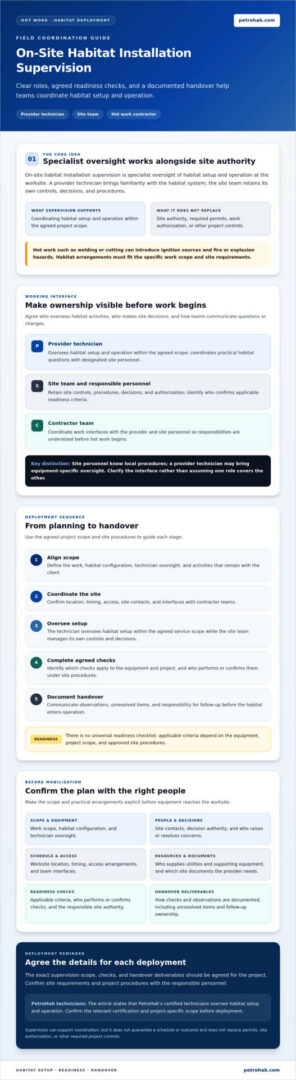
What to Confirm Before Booking On-Site Habitat Installation Supervision
Before mobilization, define what the technician will oversee and what remains the client’s responsibility. A clear scope helps the provider, site team, and contractors prepare around the same work plan. Confirm project-specific standards, technician credentials, and readiness criteria with the relevant provider and site authority rather than relying on assumptions.
Use this pre-mobilization checklist to organize the discussion:
- Scope: Which habitat setup and operational activities will the technician oversee? Which tasks, checks, and decisions remain with the client or contractor?
- Contacts: Who is the designated contact for installation questions, operational concerns, and escalation? Identify alternates if the primary contact is unavailable.
- Schedule and access: Confirm the planned arrival and work schedule, site entry arrangements, work location, and any access information the provider needs.
- Site information and interfaces: Ask what documents or project details are required, and clarify interfaces with utilities, supporting equipment, and the planned hot work scope.
- Readiness and handover: Confirm which criteria apply, who verifies them, how observations or open items will be recorded, and what handover information is expected.
Questions to ask the habitat provider
Ask the provider to describe the supervision scope in practical terms. Request a clear account of what the technician will oversee during setup and operation, and what falls outside that scope. If the technician is described as certified, confirm which certifications are relevant to the project and how they relate to the assigned work. Ask what documentation or handover information will be available after setup, and how unresolved items will be communicated.
Questions to resolve with the site team
Confirm who controls site access, permits, work authorization, and operational decisions under the project’s procedures. Agree how the site team and provider will communicate equipment questions or concerns, including pressure-related concerns where relevant to the habitat and project. Check that the supervision schedule aligns with the work plan and contractor interfaces. If scope or site conditions change, identify who reviews the change and confirms next steps.
Record the agreed boundaries and contacts in the project documentation. This gives each team a reference point before work starts and helps prevent gaps between provider oversight and site responsibilities.
To discuss how certified technicians can support habitat setup and operation, contact PetroHab about supervision scope for your planned deployment.
How PetroHab Supports On-Site Habitat Installation and Operation
PetroHab manufactures, leases, and sells Hot Work Safety Enclosures for the oil and gas industry. Its services include certified technicians who oversee habitat setup and operation, along with training for client personnel. This provider support can be discussed as part of planning a PetroHab deployment. Confirm the specific technician responsibilities, deliverables, and availability for each project.
Supervision works alongside the site team’s controls and decisions. It doesn’t establish project readiness or authorize hot work. Instead, the teams can agree how the technician’s equipment oversight fits the site’s procedures, who handles site authorization, and how questions or outstanding items will be communicated.
What to discuss when planning a PetroHab deployment
For an initial discussion, share the worksite context, intended hot work, anticipated schedule, and known site requirements. Explain which PetroHab habitat system is being considered and identify relevant equipment interfaces or coordination needs. If the project involves Safe-Stop or Quadra-Lock, ask how those components relate to the proposed deployment and agreed supervision scope. Confirm technical or standards-related questions with PetroHab and the responsible site personnel.
Clarify the service details before mobilization. Useful questions include:
- Technician oversight: Which setup and operational activities will the technician oversee, and which remain with the client or contractor?
- Training: Is training for client personnel part of the project scope, and what does it cover?
- Credentials: Which technician certifications are relevant to this deployment?
- Handover: What information or documentation will be provided, and how will open items be communicated?
- Coordination: Who are the site and provider contacts for access, schedule changes, and escalation?
Confirm availability, responsibilities, and deliverables directly with PetroHab. Recording these details with the project team gives everyone a clear basis for coordinating the deployment without assuming one scope applies to every worksite.
Choose the right next step for your project
If you need foundational context before discussing deployment, consult PetroHab’s Hot Work Safety Enclosure guide and procurement guide. The first can help orient readers to the enclosure category; the second can support supplier and service-scope evaluation. Confirm the page addresses through PetroHab’s website rather than relying on an unverified URL.
Contact PetroHab to discuss your project requirements, planned deployment, and the supervision and training scope to confirm for your site.
Plan Your Habitat Deployment with Clear Responsibilities
Effective on-site habitat installation supervision starts with agreed responsibilities. Confirm what the provider’s technician will oversee, what remains with site personnel and contractors, and which project-specific readiness criteria apply. A clear handover and communication route help teams coordinate without confusing installation progress with authorization to begin hot work.
Specialist oversight complements the site team’s knowledge of local procedures. PetroHab manufactures, leases, and sells Hot Work Safety Enclosures, and provides certified technicians to oversee habitat setup and operation. Before mobilization, discuss the project scope, site requirements, technician responsibilities, and relevant credentials directly with the provider and responsible site personnel.
Taking these steps gives each team a clearer basis for planning and coordination. Discuss your habitat installation and supervision requirements with PetroHab to review the needs of your planned deployment. A well-defined scope is a practical place to start.
Frequently Asked Questions
What does on-site habitat installation supervision include?
On-site habitat installation supervision can include specialist oversight of habitat setup and operation, depending on the agreed project scope. The provider’s technician may coordinate equipment questions with designated site personnel, while the site team retains its own controls and decisions. Before mobilization, confirm which tasks are covered, what remains with the client, how issues are escalated, and what handover information will be provided. Supervision doesn’t automatically include every safety function or site authorization.
When should a project use specialist habitat installation supervision?
Consider specialist supervision if the site team is unfamiliar with the habitat system, setup involves several work groups, or provider-side technical coordination would help clarify responsibilities. These are planning factors, not a universal requirement. Review the project’s risk assessment, site procedures, equipment, and team experience. Then agree with the provider which activities require oversight and which remain with site personnel or contractors. Confirm the scope before mobilization.
Can our site team install a hot work habitat without a provider technician?
That depends on the equipment, team experience, project scope, and applicable site procedures. Site personnel may understand local controls, while the provider can offer equipment-specific oversight. Before work begins, confirm who is responsible for setup, applicable operational checks, and recording outstanding items. This general guidance doesn’t approve a particular installation or authorize hot work. Responsible site personnel must make decisions through the project’s established procedures.
What information should we provide before arranging supervision?
Provide the worksite location, intended work scope, target schedule, access requirements, designated site contacts, and known project procedures. Identify interfaces with contractors or site operations, and note any supporting equipment or documentation that may be needed. Ask the provider what additional information is required and clarify who supplies each item. Requirements vary by deployment, so confirm the full scope, responsibilities, and handover arrangements with project stakeholders before mobilization.
Does installation supervision include training for our personnel?
PetroHab’s service offering includes training for client personnel, but the training scope should be confirmed for each project. Ask who will receive training, which equipment or operating topics it covers, and how it fits with site procedures. Also confirm what training deliverables are included. Don’t assume a supervision arrangement includes a particular duration, credential, or training format unless PetroHab confirms that detail for the deployment.
Does a technician’s handover mean hot work can start immediately?
No. A handover can communicate installation status, observations, and outstanding items, but it doesn’t automatically grant site authorization or replace required project controls. Responsible site personnel must review readiness under applicable procedures and make the decision to proceed. Before mobilization, agree what the technician will document, who reviews the information, how open items are resolved, and who has authority to authorize the work.
How do we confirm which standards apply to habitat installation?
Confirm applicable standards with the responsible site authority and qualified project personnel, taking into account the work location, scope, equipment, and site requirements. Don’t rely on a generic online list or assume a standard applies solely because the project is in the oil and gas industry. Ask the provider to identify relevant equipment documentation, then verify project-specific requirements and any compliance claims with the appropriate personnel.