Blog Posts
Reducing Hot Work Incident Frequency Rate: Engineering Controls for Hazardous Zones
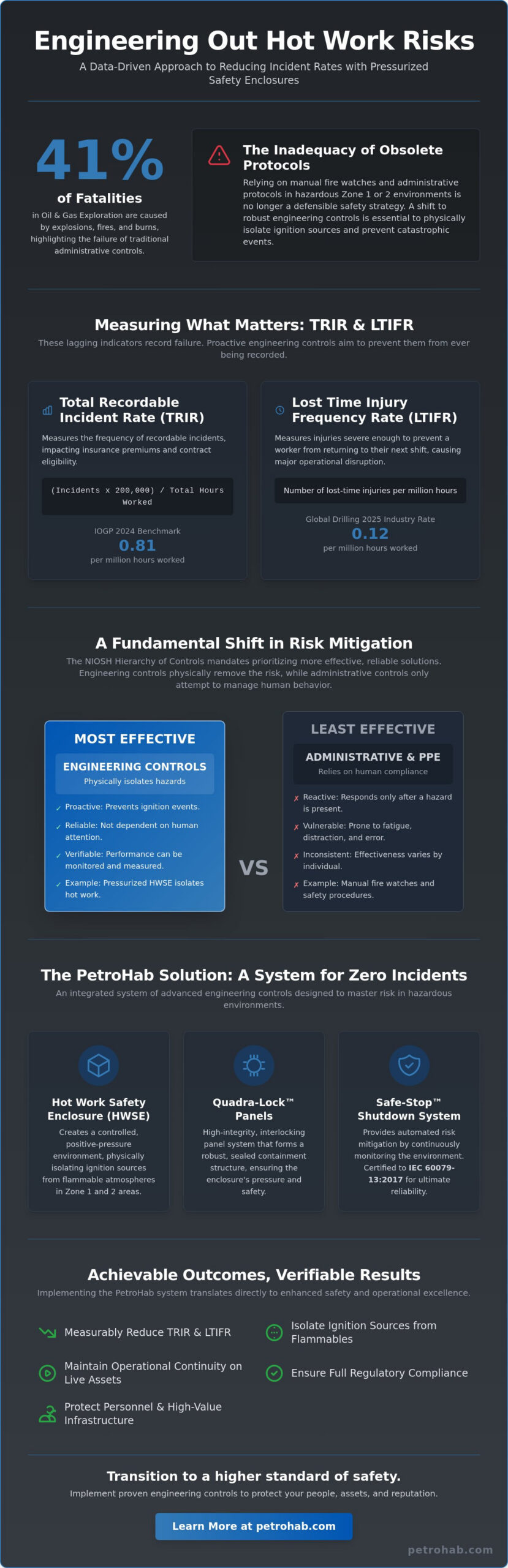
Explosions, fires, and burns accounted for 41% of the 32 fatalities in the oil and gas exploration sector in 2024. This data confirms that traditional administrative controls often fail to mitigate the lethal risks inherent in hazardous zones. Achieving a measurable reduction in your hot work incident frequency rate demands a transition to rigorous engineering controls that isolate ignition sources at the point of origin. Relying on manual fire watches in Zone 1 or 2 environments is no longer a defensible strategy for modern safety managers.
You recognize that an elevated Total Recordable Incident Rate (TRIR) jeopardizes both personnel safety and your standing in competitive bidding processes. We’ll demonstrate how to lower your TRIR and LTIFR through the deployment of pressurized containment systems. This analysis details the operational capabilities of the PetroHab Hot Work Safety Enclosure and Quadra-Lock panels. We’ll also examine how the Safe-Stop automatic shutdown system, certified to IEC 60079-13:2017, provides the technical precision required to maintain operational continuity without compromising safety standards. This methodical approach ensures full regulatory compliance while protecting your high-value assets.
Key Takeaways
- Analyze the mathematical correlation between hot work activities and recordable incident rates to identify primary safety risk drivers.
- Implement a robust strategy for reducing hot work incident frequency rate by prioritizing engineering controls over less reliable administrative protocols.
- Master the science of positive pressure using PetroHab HWSE technology and Quadra-Lock panels to isolate ignition sources in Zone 1 and 2 environments.
- Integrate lead indicators with the Safe-Stop automatic shutdown system to achieve automated risk mitigation and ensure full regulatory compliance.
- Optimize operational continuity by executing hot work on live assets without compromising the safety of personnel or high-value infrastructure.
Defining Metrics: TRIR and LTIFR in Hot Work Operations
In heavy industry, safety performance is measured through rigorous statistical tracking. Total Recordable Incident Rate (TRIR) and Lost Time Injury Frequency Rate (LTIFR) serve as the primary benchmarks for assessing operational risk. Hot work activities, which involve ignition sources like welding or grinding, represent a disproportionate share of these metrics. Success in reducing hot work incident frequency rate requires an uncompromising understanding of how these figures are calculated and what they reveal about systemic vulnerabilities.
Referencing the definition of hot work, it’s clear that any process involving open flames or heat generation in a refinery or offshore platform carries extreme risk. TRIR and LTIFR are lagging indicators. They record failure. By the time an incident appears in these reports, personnel have been endangered and assets potentially compromised. Relying solely on these figures is a reactive posture that overlooks the technical precursors to a catastrophe.
To better understand the foundational controls required to manage these risks, watch this training overview:
Calculating Total Recordable Incident Rate (TRIR)
TRIR is calculated using the standard OSHA formula: (Number of Recordable Incidents x 200,000) / Total Hours Worked. In a high-stakes maintenance turnaround, recordable events include flash burns, gas ignitions, or toxic fume exposure. High frequency rates don’t just indicate danger; they impact the bottom line. Insurance premiums rise. Contract eligibility for major energy projects often depends on maintaining a TRIR below industry averages. For IOGP member companies, the 2024 benchmark was 0.81 per million hours worked.
Lost Time Injury Frequency Rate (LTIFR) Analysis
LTIFR measures the number of lost-time injuries per million hours worked. In a welding environment, a lost time injury occurs when an incident prevents a worker from returning to their next scheduled shift. The 2025 global drilling industry reported an LTIFR of 0.12. Beyond the immediate human impact, these incidents incur massive hidden costs. Operational downtime, emergency mobilization of replacement personnel, and regulatory investigations disrupt production schedules. Shifting from reactive calculation to proactive prevention involves deploying engineering controls that stop the incident before it becomes a statistic.
The Hierarchy of Controls: Engineering Out Hot Work Risks
The NIOSH Hierarchy of Controls provides a structured framework for risk mitigation in heavy industry. This model dictates that elimination and substitution are the most effective measures. However, when hot work is essential for critical maintenance, engineering controls represent the highest achievable level of protection. While training and administrative protocols are necessary, they don’t have the physical capability to prevent an ignition event. A successful strategy for reducing hot work incident frequency rate must prioritize the physical isolation of the hazard through technological means.
Relying on administrative controls often creates a false sense of security. These methods depend on human compliance, which is inherently inconsistent. Transitioning from a reliance on Personal Protective Equipment (PPE) to physical hazard isolation ensures that safety isn’t dependent on individual behavior. Engineering controls, such as the PetroHab Hot Work Safety Enclosure (HWSE), provide a definitive barrier that administrative measures simply cannot match. They transform the work environment into a controlled space where risks are physically managed rather than just monitored.
Administrative vs. Engineering Controls
Administrative controls, specifically the use of human fire watches, are statistically vulnerable. Human observers are subject to fatigue, distraction, and delayed reaction times. In complex Zone 1 or Zone 2 environments, a fire watch cannot detect gas ingress or microscopic spark escape with the same reliability as a pressurized containment system. Pressurized habitats remove human error from the safety equation. These systems establish a documented, physical barrier between the ignition source and the external environment. Investing in hardware rather than simply increasing safety personnel creates a more resilient safety profile. You can explore our range of pressurized welding enclosures to see how these systems integrate into live operations.
Physical Isolation of the Ignition Source
Effective engineering controls rely on the mechanics of environmental containment. This process involves creating a positive pressure differential that prevents the ingress of flammable gases into the workspace. Utilizing fire-resistant Quadra-Lock Panels ensures that sparks and slag remain contained within the enclosure. These panels provide the structural integrity required to withstand the high temperatures associated with heavy welding and grinding. Maintaining this isolation ensures strict adherence to hazardous environment standards. This technical approach moves beyond the limitations of PPE, which only protects the individual worker. Engineering controls protect the entire facility. They ensure that even if an ignition occurs inside the enclosure, the external explosive atmosphere remains undisturbed. This proactive isolation is the only reliable method for achieving zero incidents in high-risk zones.
Reducing Incident Rates with Pressurized Safety Enclosures
Deploying pressurized safety enclosures is a definitive method for reducing hot work incident frequency rate across energy facilities. These systems operate on the principle of positive pressure, where the internal atmosphere of the enclosure is maintained at a higher pressure than the external environment. This pressure differential creates a physical barrier that prevents flammable gases from entering the work area. It’s a calculated engineering solution that allows for critical maintenance on live assets without requiring costly facility shutdowns. By isolating the ignition source, operators maintain production continuity while ensuring the highest level of personnel protection.
The complexity of permit-to-work systems often leads to administrative friction and potential safety gaps. Standardizing the deployment of the PetroHab Hot Work Safety Enclosure (HWSE) streamlines this process. Because the habitat provides a controlled environment, the safety parameters are predictable and repeatable. This standardization reduces the burden on safety officers and minimizes the risk of human error during the permitting phase. Case evidence from global oil and gas majors shows that standardized habitat use correlates with a significant drop in recordable incidents. It moves safety from a subjective checklist to a verifiable engineering standard.
Maintaining Habitat Integrity with Quadra-Lock
Habitat integrity relies on the quality of its structural components. Quadra-Lock panels are engineered to provide a gas-tight seal that traditional welding blankets cannot achieve. These fire-resistant panels are modular, which simplifies the assembly process and reduces the likelihood of setup errors. Their durability ensures they withstand the intense heat of industrial welding while maintaining the enclosure’s structural integrity. Modular designs are a critical factor in reducing the overall risk profile of a project. They allow for a precise fit around complex piping and structures, ensuring no gaps exist for gas ingress or spark escape.
Positive Pressure and Gas Detection
Active safety measures must complement physical containment. Continuous monitoring of differential pressure ensures that the habitat remains effective throughout the duration of the hot work. Integrating manometers allows technicians to verify safety in real time. If the pressure drops, the system identifies the vulnerability immediately. For comprehensive technical specifications, refer to our guide on pressurized welding habitats. This combination of physical barriers and active monitoring is the benchmark for modern industrial safety. It ensures that the environment inside the enclosure remains isolated from external hazards at all times.
Lead Indicators: Monitoring and Automatic Shutdown Systems
Proactive safety management relies on lead indicators. These metrics identify hazardous conditions before they manifest as recordable injuries or asset damage. While TRIR and LTIFR document past failures, lead indicators provide the data necessary for immediate risk mitigation. Integrating automated hardware logic into hot work operations allows for the detection of atmospheric changes that a human observer cannot perceive. This transition from manual oversight to technical surveillance is essential for reducing hot work incident frequency rate in high-risk environments.
Automated systems remove the variability of human reaction time from the safety equation. In the event of a gas leak or pressure loss, the decision to cease operations must be instantaneous. Standardizing emergency responses through hardware ensures that safety protocols are executed with mathematical precision. This approach reduces the frequency of near-miss escalations by neutralizing threats at the earliest possible stage. It transforms the safety profile of a facility from one that reacts to incidents to one that physically prevents them.
Safe-Stop: The Ultimate Fail-Safe
The Safe-Stop automatic shutdown system serves as the primary guardian of the pressurized environment. It simultaneously monitors oxygen levels, Lower Explosive Limit (LEL) concentrations, and internal differential pressure. If any parameter deviates from the programmed safety threshold, the system triggers an immediate shutdown of all hot work tools. The 0.1-second response time ensures that ignition sources are deactivated before flammable gases can reach a dangerous concentration. By eliminating the lag associated with human panic or hesitation, Safe-Stop provides a level of reliability that manual fire watches cannot replicate. You can secure your facility by integrating the Safe-Stop Automatic Shutdown System into your next maintenance turnaround.
Integrating ATEX and IECEx Certified Systems
Certified gas detection is a non-negotiable requirement for operations in Zone 1 environments. Equipment must meet rigorous international standards, such as IEC 60079-13:2017, to ensure it won’t become an ignition source itself. Maintaining equipment compliance during long-term maintenance projects requires hardware that is as durable as it is precise. These certifications serve as linguistic and technical anchors for quality, providing safety managers with absolute confidence in their containment strategies. To understand the technical requirements for these environments, see more on hot work safety systems. Utilizing certified technology ensures that your engineering controls remain compliant with global regulatory frameworks while providing maximum protection for personnel and high-value assets.
The PetroHab Solution: A Strategy for Zero Incidents
PetroHab provides the definitive technological remedy for hazardous zone operations. We don’t just supply equipment; we implement a comprehensive safety architecture designed for high-stakes environments. By integrating the PetroHab Hot Work Safety Enclosure (HWSE) with the Safe-Stop system, operators achieve a measurable reducing hot work incident frequency rate. This synergy ensures that every ignition source is physically isolated and electronically monitored. It’s a calculated approach that prioritizes the protection of personnel and high-value assets above all else.
Engineering redundancy is the cornerstone of a “Zero Incident” culture. It replaces the uncertainty of manual oversight with the certainty of automated protection. This strategy ensures that if one layer of protection is challenged, secondary systems remain active. For instance, if the physical seal of the habitat is compromised, the Safe-Stop system detects the pressure drop and neutralizes the ignition source before gas ingress occurs. This layered approach is why our technology is the industry benchmark for safety excellence. It allows for welding on live assets without increasing the facility’s risk profile, maintaining operational continuity during critical maintenance.
Modular HWSE and Safe-Stop Integration
Combining Quadra-Lock panels with automated monitoring creates a total containment solution. These panels are engineered for durability, providing a resilient barrier against sparks and slag. Their modular design is particularly effective for complex geometries found on offshore platforms where space is limited and piping is intricate. By utilizing these components, operators reduce setup downtime while simultaneously increasing their safety benchmarks. The integration ensures that the work area remains isolated from the external explosive atmosphere, providing absolute confidence to safety managers and engineers. It’s a functional, direct solution to the problem of ignition prevention in Zone 1 and 2 environments.
Global Support and Training
Hardware alone is insufficient without expert oversight. PetroHab provides certified on-site supervision to ensure habitat integrity is maintained throughout the project lifecycle. Our technicians are seasoned veterans who understand the granular details of industrial hazards. They train client personnel in the rigorous standards of habitat operation and maintenance, ensuring that safety protocols are followed with meticulous precision. This commitment to training directly impacts incident frequency by eliminating gaps in technical knowledge. For detailed procurement strategies and technical data, consult the definitive guide to HWSE. Utilizing our global support network ensures that your engineering controls remain an active guardian of your site’s safety.
Advancing Toward Zero Incident Safety Excellence
Transitioning from passive reporting to active hazard isolation is the only reliable method for reducing hot work incident frequency rate. This analysis has demonstrated that administrative protocols and human fire watches can’t address the granular risks of Zone 1 and 2 environments. By deploying engineering controls, you move your facility beyond the limitations of lagging safety metrics like TRIR and LTIFR. You establish a documented environment where ignition sources are physically neutralized.
PetroHab delivers this uncompromising protection through patented Quadra-Lock technology and ATEX and IECEx certified shutdown systems. These tools represent the industry benchmark for ignition prevention. When combined with our global on-site supervision, they form a resilient barrier against operational failure. This methodical approach ensures that your hot work activities remain a controlled, predictable procedure rather than a facility-wide liability. It’s time to elevate your safety standards through proven engineering.
Request a Technical Consultation to Reduce Your Facility’s Incident Rate. Achieving zero incidents is a challenging goal, but with the right technological partners, it’s a target your team can hit with absolute confidence.
Frequently Asked Questions
How does a hot work safety enclosure directly reduce TRIR?
A PetroHab Hot Work Safety Enclosure (HWSE) reduces TRIR by establishing a physical barrier between ignition sources and flammable atmospheres. This isolation prevents the fires, explosions, and burns that constitute recordable incidents in the energy sector. By eliminating the root cause of these events, operators see a measurable impact on reducing hot work incident frequency rate across their facilities.
Can hot work be performed in Zone 1 areas without a facility shutdown?
Hot work can be performed in Zone 1 areas without a facility shutdown through the deployment of pressurized habitats. These systems maintain a positive pressure differential that physically blocks the ingress of hydrocarbons or other flammable gases. This engineering control allows maintenance to proceed on live assets, ensuring operational continuity while maintaining a safety profile that meets international standards.
What is the difference between an administrative fire watch and an engineering control?
Administrative fire watches rely on human observation and manual intervention, which are subject to fatigue and delayed response times. Engineering controls, such as pressurized welding enclosures, provide a physical and automated solution to hazard management. While a fire watch can only react to a fire, an engineering control prevents the ignition from occurring by managing the environment at a technical level.
How does the Safe-Stop system prevent ignition in hazardous environments?
The Safe-Stop system prevents ignition by continuously monitoring the habitat atmosphere for oxygen levels, gas concentrations, and internal pressure. It uses automated hardware logic to deactivate all hot work tools within 0.1 seconds if any safety threshold is breached. This rapid, automated response neutralizes the risk before flammable gases can reach the ignition source, providing a fail-safe that human intervention can’t match.
Are PetroHab enclosures compliant with NFPA 51B and OSHA standards?
PetroHab enclosures are designed to meet and exceed the requirements of NFPA 51B and OSHA standards for fire prevention during hot work. These systems integrate the fire-resistant materials and environmental monitoring protocols mandated by the 2024 edition of NFPA 51B. Compliance is documented through rigorous testing and adherence to international technical certifications like IEC 60079-13:2017.
What are lead indicators in hot work safety management?
Lead indicators are proactive metrics used to identify potential safety failures before an incident occurs. In hot work management, these include the frequency of automated shutdowns triggered by Safe-Stop, the consistency of habitat pressure differentials, and the results of pre-work gas testing. Tracking these data points allows safety managers to implement corrective actions that contribute to reducing hot work incident frequency rate.
How long does it take to deploy a pressurized welding habitat?
Deployment times for a pressurized welding habitat vary based on the geometric complexity of the work site and the required enclosure size. The modular nature of PetroHab systems allows for a structured assembly process that is typically more efficient than traditional custom-built solutions. Meticulous planning and the use of certified supervisors ensure that the setup is both efficient and technically sound.
Why should I use Quadra-Lock panels instead of traditional welding tents?
Quadra-Lock panels offer superior structural integrity and gas-tight sealing compared to traditional welding tents or blankets. While tents merely provide a visual or weather barrier, Quadra-Lock panels are engineered to maintain positive pressure and resist high-temperature sparks. This modular panel system reduces the risk of gaps or seal failures, ensuring the habitat remains a resilient barrier in hazardous zones.