Blog Posts
Hot Work Permit to Work System: A 2026 Safety Integration Guide
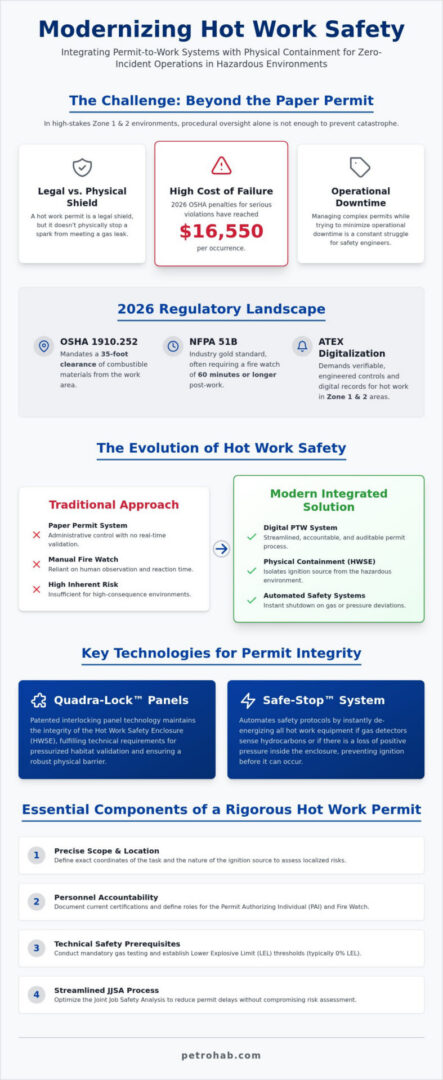
A hot work permit is a legal shield, but it doesn’t physically stop a spark from meeting a gas leak. In the high-stakes world of Zone 1 and Zone 2 environments, a signature on a page isn’t enough to prevent a catastrophe. You know that managing a complex hot work permit to work system while trying to minimize operational downtime is a constant struggle for any safety engineer, especially with 2026 OSHA penalties for serious violations reaching $16,550 per occurrence.
This guide empowers you to master the integration of physical containment and procedural oversight to ensure absolute safety. We’ll explore how to modernize your safety protocols by embedding hardware solutions like the PetroHab Hot Work Safety Enclosure (HWSE) directly into your legal permit framework. By utilizing Quadra-Lock technology and Safe-Stop automatic shutdown systems, you can achieve zero-incident operations. We will examine the 2026 regulatory updates, including the latest ATEX digitalization guidelines, to provide a clear path for streamlining your PTW process without compromising the protection of your personnel or high-value assets.
Key Takeaways
- Navigate the 2026 regulatory landscape, including NFPA 51B and OSHA 1910.252, to ensure your facility meets the latest safety and fire watch standards.
- Learn to integrate a hot work permit to work system with physical containment solutions to validate safety conditions in real-time within hazardous zones.
- Discover how patented Quadra-Lock technology maintains enclosure integrity, fulfilling the technical requirements for pressurized habitat validation.
- Automate your safety protocols using the Safe-Stop system to de-energize equipment instantly when gas or pressure deviations occur.
- Optimize operational efficiency by streamlining the Joint Job Safety Analysis (JJSA) process to reduce permit delays without increasing risk.
Understanding the Hot Work Permit to Work (PTW) System
A hot work permit to work system serves as the foundational administrative control for industrial safety. It’s a formalized, documented process that authorizes specific activities involving ignition sources in areas not originally designed for such risks. Without this rigorous oversight, the probability of catastrophic ignition in volatile environments increases exponentially. This Hot work overview details how these risks manifest during industrial operations and why a structured permit is the first line of defense against fire and explosion.
In 2026, the regulatory framework has become significantly more stringent. OSHA 1910.252 continues to set the baseline, mandating a 35-foot clearance of combustible materials from the work area. However, the industry has largely shifted toward NFPA 51B as the gold standard, which often requires a fire watch of 60 minutes or longer depending on the specific risk level. As of January 2026, OSHA penalties for serious violations have reached $16,550 per instance. This makes non-compliance a massive financial liability for any organization. The primary distinction safety managers must make is between ‘Designated Areas’, such as a permanent, fire-safe welding shop, and ‘Permit-Required Areas’, where temporary hot work introduces new hazards to the existing environment.
The Legal and Operational Scope of PTW
Hot work includes any activity producing sparks, flames, or heat. This encompasses welding, brazing, grinding, and thermal spraying. The Permit Authorizing Individual (PAI) holds the ultimate responsibility for verifying that all safety conditions are met before work commences. In 2026, the PAI’s role has expanded to include the verification of automated monitoring systems and digital documentation. A properly managed hot work permit to work system doesn’t just protect lives; it actively reduces legal liability. It can also lower insurance premiums by demonstrating a commitment to industry best practices and documented risk mitigation.
Hazardous Zone Classifications and Permit Rigor
Standard administrative permits often fail in high-risk oil and gas facilities where ATEX Zone 1 or Zone 2 classifications are present. In these volatile atmospheres, a paper permit cannot physically prevent a gas ingress. This is why modern safety integration requires more than just a checklist. You must pair the permit with physical containment solutions. In 2026, the industry demands engineered controls that isolate the ignition source from the surrounding hazardous environment. Utilizing specialized hardware like Quadra-Lock panels ensures the integrity of the enclosure for the duration of the permit. Relying solely on a fire watch is no longer considered sufficient for high-consequence environments where a single spark could lead to property damage exceeding the $1.5 billion annual industry average.
Essential Components of a Rigorous Hot Work Permit
A hot work permit to work system is only as strong as its most specific entry. Vague descriptions lead to operational gaps. Every permit must define the exact coordinates of the task and the precise nature of the ignition source. This clarity allows the Permit Authorizing Individual (PAI) to assess localized risks, such as nearby vent stacks or drainage systems, that might be overlooked in a general site assessment. In 2026, the integration of digital mapping and real-time location tracking has made this level of precision a standard expectation for high-hazard environments.
Administrative Data and Personnel Accountability
Accountability rests on the verification of competency. You must document the current certifications and safety training records for every welder and technician on site. Modern permit systems often link directly to personnel databases to ensure no unauthorized worker enters a high-hazard area. The permit must also clearly define the roles of the Performing Authority and the Fire Watch. The Fire Watch isn’t a passive observer. They are a critical safety barrier with the authority to stop work immediately if conditions deviate from the permit’s requirements. Reliable communication channels between the work site and the central control room must be tested and confirmed before the first spark is struck.
Technical Safety Prerequisites
Technical validation forms the core of the pre-work checklist. Mandatory gas testing is the primary defense against explosive atmospheres. According to OSHA 29 CFR 1910.252, fire prevention and protection are paramount. You must establish Lower Explosive Limit (LEL) thresholds, typically requiring 0% LEL before work begins. Continuous monitoring is preferred over periodic spot checks in volatile zones. It’s the only way to ensure gas hasn’t migrated into the area after the initial test.
Fire suppression equipment, including extinguishers and fire blankets, must be within immediate reach. You must also verify the isolation of surrounding process equipment through Lockout/Tagout (LOTO) procedures. This prevents the accidental release of hazardous materials into the work area. To maintain these technical conditions throughout the shift, many safety managers integrate pressurized welding enclosures into their standard operating procedures. These systems provide a physical barrier that complements the administrative permit.
Finally, every permit requires a time-stamped authorization. Strict expiration protocols ensure that safety assessments remain current. If a shift change occurs or work is suspended for more than a designated period, the permit must be re-validated. This prevents “permit creep,” where work continues under conditions that have fundamentally changed since the initial inspection. Safety isn’t static. Your documentation shouldn’t be either.
Integrating Pressurized Habitats into the PTW Workflow
A paper permit authorizes work but provides no physical barrier against flammable gases. Integrating a PetroHab Hot Work Safety Enclosure (HWSE) into the hot work permit to work system transforms an administrative approval into a robust engineered control. This physical isolation is essential in hazardous zones where the risk of gas ingress is constant. By creating a controlled environment, the HWSE ensures that sparks and heat remain contained while hazardous external atmospheres are excluded.
HWSE as a Primary Control Measure
In a 2026 safety workflow, habitat certification isn’t an optional attachment. It’s a prerequisite for permit issuance. The Permit Authorizing Individual (PAI) must inspect the HWSE setup to confirm it meets the specific requirements of the volatile work area. By using pressurized welding habitats, operators can bypass broad-area gas restrictions that would otherwise halt production. This approach aligns with rigorous institutional standards, similar to those found in a University hot work safety program, where procedural oversight is matched with physical safeguards. The PAI’s signature validates that the enclosure is fit for purpose and that all ignition sources are effectively isolated.
Pressure Maintenance and Gas Ingress Prevention
The permit’s technical section must mandate ‘Positive Pressure’ validation. This involves setting specific manometer requirements that the performing authority must monitor and log throughout the shift. Hot work safety enclosures maintain this status by ensuring internal pressure remains higher than the surrounding atmosphere. If pressure drops, the risk of gas ingress increases immediately. Documentation of these pressure logs is a mandatory part of the permit close-out process to prove that safety conditions were maintained for the duration of the work.
To ensure enclosure integrity for the entire permit duration, the use of modular Quadra-Lock panels is mandatory. These panels provide a secure, flame-retardant seal that resists high-heat applications. Unlike generic welding blankets or tarpaulins that only manage sparks, these panels maintain the habitat’s structural and atmospheric integrity. They prevent the gaps and leaks often found in less sophisticated containment systems.
One of the most significant advantages of this integration is the reduction of permit downtime. Traditionally, hot work in a hazardous zone required a total facility shutdown. By isolating the work area within an HWSE, the hot work permit to work system allows for simultaneous operations. This keeps production active while ensuring absolute safety for the personnel inside the habitat. It’s a calculated strategy that prioritizes both safety excellence and operational efficiency.
Operational Best Practices for Permit Compliance in 2026
Operational excellence in hazardous environments requires moving beyond the static checklists of the past. In 2026, the industry standard for a robust hot work permit to work system involves the integration of a Joint Job Safety Analysis (JJSA). This collaborative assessment brings together the Performing Authority, the Area Authority, and safety personnel to reach a technical consensus before any permit is issued. This proactive approach ensures that all parties understand the specific hazards of the task and the engineered controls required to mitigate them. It eliminates the communication gaps that often lead to permit violations or accidents.
The January 2026 update to the ATEX guidelines has accelerated the shift toward the digitalization of safety documentation. Digital permit management allows for real-time PTW tracking, giving control room operators an immediate overview of all active hot work across the facility. This visibility is vital for preventing simultaneous operations (SIMOPS) conflicts where work in one area could compromise the safety of another. Digital systems also provide an immutable audit trail, ensuring that every safety check is time-stamped and verified by the appropriate personnel.
Continuous Monitoring and Validation
Relying on periodic gas tests is no longer an acceptable practice in high-risk zones. Continuous monitoring is the only way to validate the ‘safe environment’ status of a permit throughout the entire shift. By integrating advanced hot work safety systems into your framework, you create a dynamic safety barrier. Redundant gas detectors must be placed strategically both inside the enclosure and at external points where gas migration is likely. These systems must be linked to the permit’s technical requirements, ensuring that any detection of flammable gas leads to an immediate cessation of work. Maintaining a detailed log of these safety checks is a critical component of your facility’s safety data.
Emergency Protocols and Permit Suspension
A rigorous permit system must clearly define ‘Stop Work Authority’ triggers. If a habitat loses positive pressure or the Quadra-Lock panels show signs of compromise, the permit is automatically suspended. Personnel must be trained to recognize these failure modes and react without hesitation. A tiered emergency response plan should outline the specific steps for evacuation, equipment de-energization, and incident reporting. Re-validation of the permit is mandatory after any safety-related work stoppage. This ensures that work only resumes once the environment is confirmed to be safe and all engineered controls are fully operational.
To automate these safety barriers and reduce the risk of human error, you can integrate Safe-Stop automatic shutdown systems into your legal permit framework. These systems ensure that the ‘Safe Condition’ specified in your permit is maintained through automated hardware response.
Elevating Permit Integrity with PetroHab HWSE and Safe-Stop
A rigorous administrative framework requires a definitive technological remedy to be effective in high-stakes industrial environments. Integrating these hardware solutions into your hot work permit to work system creates a fail-safe mechanism that administrative controls alone cannot match. While the permit defines the safety parameters, PetroHab hardware enforces them physically and automatically. This synergy ensures that the ‘Safe Condition’ documented on paper is maintained through every minute of the hot work operation.
Technological Safeguards for PTW Validation
The Safe-Stop Automatic Shutdown System acts as the active guardian of your permit’s integrity. It eliminates the risks associated with human error or delayed manual response. The system monitors the habitat’s internal atmosphere and pressure in real-time. If gas concentrations reach a pre-set limit or if positive pressure is lost, Safe-Stop immediately de-energizes the welding equipment or heat source. This automated intervention validates the permit’s safety requirements without requiring constant manual oversight from the fire watch. It provides a level of precision that satisfies the most demanding hazardous environment standards.
Enclosure integrity is maintained through the use of modular Quadra-Lock panels. These panels are engineered for superior containment in high-heat applications. Their interlocking design prevents the gaps that often occur with traditional welding blankets. By using Quadra-Lock technology, you ensure that sparks and slag are completely contained within the habitat. This physical barrier is a critical prerequisite for issuing a permit in close proximity to live process equipment. It provides a durable and resilient solution that withstands the harsh conditions of offshore and refinery environments.
Global Support for Your PTW Infrastructure
Implementing a sophisticated hot work permit to work system requires more than just hardware; it requires expert integration and support. PetroHab offers various models to scale your safety infrastructure according to your permit volume. Whether you choose to lease equipment for a specific turnaround or purchase a fleet for ongoing maintenance, the hardware is backed by technical precision. We provide certified training for your personnel. This ensures that your team can manage the HWSE and Safe-Stop systems within your existing permit framework with absolute confidence.
- Modular Scalability: Adapt the size and configuration of your enclosure to the specific constraints of the work site.
- Automated Compliance: Use Safe-Stop to provide the continuous monitoring required by 2026 ATEX guidelines.
- Expert Consultation: Request a technical consultation to align your hardware setup with your facility’s specific safety protocols.
Safety is a duty. By pairing your procedural oversight with PetroHab’s engineered controls, you protect your personnel and high-value assets from the inherent risks of hot work. Our systems are designed to be as resilient as the industries they serve, providing a reliable foundation for zero-incident operations in any hazardous zone.
Securing the Future of Industrial Hot Work
Industrial safety in 2026 demands a shift from passive observation to active, technological guardianship. A robust hot work permit to work system is only effective when it’s supported by engineered barriers that physically isolate ignition sources from volatile atmospheres. You’ve learned that integrating pressurized enclosures and digital monitoring isn’t just about compliance; it’s about the uncompromising protection of your personnel and high-value assets. Relying on administrative oversight alone is no longer sufficient in high-consequence environments.
PetroHab provides the specialized hardware necessary to fulfill these high-stakes requirements. Our solutions feature patented Quadra-Lock containment technology for maximum habitat integrity and Safe-Stop automated shutdown integration for instantaneous risk response. Backed by certified global on-site supervision, we offer the reliability safety managers need to navigate complex regulatory landscapes with absolute certainty. We act as a critical partner in your mission to eliminate workplace accidents.
Don’t leave your site’s safety to chance or outdated protocols. Ensure 2026 PTW Compliance with PetroHab HWSE Systems. You have the tools to achieve operational excellence while maintaining an unwavering commitment to safety. You can lead your team toward a zero-incident future with confidence and technical precision.
Frequently Asked Questions
What is the primary purpose of a hot work permit to work system?
The primary purpose of a hot work permit to work system is to provide a formalized administrative control that identifies hazards and implements necessary safeguards before ignition-source activities begin. It acts as a mandatory technical checkpoint to ensure the work area is free of flammable vapors and combustible materials. By documenting these conditions, the system significantly reduces the risk of fire and explosion in volatile industrial environments.
How long is a hot work permit typically valid in 2026?
In 2026, a hot work permit is typically valid for the duration of a single work shift, generally not exceeding 12 hours. If the scope of work changes, personnel are replaced, or work is suspended for more than two hours, the permit must be re-validated. This strict time-stamping prevents permit creep where safety conditions might have degraded since the initial inspection and gas testing.
Can hot work be performed in an ATEX Zone 1 area with a permit?
Hot work can be performed in ATEX Zone 1 areas, but it requires more than just a standard permit. You must implement engineered controls like a PetroHab Hot Work Safety Enclosure (HWSE) to isolate the ignition source from the hazardous atmosphere. The permit for such work will specifically mandate positive pressure validation and continuous gas monitoring to maintain safety within the volatile zone.
Who is responsible for issuing and signing off on a hot work permit?
The Permit Authorizing Individual (PAI) or the designated Area Authority holds the responsibility for inspecting the site and issuing the permit. This individual must verify that all safety prerequisites, such as gas testing and equipment isolations, are met. The Performing Authority and the Fire Watch also sign the document to acknowledge their specific responsibilities and the operational limits of the hot work permit to work system.
What are the fire watch requirements for a permit-required hot work area?
Fire watch requirements in 2026 often follow the stringent NFPA 51B standard, which mandates a continuous watch during work and for at least 60 minutes after completion. This duration can be extended based on the risk profile of the environment. The fire watch must maintain a clear line of sight to the work area and possess the authority to stop work immediately if conditions deviate.
How do pressurized habitats change the requirements of a hot work permit?
Pressurized habitats shift the permit focus toward the technical validation of pressure and containment integrity. The permit must include specific fields for recording manometer readings and confirming the seal of Quadra-Lock panels. These habitats allow hot work to proceed without a full facility shutdown by creating a controlled atmosphere that prevents the ingress of flammable gases into the work area.
What happens if a gas detector alarms during a permitted hot work session?
All hot work must cease immediately and equipment must be de-energized if a gas detector alarms. When using a Safe-Stop Automatic Shutdown System, this process is automated to remove human delay. The permit is suspended instantly, and work cannot resume until the source of the gas is identified, mitigated, and a new gas test confirms 0% LEL (Lower Explosive Limit).
Is a permit required for hot work in a ‘Designated Area’ like a welding shop?
A permit is generally not required for hot work conducted in a ‘Designated Area’, such as a permanent maintenance shop specifically engineered for welding. These areas feature permanent fire-resistant barriers and optimized ventilation. However, if the work introduces new risks or if the area’s safety features are compromised, a temporary permit becomes necessary to manage the hazardous condition effectively.