
Blog Posts
Choosing an ATEX Certified Gas Detection System for Hazardous Hot Work in 2026
In 2026, simple adherence to ATEX directives is no longer the industry benchmark; it’s the absolute baseline for survival in high-stakes energy environments. The January 2026 update to the ATEX Guidelines 6th Edition has sharpened the definition of intended use, making it clear that equipment must do more than just exist in a hazardous zone. You recognize that a single ignition during welding operations represents an unacceptable risk to both personnel and infrastructure. To mitigate this, engineers are increasingly prioritizing the integration of automatic shutdown triggers for hot work to eliminate the dangerous lag time inherent in manual emergency protocols.
You need a system that functions as a silent, rigorous guardian, moving beyond basic detection into active environmental control. This article provides the technical framework required to select ATEX certified gas detection that guarantees 100% regulatory compliance. We’ll explore the critical role of the Safe-Stop system, the structural integrity provided by Quadra-Lock panels, and how PetroHab LLC implements a fail-safe shutdown loop that secures your site against catastrophic failure. By the end of this guide, you’ll possess the criteria to maintain operational excellence in the most volatile atmospheres.
Key Takeaways
- Identify the specific technical requirements for ATEX Zone 0, 1, and 2 to correctly match equipment categories with hazardous environmental conditions.
- Compare the operational capabilities of catalytic bead, electrochemical, and infrared sensor technologies for optimal gas detection in 2026.
- Implement automatic shutdown triggers for hot work through the Safe-Stop system to eliminate human error and ensure an immediate fail-safe response.
- Establish total environmental integrity by integrating gas detection systems with pressurized habitats and patented Quadra-Lock panel technology.
- Achieve 100% regulatory compliance and protect high-value assets by transitioning to a synchronized safety loop that monitors both gas concentrations and enclosure pressure.
The Critical Role of ATEX Certified Gas Detection in Explosive Atmospheres
ATEX certified gas detection provides the technical foundation for safe operations in volatile environments. These systems consist of equipment specifically engineered and tested to operate without becoming an ignition source itself. The ATEX directives establish the legal framework for this equipment within the European Union, but the principles are globally recognized as the gold standard for risk mitigation. In 2026, the emphasis has shifted from the mere presence of detection to the speed and reliability of the response loop. Safety managers now demand systems that don’t just alert but actively control the environment through automated intervention.
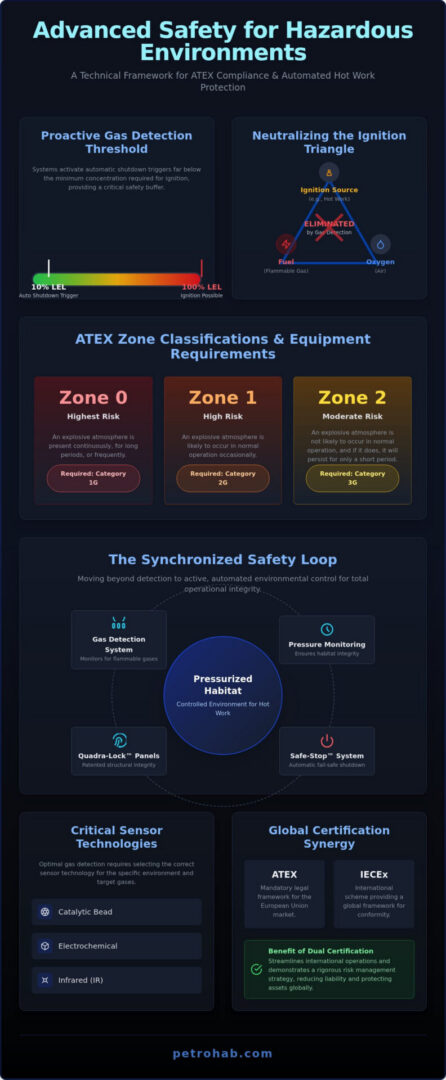
Neutralizing the ‘Ignition Triangle’ remains the primary objective of any safety engineer. By identifying flammable gas concentrations before they reach the Lower Explosive Limit (LEL), these systems eliminate the fuel component of the triangle before an ignition source can trigger a disaster. For offshore environments, where weather and confined spaces complicate gas dispersion, 2026 standards demand higher precision in sensor response times (T90). This technical rigor ensures that detection systems integrate seamlessly with broader hazardous environment standards that govern modern energy infrastructure.
Understanding the Danger: LEL and UEL
Explosive atmospheres are defined by the concentration of gas in the air. The Lower Explosive Limit (LEL) is the minimum concentration at which a gas can ignite; the Upper Explosive Limit (UEL) is the point where the mixture is too rich to burn. Industrial safety protocols don’t wait for these limits to be reached. Most high-performance systems activate automatic shutdown triggers for hot work at 10% LEL. This conservative threshold provides a critical buffer, accounting for the rapid accumulation of gases like Methane, H2S, and Propane, which remain primary concerns for industrial safety managers in 2026. Precision at these lower levels is essential for preventing the transition from a controlled environment to a hazardous one.
ATEX vs. IECEx: Global Certification Synergy
While the ATEX directive is a mandatory requirement for the European market, the IECEx scheme provides a global framework for conformity. Dual-certified equipment streamlines operations for oil and gas companies working across different continents. Using systems that meet both standards reduces the complexity of international compliance and significantly impacts insurance premiums. Insurers view the implementation of automatic shutdown triggers for hot work and dual-certified sensors as definitive proof of a rigorous risk management strategy. This approach protects high-value assets and reduces long-term liability by ensuring that equipment maintains its integrity regardless of the geographic location of the industrial site.
Decoding ATEX Zone Classifications and Device Requirements
Precise hazardous area classification is the only method to ensure equipment selection matches the actual risk profile of an industrial site. According to the UK Health and Safety Executive guidance on ATEX, zones are categorized based on the frequency and duration of an explosive atmosphere. This classification dictates the equipment category required for safe operation. Category 1G equipment is mandatory for Zone 0; Category 2G is required for Zone 1; and Category 3G is sufficient for Zone 2. Misidentifying a zone leads to either compromised safety or unnecessary capital expenditure on over-engineered hardware.
Engineers must also distinguish between protection methodologies like Intrinsic Safety (Ex i) and Explosion Proof (Ex d) enclosures. Intrinsic Safety limits electrical and thermal energy to levels below what is required to ignite a specific hazardous atmospheric mixture. In contrast, Explosion Proof enclosures are designed to contain an internal explosion and prevent it from propagating into the surrounding environment. Decoding the ATEX marking string is a critical skill for safety managers. The ‘Ex’ prefix confirms the device meets explosive atmosphere standards, while temperature codes (T1 through T6) specify the maximum surface temperature the device can reach, ensuring it remains below the auto-ignition temperature of gases present on-site.
Zone 0: Continuous Hazard Environments
Zone 0 represents areas where explosive gas is present continuously or for long periods. Sensors in these environments must meet the most stringent Category 1G requirements. Redundancy is non-negotiable here. A single sensor failure in a Zone 0 environment could leave a site blind to a catastrophic build-up of flammable vapours. Material selection is equally vital. For corrosive offshore environments like the North Sea, sensor housings must utilize high-grade stainless steel or specialized polymers to prevent degradation that could compromise the device’s protective rating. Integrating automatic shutdown triggers for hot work into these systems ensures that any detection of gas leads to an immediate cessation of all potential ignition sources.
Zone 1 and 2: Intermittent and Abnormal Risks
Zone 1 and 2 environments involve intermittent or abnormal risks, yet they still require rigorous monitoring. In Zone 1 maintenance areas, gas detection serves as the primary defense during routine operations. During temporary hot work, gas detection is often used to ‘de-classify’ a zone by proving the absence of flammable vapours within a pressurized enclosure. Even in Zone 2, where risks are statistically lower, monitoring remains a regulatory necessity to capture unexpected leaks or equipment failures. Navigating these technical nuances requires a partner who understands the high-stakes nature of pressurized environments, which is why engineering teams consult with PetroHab LLC for modular safety solutions. Implementing automatic shutdown triggers for hot work across all zones creates a standardized safety protocol that protects personnel regardless of the primary zone classification.
Essential Features of a High-Performance Gas Detection System
High-performance gas detection is defined by its ability to provide actionable data within the narrowest possible window of time. In 2026, the choice of sensor technology dictates the reliability of the entire safety loop. Catalytic bead sensors remain a staple for detecting a wide range of flammable gases, yet they’re vulnerable to poisoning by silicones or lead. Infrared (IR) sensors have become the preferred choice for hydrocarbon detection because they’re immune to poisoning and operate effectively in oxygen-deficient environments. Electrochemical sensors provide the necessary specificity for toxic gases like Hydrogen Sulphide (H2S). Selecting the right sensor isn’t just about detection; it’s about ensuring the automatic shutdown triggers for hot work receive an accurate signal before a hazardous concentration reaches a critical level.
The Response Time, specifically the T90 value, represents the duration required for a sensor to reach 90% of its final stable reading. In a high-pressure gas release, a difference of five seconds can be the margin between a controlled shutdown and an ignition event. This speed must be matched by robust communication protocols. While traditional 4-20mA signals are still in use, modern sites prioritize HART and Modbus for their diagnostic capabilities. Wireless ISA100.11a protocols are also gaining traction for their ability to provide flexible, reliable connectivity in complex industrial layouts where cabling is impractical.
Durability is a prerequisite for equipment operating in heavy industry. Systems must carry high Ingress Protection (IP) ratings, typically IP66 or IP67, to withstand salt spray, high humidity, and extreme heat. These ratings ensure that internal electronics remain isolated from the harsh external conditions common in offshore or desert environments. This resilience prevents hardware failure from compromising the safety of the personnel and assets protected by the system.
Sensor Lifespan and Calibration Requirements
Sensor poisoning represents a significant hidden cost in gas detection, as exposure to certain chemicals can permanently desensitize the sensor. To maintain integrity, remote industrial sites are moving away from manual field calibration in favor of automated bump testing systems. These systems verify sensor functionality daily without requiring extensive technician hours. Sensor drift refers to the gradual deviation of a sensor’s baseline output over time, potentially causing inaccurate gas concentration readings that compromise safety thresholds. Regular maintenance prevents this drift from causing false alarms or, more dangerously, failing to trigger when gas is present.
Alarm Logic and Visual/Audible Signalling
Effective safety systems utilize multi-stage alarm logic to manage escalating risks. A low-level warning might trigger at 5% LEL to alert personnel, while a critical alarm at 10% LEL activates the automatic shutdown triggers for hot work to isolate ignition sources immediately. In high-noise environments like drilling floors, visual beacons and high-decibel sirens are essential to ensure the alarm is perceived by all personnel. Safety Integrity Level (SIL) 2 ratings are now the industry standard, providing a quantified measure of the system’s reliability and its probability of failure on demand. This certification gives safety managers the technical assurance that the system will perform its protective function when it matters most.
Implementing Gas Detection for Hot Work Habitats
Integrating high-precision detection within pressurized welding habitats represents the pinnacle of industrial risk management. The hardware must operate as a synchronized safety loop where the physical enclosure and the electronic monitoring system function as a single unit. This synergy ensures that hot work remains isolated from the surrounding hazardous atmosphere. The implementation process follows a rigorous four-step technical protocol to guarantee environmental integrity.
The first step requires a site-specific gas dispersion modeling analysis. This engineering study identifies potential gas accumulation points based on local topography and existing infrastructure. Following this, sensors must be positioned at both high and low points relative to the enclosure. This accounts for varying gas densities; Methane rises while heavier gases like Propane and H2S settle near the deck. The third step involves integrating detection directly with the habitat’s air intake system. This provides an early warning by monitoring the source of the pressurizing air. Finally, engineers must establish the automatic shutdown triggers for hot work via the Safe-Stop system, ensuring that all ignition sources are isolated the moment a threat is identified.
Sensor Placement Strategies
Strategic sensor placement is the only way to eliminate blind spots in a hazardous environment. Monitoring the air intake is the primary defense, as it prevents flammable gas from being pumped into the pressurized enclosure. Internal monitoring is equally critical; it detects potential leaks from welding gas cylinders or fuel lines located inside the HWSE. External perimeter monitoring provides a broader safety net, offering early warning for the entire site. This multi-layered approach ensures that automatic shutdown triggers for hot work activate regardless of where the gas release originates. For a detailed consultation on sensor layout for your specific site, contact the engineering team at PetroHab LLC.
The Role of Positive Pressure and Manometers
Pressure monitoring acts as a vital complement to gas detection. While sensors identify the presence of gas, manometers verify the physical integrity of the habitat. Maintaining a minimum 0.1 inch (25 Pa) water gauge pressure differential is a technical requirement. This positive pressure ensures that even if a small breach occurs, air flows outward, preventing gas ingress. The effectiveness of this system relies on the enclosure’s construction. Utilizing patented Quadra-Lock panels ensures a gas-tight seal that maintains the required pressure levels. This combination of physical containment and active pressure monitoring creates a fail-safe environment for high-risk welding operations.
PetroHab’s Integrated Safety Solutions: Beyond Standard Detection
PetroHab LLC’s engineering philosophy centers on the transition from passive monitoring to active intervention. While individual sensors provide data, the Safe-Stop Automatic Shutdown System acts as the central logic controller that transforms that data into protective action. This system functions as the brain of the safety loop, processing real-time inputs from ATEX certified gas detectors and loss-of-pressure sensors simultaneously. By creating a synchronized ecosystem, PetroHab LLC ensures that detection never exists in a vacuum but serves as the catalyst for immediate risk neutralization.
The core of this technology is a rigorous fail-safe philosophy. Upon the detection of flammable gas or a critical loss of enclosure pressure, the system initiates an immediate isolation of all ignition sources. This includes the simultaneous termination of electrical power and the cessation of pressurized gas flow to welding equipment. Such a definitive response is essential for maintaining the integrity of hot work safety systems across global operations. This automated intervention ensures that the environment remains under total control, even when external conditions fluctuate rapidly.
The Safe-Stop Advantage
The primary advantage of the Safe-Stop system is its ability to eliminate human error during high-stress emergency events. Manual response times are often too slow to prevent ignition in high-pressure gas release scenarios. By utilizing automatic shutdown triggers for hot work, the system executes the emergency sequence in milliseconds. Furthermore, Safe-Stop integrates seamlessly with existing facility fire and gas (F&G) systems, providing safety managers with total visibility across the asset. This reliability is proven daily in the most demanding environments on earth, from the volatile conditions of the North Sea to the high-temperature fields in the Gulf of Mexico and Brazilian offshore sectors.
Total Habitat Integrity with Quadra-Lock
A safety loop is only as effective as the physical containment it supports. The patented Quadra-Lock panel system provides the structural foundation for a secure pressurized environment. Unlike inferior modular concepts that may struggle with seal integrity, the Quadra-Lock design utilizes fire-resistant materials and precision engineering to ensure a gas-tight enclosure. This modularity allows for rapid deployment without compromising the safety thresholds required for high-risk operations. When paired with automatic shutdown triggers for hot work, these panels create a fortified workspace that protects both personnel and high-value infrastructure. Contact PetroHab LLC today for a specialized hot work safety enclosure and detection consultation to secure your next project.
Advancing Industrial Safety Through Synchronized Detection and Control
Achieving absolute safety in explosive atmospheres requires moving beyond standalone sensor deployment. Modern standards in 2026 demand the seamless integration of ATEX certified hardware with pressurized containment. By prioritizing high-integrity hardware like patented Quadra-Lock panels and utilizing Safe-Stop fail-safe technology, you establish a defensive perimeter that human error can’t breach. The successful implementation of automatic shutdown triggers for hot work ensures that ignition sources are isolated at the exact moment a hazard is detected, protecting your personnel and high-value industrial assets.
Reliability in heavy industry is built on technical precision and rigorous compliance. PetroHab provides the expertise, global technician support, and training needed to maintain operational excellence across the North Sea, the Gulf of Mexico, and beyond. It’s time to transition from simple monitoring to a fully synchronized safety loop that guarantees enclosure integrity and immediate risk mitigation. Our team remains dedicated to providing the durable, resilient equipment your mission requires.
Request a technical consultation for your ATEX-compliant safety loop to ensure your site meets the highest regulatory standards. We look forward to partnering with you to eliminate workplace accidents in hazardous environments.
Frequently Asked Questions
What does ATEX certified mean for a gas detection system?
ATEX certification confirms that a gas detection system meets the essential health and safety requirements of the 2014/34/EU Directive. It ensures the equipment is engineered to operate safely in explosive atmospheres without becoming an ignition source. For safety managers, this certification serves as a technical guarantee that the device has undergone rigorous testing and conforms to European standards for hazardous area protection.
How do I determine which ATEX zone my hot work falls under?
Zone classification depends on the frequency and duration of explosive gas or vapour presence. Zone 0 is assigned where hazards are present continuously or for long periods. Zone 1 identifies areas where explosive atmospheres are likely to occur during normal operation; while Zone 2 is reserved for environments where hazards appear only briefly or under abnormal conditions. Site engineers must conduct a formal risk assessment to determine the appropriate zone for any hot work project.
Can a gas detection system automatically shut down welding equipment?
Yes, a gas detection system can automatically terminate welding operations when integrated with a logic controller. The Safe-Stop system processes signals from sensors to activate automatic shutdown triggers for hot work the moment gas is detected. This eliminates the risk of human error by immediately isolating electrical power and gas supplies to the welding equipment before a concentration reaches its Lower Explosive Limit.
How often should ATEX gas detectors be calibrated in offshore environments?
Calibration frequency is dictated by sensor type and environmental conditions. In the North Sea or Gulf of Mexico, sensors often require a bump test before every work shift to verify functionality. Full calibration typically occurs every three to six months. However, 2026 guidelines emphasize that sensors exposed to extreme humidity or potential poisoning agents may need more frequent adjustment to maintain technical accuracy.
What is the difference between LEL and ppm in gas monitoring?
LEL and ppm measure different atmospheric risks. LEL refers to the Lower Explosive Limit, which is the minimum concentration of a gas required to support an explosion. Most safety protocols trigger an alarm at 10% LEL. Conversely, ppm stands for parts per million and is used to monitor toxic gas concentrations that pose health risks to personnel rather than immediate explosion hazards.
Is wireless gas detection safe enough for Zone 0 or Zone 1 applications?
Wireless gas detection is suitable for Zone 0 and Zone 1 if the devices carry specific ATEX ratings for those zones. Modern systems utilize ISA100.11a or WirelessHART protocols to ensure communication reliability that rivals wired connections. These systems are particularly effective in complex industrial layouts where cabling is technically difficult or impossible to install safely.
What happens if a gas detector fails during active hot work?
A fail-safe safety loop is designed to protect assets even during equipment failure. If a gas detector loses power or signal integrity, the Safe-Stop system interprets the fault as an emergency event. This activates the automatic shutdown triggers for hot work, immediately ceasing all ignition-producing activities. Work cannot resume until the fault is diagnosed and the system is manually reset by authorized safety personnel.
How does PetroHab’s Safe-Stop system integrate with third-party gas sensors?
PetroHab’s Safe-Stop system is engineered for broad compatibility. It integrates with third-party gas sensors using standardized 4-20mA or Modbus communication protocols. This flexibility allows the system to act as the central intelligence for various ATEX-certified sensors, processing their data alongside pressure readings from the Quadra-Lock enclosure to maintain a synchronized safety environment for all personnel.