
Blog Posts
Remote Monitoring of Pressurized Habitats: The 2026 Technical Guide
Modern hot work safety requires digital telemetry that preemptively neutralizes ignition sources before audible alarms even sound. Relying on periodic manual manometer spot checks during live offshore operations introduces human lag that heavy industry simply can’t afford. A sudden loss of differential pressure or an undetected hydrocarbon release can trigger catastrophic ignition or force an abrupt, multi-million dollar facility shutdown. Continuous remote monitoring of pressurized habitats eliminates this operational vulnerability, replacing manual inspection with uninterrupted, real-time sensor governance.
Safety managers and integrity engineers already recognize that maintaining an uncompromised positive overpressure barrier is non-negotiable when executing critical repairs during live production. In this guide, you’ll discover how remote monitoring systems protect hot work habitats through automated gas detection, overpressure control, and real-time telemetry. We examine differential pressure dynamics above mandatory 50-Pascal thresholds, automated shutdown interlocks, and the verifiable ATEX and IECEx compliance logs required to safeguard personnel and high-value assets.
Key Takeaways
- Understand how the remote monitoring of pressurized habitats safeguards live operations by actively tracking differential pressure and blocking combustible gas ingress.
- Identify critical sensor deployment strategies across air intakes and enclosure interiors to detect toxic and flammable gases before they pose an ignition hazard.
- Evaluate how automated shutdown systems, such as Safe-Stop, achieve sub-second hot work isolation to eliminate the human error inherent in manual spot checks.
- Review compliance workflows and routine bump-testing frameworks required to maintain auditable ATEX and IECEx certification standards.
- Discover how modular Quadra-Lock panel assemblies interface with real-time telemetry to maintain positive containment across complex structural geometries.
Remote Monitoring of Pressurized Habitats: Operating Principles and System Architecture
Operating hot work equipment within classified hazardous locations demands absolute atmospheric separation. Pressurized habitats isolate welding and cutting operations by establishing a controlled, overpressured micro-environment that physically prevents combustible hydrocarbon gas intrusion. By engineering positive pressure enclosures with high-capacity intake fans, clean air purges the interior volume and expels outward through any panel seams or penetrations. This directional airflow makes it physically impossible for external hydrocarbons to reach ignition sources inside the chamber.
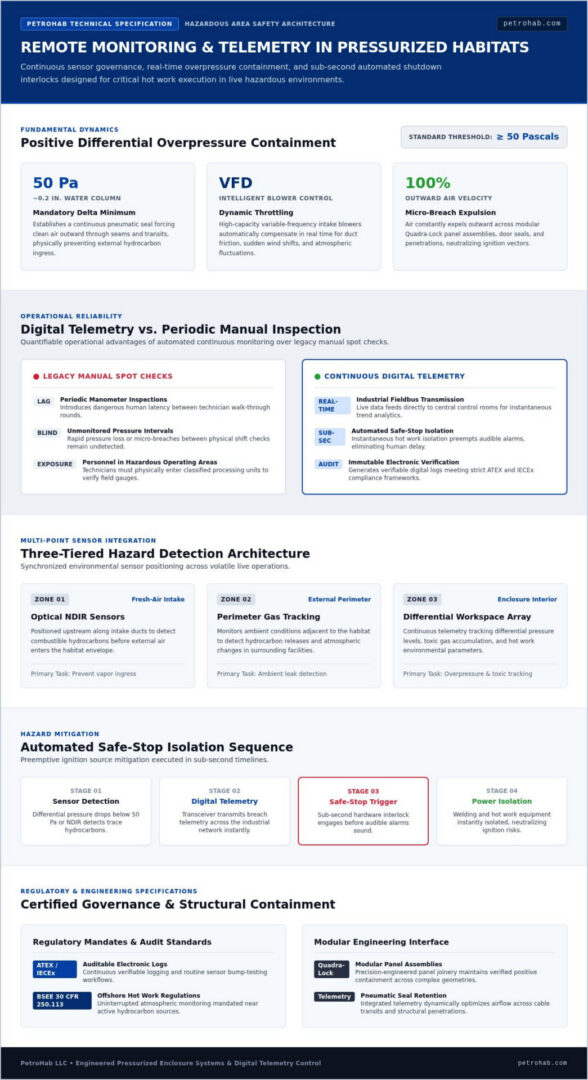
Effective safety management relies on real-time verification rather than sporadic assumptions. The remote monitoring of pressurized habitats provides continuous digital surveillance that replaces periodic manual checks in volatile operating environments. Field-mounted sensors continuously evaluate overpressure integrity, airflow rates, and external atmospheric contaminants. Telemetry systems package these vital data streams and transmit them directly to remote central control rooms, giving operators immediate visibility over habitat conditions.
To see how remote atmospheric telemetry continuously balances pressure and environmental stability in sealed habitats, watch this overview:
The Mechanics of Positive Differential Overpressure Containment
Containment integrity depends on maintaining a steady positive differential pressure, targeting a minimum threshold of 50 Pascals (approximately 0.2 inches of water column). This delta creates an active pneumatic seal. Air moves outward at high velocity across every micro-breach, cable transit, and door seal. Modern monitoring packages use intelligent controls that automatically throttle variable-frequency intake blowers, compensating instantly for dynamic external wind shifts, duct friction, and sudden atmospheric pressure changes.
Digital Telemetry vs. Local Physical Gauge Inspection
Legacy protocols forced technicians to walk into hazardous processing units for manual manometer spot checks. That method generates dangerous time lag and doesn’t account for rapid pressure loss between shift rounds. Modern digital transceivers interface directly with facility control systems via industrial fieldbus protocols. This architecture delivers instantaneous trend analysis to remote control rooms and automatically generates immutable electronic audit logs, satisfying stringent ATEX and IECEx compliance standards without placing personnel in high-risk zones.
Sensor Integration and Real-Time Hazard Detection Technologies
A pressurized barrier is only as dependable as the detection network governing it. Comprehensive remote monitoring of pressurized habitats demands a synchronized, multi-point sensor architecture that maps environmental conditions across three distinct operational zones: the fresh-air intake path, the external perimeter, and the interior workspace. Deploying discrete sensor arrays across these points ensures that combustible hydrocarbons, toxic compounds, and shifts in atmospheric pressure are detected long before vapors reach hot work tools. For teams planning turnaround scopes, reviewing our comprehensive pressurized welding habitats guide provides an essential foundation for structural containment design.
Meeting offshore compliance mandates such as the BSEE 30 CFR 250.113 welding regulations requires uninterrupted monitoring during hot work near active hydrocarbon sources. Digital control modules evaluate live telemetry from several critical sensor categories:
- Optical Non-Dispersive Infrared (NDIR) Sensors: Positioned at air intakes to detect lower explosive limit (LEL) hydrocarbons without risking catalyst poisoning from silicones or sulfur compounds.
- Catalytic Bead Sensors: Deployed internally to deliver fast-response detection of flammable gases across a wide thermal operating range.
- Electrochemical Cells: Continuously tracking toxic gas concentrations, specifically hydrogen sulfide (H₂S) and carbon monoxide (CO), alongside atmospheric oxygen levels.
- Differential Pressure Transducers: Constantly measuring micro-differential air pressure relative to the external deck atmosphere.
- Inline Thermal Mass Airflow Sensors: Verifying that duct supply lines deliver sufficient volumetric air changes to satisfy ventilation standards.
Combustible and Toxic Atmospheric Gas Detection Arrays
Intake monitoring serves as the frontline defense against vapor ingestion. Dual-redundant optical infrared detectors continuously sample inlet air streams before that air pressurizes the enclosure. If intake sensors detect combustible gas concentrations reaching 10% LEL, the control logic triggers instantaneous mechanical isolation dampers and trips blower circuits. Internally, electrochemical cells monitor oxygen levels within a strict 20.0% to 20.9% window, protecting technicians from both inert gas asphyxiation and hot-work-induced oxygen enrichment.
Differential Pressure Transmitters and Airflow Manometry
Static mechanical gauges cannot register rapid structural pressure drops caused by gusting marine winds or sudden mechanical disturbances. High-frequency piezo-resistive pressure transducers capture micro-differential pressure variations within milliseconds, streaming telemetry back to the centralized control architecture. Physical enclosure integrity works hand-in-hand with this instrumentation. Modular Quadra-Lock panel joints form an airtight mechanical interlock that stops edge leakage, ensuring differential pressure transmitters read true internal conditions rather than localized perimeter seepage. To evaluate how these instrumentation arrays integrate into complete certified enclosures, consult the engineering team at PetroHab for operational planning.
Automated Shutdown vs. Manual Intervention: Failure Mode Mitigation
Human reaction times are fundamentally incapable of preventing an ignition event when volatile gases breach an enclosure boundary. Traditional safety watches rely on an observer noticing a local warning, processing the hazard, and manually tripping an emergency stop button. Under operational stress, that sequence takes anywhere from three to ten seconds. By contrast, automated remote monitoring of pressurized habitats links digital sensing directly to electro-pneumatic interlocks, executing full system isolation in under one second.
Aligning containment infrastructure with the NFPA 496 standard for purged and pressurized enclosures requires continuous overpressure verification and fail-safe trip mechanisms. When combustible vapors migrate toward a live arc, automated logic removes all ignition potential before vapors reach stoichiometric concentrations. Operators seeking a deeper evaluation of isolation controls can review our hot work safety systems review.
The Safe-Stop Automated Shutdown Architecture
The Safe-Stop Automatic Shutdown System acts as the primary telemetry and safety gateway for the habitat. Engineered specifically to eliminate human latency, Safe-Stop continuously evaluates differential pressure alongside toxic and flammable gas levels. If an operating parameter deviates beyond programmed thresholds, the system executes an immediate triple-action isolation:
- Electrical Isolation: Heavy-duty contactors immediately cut electrical power to all welding machines, grinders, and lighting circuits within milliseconds.
- Pneumatic Isolation: High-speed shutoff valves depressurize air lines, cutting supply to pneumatic tools and torches.
- Occupant Evacuation Signalling: High-decibel audio-visual klaxon beacons activate instantly inside and outside the enclosure to command emergency egress.
Response Time Analysis Across Critical Failure Scenarios
Comparing manual responses against automated shutdown logic reveals stark operational differences across primary failure modes:
- Differential Overpressure Loss: If enclosure pressure drops below the mandatory 50-Pascal threshold, an automated loop trips equipment isolation in under one second. A human fire watch typically requires several minutes to confirm a true drop on an analog dial.
- Combustible Gas Detection: Safe-Stop triggers immediate equipment shutdown when intake or internal hydrocarbon levels reach 10% LEL, isolating sparks well before reaching the Lower Explosive Limit. Manual watches rarely detect early gas migration until external alarms sound across the wider facility.
- Instrumentation Faults: Dual-redundant telemetry circuits actively track loop resistance and sensor health. If a sensor circuit fails, the system enters a fail-safe alarm state rather than allowing hot work to proceed unmonitored.
This automated response matrix eliminates the reliance on human reflexes, ensuring that remote monitoring of pressurized habitats provides verifiable, sub-second protection across every hot work campaign.
Regulatory Compliance and Sensor Calibration Frameworks for 2026
Operating hot work enclosures in hazardous industrial areas requires strict adherence to international safety directives. For safety controllers and plant engineers, remote monitoring of pressurized habitats provides the verified instrumentation logs required by major regulatory bodies. Meeting these rigorous requirements demands a four-step verification sequence before any hot work permit goes live:
- Step 1: Execute Pre-Shift Bump Tests: Challenge all catalytic bead and electrochemical sensors using certified calibration gas (50% LEL methane balanced in air) to confirm sensor responsiveness and alarm trip logic before daily operations begin.
- Step 2: Calibrate Differential Pressure Transmitters: Zero-point and span-verify digital pressure transducers against certified micro-manometer standards to ensure precision above the mandatory 50 Pa trip baseline.
- Step 3: Verify Fail-Safe Trip Integration: Confirm electrical contactors and pneumatic emergency shutoff valves close instantly during simulated low-pressure and high-gas fault injections.
- Step 4: Establish Control Room Telemetry: Validate bidirectional digital fieldbus handshakes with the facility central control room to confirm continuous telemetry streaming and remote alarm annunciation.
For an in-depth breakdown of evolving international codes, consult our hazardous environment standards guide.
IEC 60079-13 and ATEX Zone 1 / Zone 2 Requirements
IEC 60079-13 establishes the global design standard for equipment protection by pressurized rooms (“p”) and artificially ventilated rooms (“v”). Under this standard, habitats operating in Zone 1 or Zone 2 locations must complete a mandatory pre-work purge cycle. This step exchanges the internal volume multiple times using clean air to flush residual vapors before tool energization. Transmitters, beacons, and telemetry transceivers mounted inside or adjacent to the enclosure must carry certified Intrinsic Safety (Ex i) or Flameproof (Ex d) ratings to ensure the monitoring infrastructure itself never presents an ignition risk.
Audit-Ready Digital Logging and Permit-to-Work Integration
Paper records and manual logbooks fail modern forensic safety scrutiny. Modern remote monitoring architectures sync sensor data directly to secure electronic repositories every second. These continuous time-stamped logs link differential pressure values and atmospheric gas concentrations directly to active electronic Permit-to-Work authorizations. When offshore safety inspectors or regulatory auditors review turnaround operations, digital archives prove that containment remained unbroken throughout the maintenance window. To deploy fully certified enclosures equipped with compliant telemetry packages, request a technical consultation with PetroHab today.
Deploying PetroHab Engineered Habitats with Intelligent Telemetry Control
Hardware reliability and digital intelligence must operate in complete synchronization during hazardous hot work. PetroHab pairs patented Quadra-Lock panels with the certified Safe-Stop Automatic Shutdown System, establishing an integrated defense against atmospheric hazards. Deploying the remote monitoring of pressurized habitats alongside high-integrity physical containment creates an unyielding barrier for continuous hot work execution. Standardized modular panels assemble rapidly around complex pipe racks, structural beams, and deck penetrations without sacrificing sealing integrity. A standard 2 m × 2 m × 2 m Petro-Habitat enclosure can be assembled and fully pressurized in approximately 30 minutes, allowing maintenance teams to mobilize swiftly. To explore hardware configurations, consult our guide to hot work safety enclosures.
Patented Quadra-Lock Panel Sealing Performance
PetroHab Hot Work Safety Enclosures (HWSE) utilize standardized 1 m × 1 m interchangeable panels constructed with ANSI/FM 4950 certified silicone-coated fiberglass fabric. Rated to withstand radiant heat and sparks up to 1,000°F (538°C), these panels protect surrounding process lines from welding spatter. The patented Quadra-Lock mechanical interlocking mechanism joins panel seams without zippers or Velcro, preventing seam failure under marine conditions. This rigid joint design eliminates gas migration paths and resists pressure fluctuations caused by high platform wind shear, ensuring differential pressure sensors register stable, accurate readings.
Global Field Deployment, Supervision, and Technician Support
Executing high-consequence turnaround campaigns requires field-level precision and dedicated operational oversight. PetroHab provides factory-trained safety technicians globally from Houston, Texas, delivering on-site commissioning, sensor calibration routines, and personnel training. Flexible commercial arrangements match varied maintenance profiles:
- Turnkey Equipment Leasing: Gives operators rapid access to certified Petro-Habitats and Safe-Stop shutdown systems for short-term turnarounds and planned inspection scopes.
- Direct Equipment Sales: Equips facility owners with permanent pressurized welding enclosures to support ongoing platform modifications and capital projects.
- Specialized Supervision: Ensures on-site crews adhere to rigorous pressure containment and instrumentation verification protocols.
This combined delivery model ensures that remote monitoring of pressurized habitats provides dependable risk mitigation, protecting personnel and high-value assets across every phase of production maintenance.
Securing the Future of High-Consequence Hot Work Operations
Maintaining continuous production while conducting critical maintenance requires engineering controls that leave zero margin for error. Real-time telemetry replaces the dangerous lag of manual spot checks with continuous, millisecond-level environmental verification. By uniting automated multi-gas sensing with sub-second electrical and pneumatic isolation, the remote monitoring of pressurized habitats prevents volatile hydrocarbons from ever encountering an active ignition source.
Achieving this level of operational integrity requires structural containment and digital controls designed to perform together under severe offshore and downstream conditions. PetroHab integrates patented Quadra-Lock panel interlocking technology with certified Safe-Stop automated shutdown systems, delivering proven safety performance across North America, Europe, and South America. You don’t have to choose between plant uptime and absolute hazard mitigation. Consult PetroHab safety engineers to deploy monitored hot work habitats engineered to safeguard your facility and keep critical scopes on schedule.
Frequently Asked Questions
How does remote monitoring maintain positive pressure inside a hot work habitat?
Remote systems maintain positive pressure by continuously measuring internal-to-external air differential via digital piezo-resistive transducers. When door cycling or wind shear causes pressure variations, the telemetry control module automatically signals variable-frequency drive blowers to modulate airflow rates. This dynamic regulation maintains higher internal pressure than the surrounding atmosphere, ensuring continuous outward velocity across panel seams to physically block combustible vapor ingress.
What is the required differential pressure threshold for an operational welding enclosure?
Under international standards including IEC 60079-13, a pressurized welding enclosure must maintain a minimum positive differential pressure of 50 Pascals, equivalent to 0.2 inches of water column or 0.5 millibars. If internal pressure drops below this 50-Pascal limit, the system initiates an immediate visual alarm and executes an automatic low-pressure trip, de-energizing ignition sources to prevent toxic or flammable hydrocarbons from entering the enclosure.
How does the Safe-Stop Automatic Shutdown System isolate hot work equipment?
The Safe-Stop Automatic Shutdown System integrates directly into primary facility utilities to execute instantaneous electrical and pneumatic isolation. When onboard sensors detect an overpressure drop below 50 Pa or combustible gases at 10% LEL, Safe-Stop opens heavy-duty contactors within one second to kill welding and cutting power. Concurrently, pneumatic solenoid valves vent torch lines, and audio-visual klaxons activate to direct personnel to initiate evacuation protocols.
Can remote habitat telemetry operate within classified ATEX Zone 1 hazardous environments?
Yes, the remote monitoring of pressurized habitats operates safely within ATEX Zone 1 and Zone 2 environments when using certified instrumentation. Field transceivers, gas sensors, and pressure transmitters are engineered with Intrinsic Safety (Ex i) or Flameproof (Ex d) enclosures in full compliance with IEC 60079 standards. This ensures telemetry equipment cannot create thermal or electrical ignition sparks, allowing real-time data transmission directly across explosive production environments.
What happens if the primary air intake detects combustible hydrocarbon gases?
If intake optical infrared sensors detect combustible hydrocarbons reaching 10% of the Lower Explosive Limit (LEL), the system triggers an emergency intake isolation sequence. Automated intake dampers close immediately to prevent drawing contaminated air into the habitat. At the exact same instant, the control module isolates all hot work equipment power and triggers evacuation alarms, neutralizing potential ignition sources before hazardous vapors can enter the workspace.
Why is automated digital telemetry preferred over traditional manual fire watch manometers?
Manual fire watch inspections rely on periodic spot checks, introducing severe reaction lag and exposure risks for safety personnel in hazardous locations. Automated remote monitoring of pressurized habitats replaces intermittent visual readings with continuous, millisecond-level digital telemetry. Digital monitoring eliminates human error, isolates ignition sources automatically during rapid pressure drops, and compiles immutable, auditable electronic safety logs required by regulatory authorities for Permit-to-Work verification.