Blog Posts
The Business Case for Pressurized Safety Enclosures in 2026
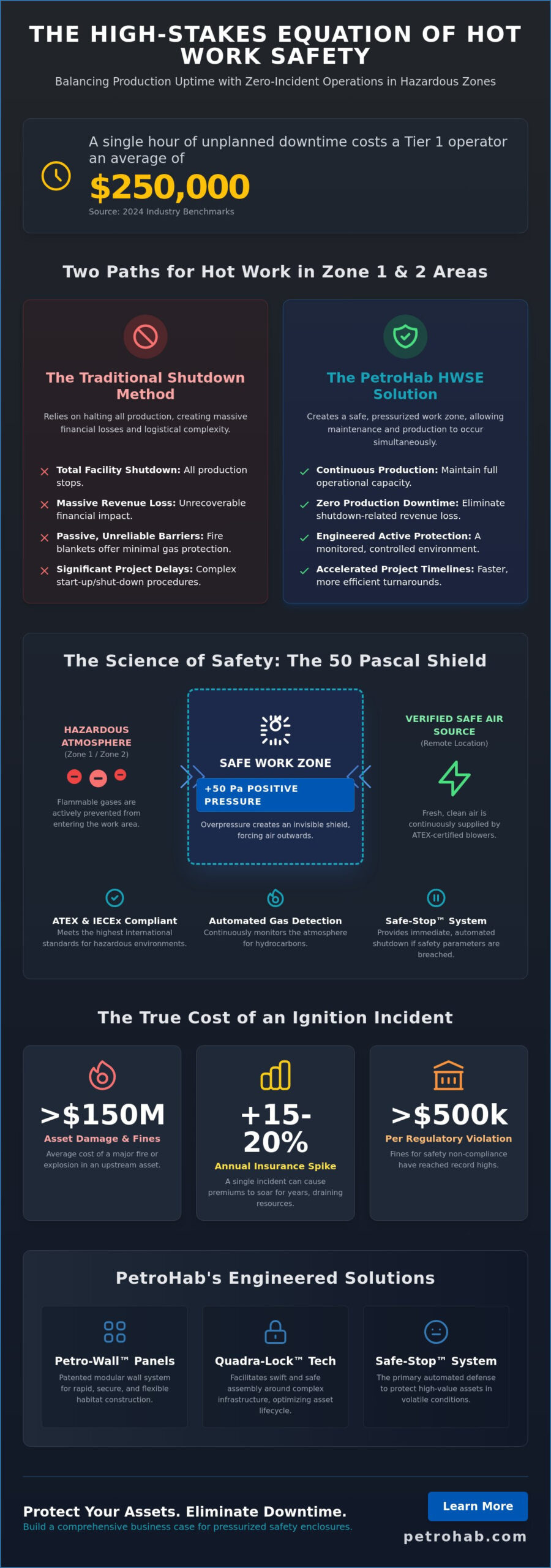
For a Tier 1 oil and gas operator, a single hour of unplanned production downtime in 2024 averaged $250,000 in lost revenue according to industry benchmarks. In Zone 1 and Zone 2 hazardous areas, the margin for error is non-existent; yet, traditional maintenance often requires total facility shutdowns to manage ignition risks. You know that balancing these massive operational costs with stringent safety protocols is the most difficult part of any turnaround strategy. Building a comprehensive business case for pressurized safety enclosure technology is the only way to reconcile these competing priorities as we move into 2026.
This article demonstrates how pressurized hot work safety enclosures (HWSE) reduce operational downtime, ensure absolute ATEX and IECEx compliance, and protect high-value assets from accidental ignition. We’ll provide the financial justification for HWSE and show how our patented Petro-Wall and Safe-Stop systems facilitate a zero-incident safety record. You’ll see exactly how these modular systems accelerate project timelines while maintaining the highest levels of industrial integrity and engineering precision.
Key Takeaways
- Quantify the financial advantage of maintaining production while conducting hot work in Zone 1 and 2 environments to eliminate the high cost of facility shutdowns.
- Understand the business case for pressurized safety enclosure systems by examining how a 50 Pascal pressure differential maintains technical integrity in hazardous areas.
- Navigate the evolving 2026 regulatory landscape, including ATEX and IECEx standards, to mitigate corporate liability and ensure uncompromising site safety.
- Discover how modular Quadra-Lock technology facilitates rapid assembly around complex infrastructure to optimize asset lifecycle management and operational efficiency.
- Evaluate the integration of automated gas detection and Safe-Stop systems as the primary defense for protecting high-value assets in volatile atmospheric conditions.
The Economic Impact of Hot Work in Hazardous Environments
Performing maintenance in Zone 1 and Zone 2 hazardous areas presents a significant threat to industrial asset integrity. Traditional hot work methods, such as utilizing basic fire blankets, often fail to provide adequate protection against gas ingress in volatile environments. These passive barriers don’t address the fundamental risk of hydrocarbon ignition. This failure creates a critical need for engineered solutions that provide active protection. The business case for pressurized safety enclosure technology is built on the necessity of maintaining production while ensuring absolute safety during welding, grinding, or cutting operations.
Modern Permit-to-Work (PTW) systems now recognize Hot Work Safety Enclosures (HWSE) as a primary control measure. These systems don’t just shield sparks; they manage the atmosphere surrounding the ignition source. By implementing a pressurized habitat, operators eliminate the need for costly facility-wide shutdowns. This approach ensures that maintenance doesn’t compromise the safety of the entire platform or refinery. PetroHab’s patented systems, including the Petro-Wall, provide a rigorous defense that exceeds standard safety protocols.
Defining the Pressurized Habitat Concept
A positive pressure enclosure works by maintaining an internal air pressure higher than the external atmosphere. This overpressure mechanism ensures that flammable gases cannot enter the workspace even if the enclosure’s integrity is slightly compromised. While fire blankets only offer a physical shield against sparks, a fully engineered enclosure provides a monitored, airtight environment. HWSE is a temporary controlled environment for ignition source control.
These habitats utilize specialized blowers and ducting to pull fresh air from a remote, verified location. This air is then pumped into the modular Petro-Wall structure. Every system integrates safety certifications like ATEX and IECEx to ensure compliance with international standards. The business case for pressurized safety enclosure adoption becomes clear when comparing the cost of these modular units against the logistical nightmare of a full site depressurization.
The High Cost of Maintenance-Related Incidents
Ignition events in the energy sector carry devastating financial consequences. According to industry loss reports from 2024, the average cost of a major fire or explosion in an upstream asset exceeds $150 million. These figures account for direct equipment damage, environmental remediation fines, and lost production time. Beyond the immediate capital loss, a single incident can cause insurance premiums to spike by 15% to 20% annually. This financial burden persists for years, draining corporate resources and damaging market reputation.
- ALARP Principle: Regulators require risks to be “As Low As Reasonably Practicable.” HWSE is the gold standard for meeting this requirement.
- Regulatory Compliance: Fines for safety violations in 2025 have reached record highs, often exceeding $500,000 per citation.
- Asset Protection: Protecting high-value assets with Safe-Stop technology prevents the “domino effect” of industrial accidents.
Reliability is the cornerstone of PetroHab’s engineering philosophy. We understand that safety managers cannot afford to guess when it comes to ignition source control. By utilizing a pressurized habitat, engineers move from a reactive posture to a proactive one. This transition is essential for any facility aiming for operational excellence in 2026. The investment in high-quality enclosures is a direct investment in the long-term viability of the asset.
Technical Integrity: How Pressurization Creates a Controlled Environment
Engineering a controlled environment requires more than just physical barriers; it demands the precise application of fluid dynamics. The technical core of the business case for pressurized safety enclosure lies in the physics of overpressure. By maintaining a constant 50 Pascal (Pa) differential relative to the external atmosphere, the system ensures that flammable hydrocarbon gases cannot enter the workspace. This positive pressure acts as an invisible shield, forcing air outward through any microscopic gaps and preventing the ingress of hazardous vapors.
Operators must strictly adhere to OSHA hot work regulations to ensure legal compliance and mitigate risk during welding or grinding operations in Class 1, Division 1 environments. Our Petro-Wall panels utilize fire-resistant materials designed to withstand temperatures exceeding 1,000 degrees Celsius. This modular construction isn’t just about containment; it’s about structural resilience. Integrated airflow management systems provide 20 to 30 air changes per hour. This volume of air exchange removes toxic welding fumes and maintains worker core temperatures, which directly improves labor productivity by 15% in high-heat conditions.
The Role of Automatic Shutdown Systems
The Safe-Stop system provides the intelligence behind the enclosure. It continuously monitors internal pressure and gas concentrations at both the air intake and the habitat interior. If the pressure falls below the 25 Pa threshold or if gas is detected at 10% of the Lower Explosive Limit (LEL), the system triggers an immediate isolation of the ignition source. This fail-safe mechanism removes human error from the safety equation. For a deeper look at these automated technologies, consult A Comprehensive Guide to Advanced Hot Work Safety Systems in 2026.
Maintaining Structural and Pressure Integrity
Offshore assets often face wind speeds exceeding 80 knots; these conditions test the limits of modular enclosures. Maintaining integrity requires precise manometer calibration to verify pressure levels in real-time. Common failures often stem from improper ducting or neglected leakage points around structural penetrations like pipes and beams. A robust business case for pressurized safety enclosure depends on minimizing these operational disruptions. Engineers should prioritize systems that utilize patented interlocking seals to prevent pressure loss during high-vibration activities. You can explore our modular safety solutions to see how we address these specific environmental challenges through advanced engineering.
HWSE vs. Production Shutdown: Analyzing the Cost of Downtime
Maintaining production flow while executing critical repairs is the primary objective for asset managers in 2026. The business case for pressurized safety enclosure technology rests on the elimination of the dilemma between safety and revenue. When a refinery or offshore platform shuts down for hot work, the opportunity cost isn’t just the lost volume of hydrocarbons. It includes the labor costs of the shutdown and restart sequence, the flare tax implications, and the potential for mechanical failures during thermal cycling. PetroHab systems provide a definitive technological remedy by isolating the ignition source from the surrounding explosive atmosphere.
The use of pressurized habitats allows for hot work to proceed without stopping the flow of hydrocarbons. This capability transforms maintenance from a disruptive event into a routine operational task. While a total shutdown might take 48 hours for purging and cooling alone, a PetroHab HWSE can be fully pressurized and certified for work within a few hours. This drastic reduction in the “Critical Path” ensures that high-value assets remain online and profitable.
Calculating the ROI of Pressurized Enclosures
Quantifying the return on investment requires a rigorous comparison of daily rental and supervision costs against the facility’s daily production value. PetroHab’s modular systems adhere to the NFPA 496 standard for purged and pressurized enclosures, ensuring technical integrity is never compromised for speed. For a platform producing 20,000 barrels per day at $75 per barrel, an hour of downtime costs over $62,000. Under these financial conditions, an HWSE often pays for itself within the first 4 hours of avoided shutdown.
The break-even point occurs when the cost of the habitat rental and the 24/7 safety technician coverage is surpassed by the revenue generated during the hours the facility would have otherwise been offline. This calculation doesn’t even account for the secondary savings found in reduced mobilization of specialized shutdown crews or the avoidance of emergency parts procurement.
Operational Flexibility and Project Timelines
Operational flexibility increases through Simultaneous Operations (SIMOPS). PetroHab’s patented Petro-Wall panels allow for rapid assembly around complex piping, enabling welding to proceed while adjacent lines remain live. This strategy reduces the duration of refinery turnarounds by 15% to 22% on average. By integrating ignition source control directly into the workflow, engineers can schedule repairs based on urgency rather than shutdown windows. Detailed technical specifications on these systems are available in our Pressurized Welding Habitats: The Definitive Guide to HWSE Technology.
In a 2023 deployment for a major operator in the Gulf of Mexico, the use of pressurized habitats allowed for the replacement of a corroded flare line without stopping production. The operator reported savings exceeding $4.2 million by avoiding a scheduled five-day outage. This case demonstrates that the business case for pressurized safety enclosure usage is not merely about safety compliance; it’s a fundamental strategy for maximizing asset uptime and protecting the bottom line.
Strategic Risk Mitigation and Regulatory Compliance Frameworks
The 2026 regulatory environment demands more than simple compliance; it requires proactive risk elimination. OSHA 1910.252 and NFPA 51B standards have evolved to prioritize engineered solutions over administrative ones. Relying on fire watches or manual permits alone is no longer sufficient to mitigate liability in high-stakes environments. The business case for pressurized safety enclosure systems rests on their ability to replace human error with technological certainty. By deploying a certified habitat, organizations shift the liability burden from individual operators to a tested, automated system.
PetroHab’s patented Safe-Stop and Petro-Wall technologies provide the technical foundation for this shift. These systems don’t just alert workers to hazards; they actively isolate ignition sources. This transition from administrative to engineered controls is a critical component of 2026 safety audits. Certified on-site supervision further strengthens this framework. Having a specialized technician manage the habitat ensures that every pressure reading and gas detection log is documented. This level of granular data is vital during compliance audits, providing a clear paper trail of safety integrity.
Global Standards and Local Regulations
Navigating the distinction between Zone 1 and Zone 2 environments is essential for operational continuity. Zone 1 areas require equipment that prevents ignition even under frequent fault conditions. PetroHab habitats meet these rigorous ATEX and IECEx standards by integrating sophisticated gas detection and automatic shutdown systems. Our panels exceed the fire resistance requirements of ISO 15540, ensuring integrity during high-intensity hot work. This technical compliance allows for seamless operations across international borders. For a deeper analysis of these requirements, consult our Hazardous Environment Standards: The 2026 Guide to Global Compliance and Hot Work Safety.
Insurance and Stakeholder Confidence
Insurers increasingly rely on detailed Risk Engineering reports to determine premiums and coverage limits. Utilizing a certified business case for pressurized safety enclosure deployment demonstrates a commitment to technical excellence that can lead to more favorable terms. For joint venture partners, these enclosures act as a physical guarantee of asset protection. A Zero Accident culture isn’t just a safety goal; it’s a strategic recruitment tool. In a competitive labor market, skilled technicians prioritize sites that invest in the highest level of protection. This investment builds trust with both internal teams and external stakeholders, proving that safety is a core operational value rather than a secondary concern.
Secure your operations with the industry’s most reliable hot work protection. Explore PetroHab’s certified safety solutions today.
Optimising Asset Lifecycle with PetroHab’s Modular Solutions
PetroHab’s engineering philosophy centers on the integration of patented technologies that extend beyond simple containment. The business case for pressurized safety enclosure systems in 2026 rests on their ability to minimize downtime while maintaining the highest levels of ignition source control. By utilizing the Petro-Wall system, operators secure a flame-retardant barrier that withstands temperatures exceeding 1,000 degrees Celsius. This level of thermal integrity ensures that hot work occurs without compromising surrounding high-value assets. When paired with the Safe-Stop automatic shutdown system, the enclosure becomes an active safety mechanism rather than a passive structure.
Modularity and Rapid Deployment
The Quadra-Lock technology represents a significant shift in modular assembly. Unlike traditional configurations, these panels interlock through a unique 10-centimeter overlap system that provides a gas-tight seal without specialized tools. This design reduces labor costs by approximately 30% during the initial setup phase. Engineers can customize these habitats to fit precisely around complex structural steel and intricate piping manifolds. This flexibility is critical for offshore platforms where space is limited and structural penetrations are frequent. The durability of the silicone-coated fiberglass materials ensures the system remains functional in extreme environments, from 50-degree Celsius desert heat to the corrosive salt spray of the North Sea. For a deeper technical dive, consult The Definitive Guide to Hot Work Safety Enclosures (HWSE) in 2026.
Decision-makers in 2026 must evaluate the procurement model that best fits their operational cadence. Purchasing the hardware provides long-term depreciation benefits for companies with year-round maintenance schedules. It allows for immediate deployment of assets across multiple regional sites. Conversely, leasing offers a flexible solution for short-term turnarounds, shifting the burden of storage and recertification to the manufacturer. Both models ensure access to the same patented safety standards, allowing firms to scale their protection based on project volume.
PetroHab as a Strategic Safety Partner
Reliability isn’t just about the hardware; it’s about the technical supervision that governs its deployment. PetroHab provides specialized technician training to ensure every enclosure meets ISO and ATEX standards on-site. This expertise transforms the enclosure from a temporary tool into a strategic asset. By integrating these systems, safety managers build a robust business case for pressurized safety enclosure adoption, focusing on risk mitigation and human life protection. PetroHab supports these operations from logistical hubs in Houston, Dundee, and Brazil, ensuring global coverage for high-stakes energy projects.
Securing Operational Continuity Through Technical Integrity
Maintaining production while performing essential hot work is a strategic necessity for modern energy assets. Industry data from major offshore operators indicates that unplanned shutdowns can cost upwards of $500,000 per day in lost revenue. By deploying pressurized habitats, companies eliminate the need for these costly interruptions. The business case for pressurized safety enclosure implementation relies on the ability to isolate ignition sources in hazardous areas without halting revenue streams. PetroHab’s systems offer a definitive technological remedy through patented Quadra-Lock technology, ensuring structural stability and environmental control in high-risk zones.
Regulatory compliance remains a non-negotiable priority for 2026. Utilizing ATEX and IECEx compliant systems provides a documented framework for safety that satisfies international auditors and internal risk assessments. PetroHab supports these deployments with global 24/7 technical supervision and support, providing an active guardian for your personnel. It’s a calculated investment in risk mitigation that protects both human life and the bottom line. You’ll find that modular solutions offer the flexibility required for complex industrial sites where space is at a premium.
Request a Quote for Pressurized Safety Enclosure Leasing to integrate the gold standard of hot work safety into your next project. We’re ready to help you achieve zero-incident operations while maximizing your asset’s lifecycle.
Frequently Asked Questions
Is a pressurized safety enclosure required for all hot work in Zone 1?
Pressurized safety enclosures aren’t universally mandated by a single law, but they’re the operational standard for Zone 1 hot work under IEC 60079-13. Without them, operators must often execute a full facility shutdown, which is a costly alternative. By utilizing PetroHab technology, safety managers maintain a controlled environment that isolates ignition sources from potential hydrocarbon releases, ensuring site integrity stays intact.
How much pressure is needed to maintain a protected environment in a welding habitat?
A minimum overpressure of 50 Pascals, or 0.2 inches of water column, is required to maintain a protected environment. This specific pressure level prevents flammable gases from entering the enclosure through any gaps or openings. Our systems monitor these levels continuously, providing a reliable barrier that protects both personnel and high-value assets in hazardous areas while work is performed.
Can pressurized enclosures be used in both onshore and offshore environments?
Pressurized enclosures are engineered for both onshore refineries and offshore production platforms. The business case for pressurized safety enclosure adoption is particularly strong in these sectors where production downtime can exceed $1,000,000 per day. Whether it’s a remote FPSO or a midstream processing plant, PetroHab provides a modular solution that adapts to complex structural geometries and harsh weather conditions.
What happens to the hot work equipment if the habitat loses pressure?
Our patented Safe-Stop system immediately cuts power to all hot work equipment if the habitat loses pressure. If the internal atmosphere falls below the 25 Pascal threshold, the system triggers an automatic shutdown of welding leads and grinders. This definitive technological remedy eliminates the risk of human error and ensures that ignition sources don’t remain active in compromised conditions.
How long does it typically take to assemble a modular PetroHab enclosure?
A standard 2x2x2 meter PetroHab enclosure typically requires 2 to 4 hours for full assembly by a two-man crew. The modular design of our Petro-Wall panels allows for rapid deployment without the need for specialized tools. This efficiency minimizes preparation time, allowing maintenance teams to focus on the primary task while maintaining the gold standard in hot work safety.
What are the main differences between ATEX and IECEx certified habitats?
The primary difference lies in geographic and regulatory jurisdiction. ATEX is a legal requirement for equipment used in explosive atmospheres within the European Economic Area, while IECEx is the international standard for global markets. PetroHab’s commitment to safety is reflected in our dual certification, ensuring our habitats meet the rigorous technical requirements of both frameworks across 30+ countries.
Does using a pressurized habitat eliminate the need for a Hot Work Permit?
A pressurized habitat doesn’t eliminate the need for a Hot Work Permit, but it significantly streamlines the authorization process. It acts as a critical safety barrier that mitigates the risks identified in the permit’s Job Safety Analysis. By providing a controlled environment, the habitat allows safety officers to approve work that’s otherwise too hazardous to perform during live operations.
How do pressurized enclosures handle toxic fumes and welding smoke?
Pressurized enclosures manage toxic fumes through a high-volume ventilation system that provides at least 20 air changes per hour. This constant airflow removes welding smoke and particulates, maintaining a breathable atmosphere for workers. The intake air is sourced from a verified non-hazardous area, ensuring that the internal environment remains free from contaminants and combustible gases at all times.