Blog Posts
Hot Work Safety Presentation for Management: A 2026 Strategic Guide
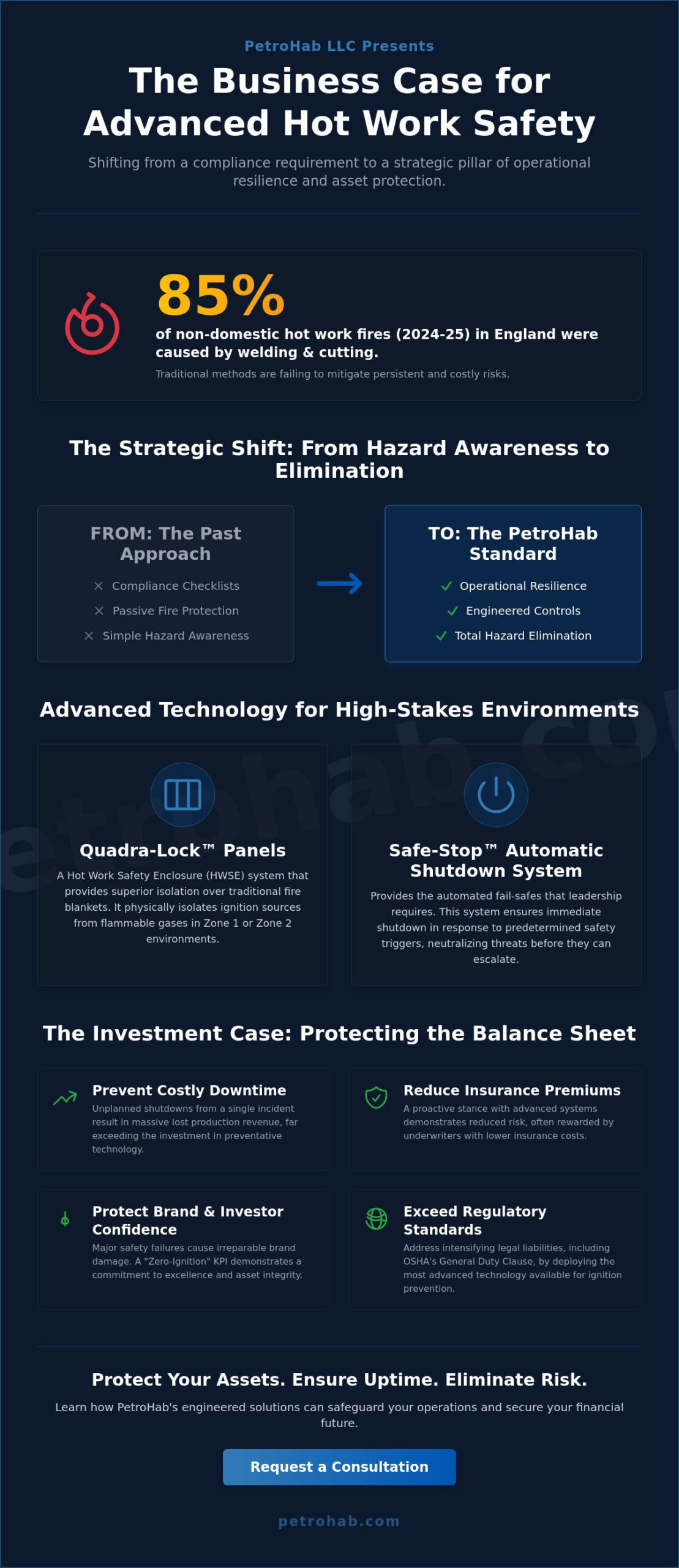
How many industrial fires must occur before the financial cost of a single incident outweighs the investment in advanced containment technology? In England alone, welding and cutting accounted for 85% of the 182 non-domestic hot work fires recorded between 2024 and 2025. For safety professionals, the challenge isn’t identifying the risk; it’s communicating that risk to executives who prioritize uptime. Crafting a high-impact hot work safety presentation for management requires a shift from simple hazard awareness to a strategic discussion on asset protection and liability reduction.
You likely understand that traditional barriers often fail to meet the rigorous demands of Zone 1 or Zone 2 environments. This guide will help you bridge the gap between engineering precision and corporate strategy. You’ll learn to secure procurement approval for advanced systems by highlighting the technical superiority of Quadra-Lock panels and the risk mitigation provided by the Safe-Stop Automatic Shutdown System. We’ll examine current 2026 OSHA enforcement trends, including the updated National Emphasis Program on heat, to build an uncompromising case for zero-incident operations and reduced insurance premiums.
Key Takeaways
- Learn to position hot work safety as a fundamental pillar of operational resilience rather than a mere compliance requirement.
- Discover how to structure a hot work safety presentation for management that prioritizes high-level risk profiles and definitive technological remedies.
- Understand the technical advantages of Quadra-Lock panels and pressurized enclosures over traditional fire blankets for isolating ignition sources in hazardous zones.
- Master the integration of Safe-Stop technology into your procurement request to provide the automated fail-safes that leadership requires for high-stakes environments.
- Calculate the financial impact of preventing unplanned downtime to build a compelling ROI case for advanced hot work safety systems.
The Strategic Importance of Hot Work Safety in 2026
Operational resilience is the capacity of an industrial asset to maintain production continuity while managing extreme hazards. In 2026, hot work safety has transitioned from a checklist-driven compliance task to a fundamental pillar of this resilience. A precise hot work safety presentation for management must articulate that safety is not a cost center. Instead, it is an active guardian of the facility’s balance sheet and operational uptime. For a foundational perspective on the risks associated with these activities, refer to this Hot Work Overview.
To better understand the inherent risks and the necessity of advanced containment, watch this helpful video:
Defining High-Stakes Risk Management
There is a critical distinction between standard hot work and operations conducted in hazardous Zone 1 or Zone 2 environments. While passive fire protection like blankets may suffice for low-risk areas, high-stakes environments demand pressurized containment. In 2026, legal liabilities have intensified. Regulatory bodies now utilize the General Duty Clause to cite facilities that fail to utilize the most advanced available technology for ignition prevention. Management must adopt “Zero-Ignition” as a primary Key Performance Indicator (KPI). Utilizing a PetroHab Hot Work Safety Enclosure (HWSE) ensures that flammable gases are physically isolated from ignition sources, effectively neutralizing the risk of a catastrophic event.
The Financial Impact of Hot Work Incidents
The cost of a single ignition incident extends far beyond immediate property damage. Unplanned shutdowns in refineries or offshore platforms result in significant lost production revenue every day. Between 2024 and 2025, welding and cutting accounted for 85% of non-domestic building fires in certain industrial sectors, highlighting the persistent danger of inadequate protection. Beyond the immediate financial loss, major safety failures cause irreparable brand damage and erode investor confidence. Modern hazardous environment standards directly influence corporate valuation by determining the risk profile of the organization. Implementing systems like Quadra-Lock panels and the Safe-Stop Automatic Shutdown System demonstrates a commitment to technical excellence. This proactive stance is often rewarded with lower insurance premiums, as underwriters recognize the reduced probability of a total loss incident. A comprehensive hot work safety presentation for management illustrates that the procurement of advanced HWSE technology is a strategic investment in long-term asset integrity.
Structuring Your Hot Work Safety Presentation for Management
Executives and facility directors don’t require a lecture on the mechanics of welding. They require a strategy for risk containment and asset protection. A high-impact hot work safety presentation for management must pivot from procedural checklists to a definitive technological remedy that ensures operational continuity. The objective is to replace “hazard awareness” with “hazard elimination” through engineered controls. By framing the discussion around these pillars, you align safety objectives with corporate financial goals.
The 10-Slide Presentation Framework
A logical, problem-solution architecture is most effective for executive audiences. Your presentation should follow a structured progression that identifies hazardous conditions and immediately offers a solution. Use this framework to maintain focus on high-stakes risk management:
- Slides 1-3: Risk Assessment and Current Vulnerabilities. Identify specific Zone 1 or Zone 2 areas where hot work is planned. Reference OSHA Hot Work Regulations to establish the legal mandate for rigorous containment and fire prevention.
- Slides 4-6: The Technology. Introduce the PetroHab Hot Work Safety Enclosure (HWSE) as the primary engineered control. Detail the structural integrity of Quadra-Lock panels and the functional reliability of Safe-Stop systems.
- Slides 7-10: ROI, Compliance, and Implementation. Contrast the cost of procurement or leasing against the catastrophic expense of unplanned shutdowns. Conclude with a clear call to action for the procurement of specific HWSE assets.
Visualizing Technical Data for Executives
Technical precision instills confidence. Instead of using generic safety slogans, present management with concrete data points. Use pressure charts and gas detection logs to demonstrate how a pressurized environment prevents the ingress of flammable vapors. Executives respond to evidence of control. You should analyze your site’s specific ignition risks before selecting the appropriate enclosure configuration.
Integrate visual proof points regarding the “Habitat Effect.” Highlighting how pressurized welding habitats maintain a positive pressure differential provides a clear, visual safety report that non-engineers can easily grasp. This approach simplifies complex ATEX or IECEx certifications into a binary “Safe vs. Unsafe” visual. It’s much easier for management to approve a budget when they can see the technological barrier between a welding spark and a volatile atmosphere. This data-driven strategy transforms the safety manager from a procedural enforcer into a critical safety partner and asset guardian.
Justifying Advanced HWSE Technology Over Traditional Methods
Management teams often default to fire blankets and welding screens because they represent a lower upfront expenditure. However, a hot work safety presentation for management must expose the technical limitations of these passive methods in high-stakes industrial environments. Fire blankets lack the structural integrity to withstand high winds and provide no barrier against the migration of flammable vapors. In contrast, a PetroHab Hot Work Safety Enclosure (HWSE) creates a controlled environment where ignition risks are actively neutralized through positive pressure.
The “Habitat Effect” is the core technical advantage of pressurized enclosures. By maintaining a constant internal pressure higher than the external atmosphere, the system physically prevents hydrocarbon gases from entering the workspace. Modern systems integrate automatic intervention capabilities, such as the Safe-Stop Automatic Shutdown System, which terminates hot work operations immediately if gas is detected or pressure is lost. This level of control is impossible with traditional spark-containment methods.
Fire Blankets vs. HWSE: A Risk Analysis
Passive containment fails during gas leaks or extreme weather events. While some institutional guidance suggests blankets are adequate, OSHA hot work regulations mandate that fire protection must be effective for the specific hazards present. In 2026, hot work safety enclosures have become the industry benchmark because they address the root cause of ignition: the presence of fuel near a heat source. The durability of fire-rated materials used in modular habitats ensures they don’t degrade under the intense thermal loads of continuous welding, unlike standard welding curtains that often require frequent replacement.
The Value of Proprietary Quadra-Lock Engineering
The integrity of a pressurized habitat depends entirely on the seal of its components. Quadra-Lock technology utilizes a patented interlocking system that ensures a “no-gap” seal across the entire enclosure surface. This engineering eliminates the vulnerabilities found in generic habitats that rely on velcro or simple overlapping flaps. For management, the benefit is twofold: enhanced safety and reduced labor costs. The speed of assembly and disassembly for Quadra-Lock panels serves as a critical labor-saving metric, allowing teams to set up or relocate enclosures with minimal impact on the production schedule. This combination of technical reliability and operational efficiency makes the procurement of Quadra-Lock systems a logical choice for any facility prioritizing asset integrity. A comprehensive hot work safety presentation for management should emphasize that superior engineering directly correlates to lower operational risk and higher productivity.
Actionable Guidance: Integrating Safe-Stop into the Presentation
Management requires certainty in high-stakes environments. While manual fire watches remain a regulatory necessity, they are inherently subject to human error, fatigue, and delayed response times. A hot work safety presentation for management must feature the Safe-Stop Automatic Shutdown System as the ultimate fail-safe. This technology provides an uncompromising layer of protection by integrating sensitive gas detection with an automatic air supply cutoff. If internal sensors detect hydrocarbons or if the enclosure loses the required positive pressure, the Safe-Stop system immediately terminates the power to the welding equipment or heat source. This active intervention ensures that ignition is physically impossible during a containment breach.
Presenting Automation as a Liability Shield
Automation serves as a critical liability shield for facility owners and safety directors. By removing human hesitation from the response chain, the Safe-Stop system meets the most stringent 2026 regulatory demands for ignition prevention and environmental containment. Management gains peace of mind through real-time monitoring data, which provides a verifiable log of safety compliance throughout the project duration. This data-driven approach reduces the reliance on constant human monitoring, allowing safety personnel to focus on broader site hazards while the automated system guards the immediate hot work area. Highlighting compliance with global safety standards for automatic intervention demonstrates that the facility is operating at the peak of industrial safety excellence.
Logistics and Operational Training
The effectiveness of any technological solution depends on professional implementation and rigorous operational standards. A successful hot work safety presentation for management should outline the necessity of on-site supervision and certified training for all personnel involved in the project. Expert oversight ensures that the integrity of the PetroHab Hot Work Safety Enclosure (HWSE) remains uncompromised from setup to completion. A “Ready-to-Work” status is only achieved when the habitat and its automated systems are configured by trained professionals who understand the granular details of ignition prevention. This professional setup guarantees that the Quadra-Lock panels are correctly interlocked and the Safe-Stop system is fully calibrated for the specific hazards of the site.
To ensure your next project meets these uncompromising standards, request a technical consultation for the Safe-Stop system.
The Business Case: ROI and Next Steps for Procurement
The final stage of a hot work safety presentation for management must translate technical safety into financial logic. Executives prioritize the bottom line, and the most compelling argument for advanced HWSE technology is the prevention of unplanned downtime. A single hour of lost production in a refinery or offshore platform results in massive revenue losses. By investing in a PetroHab Hot Work Safety Enclosure (HWSE), the facility ensures that hot work can proceed safely without shutting down adjacent operations. This operational continuity provides an immediate return on investment by protecting the production schedule from catastrophic interruptions.
Strategic procurement requires a clear roadmap. Management needs to understand how to evaluate vendors based on technical certifications and engineering reliability. Referencing a guide for choosing the right hot work safety enclosure suppliers helps establish a criteria-based selection process. This ensures that the chosen partner can meet the rigorous demands of hazardous zone operations while providing the necessary technical support.
Leasing vs. Purchasing: A Management Decision Matrix
The choice between leasing and purchasing depends on the frequency and scale of the required hot work. For short-term maintenance turnarounds or one-off repairs, rental fees offer a flexible solution that minimizes capital expenditure. However, for facilities with continuous maintenance needs, permanent equipment sales offer better long-term value. Analyzing the total cost of ownership (TCO) involves more than the initial price; it includes the durability of Quadra-Lock panels and the reduced labor costs associated with their rapid assembly. Management should evaluate the project pipeline to determine which financial model best supports the facility’s long-term asset integrity goals.
Moving Forward with PetroHab Solutions
PetroHab provides a definitive technological remedy for industrial hazards. The technical superiority of our HWSE systems, combined with the active protection of the Safe-Stop Automatic Shutdown System, establishes an uncompromising safety standard. Our global support network ensures that worldwide operations receive the same level of technical precision and reliability, regardless of location. The final slide of your hot work safety presentation for management should detail a clear implementation timeline, moving from procurement to on-site setup within a defined window. This structured approach demonstrates that the safety team is ready to execute with discipline and operational excellence.
To finalize your procurement strategy and protect your high-value assets, request a technical consultation for HWSE solutions.
Securing Operational Excellence through Advanced Containment
The successful execution of a hot work safety presentation for management hinges on your ability to present safety as an asset rather than a liability. You’ve established that passive containment methods like fire blankets are insufficient for the high-stakes environments of 2026. Instead, management now recognizes that engineered controls provide the only reliable path to zero-incident operations. By focusing on the “Habitat Effect” and the financial logic of preventing unplanned downtime, you move safety from a compliance task to a strategic priority.
PetroHab provides the technical precision required to protect personnel and high-value assets. Our systems ensure global compliance with ATEX, IECEx, and NFPA 51B standards. Through patented Quadra-Lock technology for superior containment and Safe-Stop automatic shutdown systems for zero-incident reliability, we act as an active guardian for your industrial site. You’re now equipped to lead the conversation on risk mitigation and operational resilience. Secure your facility with PetroHab’s industry-leading HWSE solutions and ensure your next project meets the highest benchmarks of industrial safety.
Frequently Asked Questions
What are the most critical slides to include in a hot work safety presentation for management?
The most critical slides focus on the transition from hazard awareness to hazard elimination. A successful hot work safety presentation for management should include a detailed site risk assessment, a technical breakdown of pressurized containment systems, and a financial analysis of downtime prevention. These slides demonstrate that safety protocols are active guardians of facility uptime. Executives prioritize data that links engineering precision to the protection of high-value industrial assets.
How do I justify the cost of a pressurized welding habitat to an executive team?
Justification relies on comparing the initial procurement cost against the catastrophic expense of a single ignition event. Pressurized welding habitats allow hot work to proceed while adjacent production units remain online. This capability eliminates the need for total facility shutdowns during maintenance. By framing the habitat as an investment in operational resilience, you show that the cost is offset by the continued revenue generated from uninterrupted production cycles.
What 2026 safety standards should be highlighted in a management presentation?
Highlight the updated OSHA National Emphasis Program on heat and the stringent requirements of NFPA 51B. In 2026, regulatory bodies have increased enforcement through the General Duty Clause. Presentations should emphasize compliance with international certifications such as ATEX and IECEx for equipment used in hazardous atmospheres. Demonstrating adherence to these anchors for quality proves the facility’s commitment to global safety excellence and reduces legal liability.
Can a hot work safety enclosure really reduce facility downtime during maintenance?
Yes, a hot work safety enclosure significantly reduces downtime by isolating ignition sources from the surrounding environment. Because the internal workspace is pressurized, it prevents the ingress of flammable vapors. This allows welding and cutting to occur in close proximity to live production equipment. Without these enclosures, safety protocols often mandate a complete unit shutdown. Using Petro-Habitats ensures that production continues safely while critical repairs are executed.
How does the Safe-Stop system integrate with existing facility safety protocols?
The Safe-Stop system acts as an automated fail-safe that complements existing manual fire watches. It integrates directly with gas detection sensors and pressure monitors to provide real-time environmental surveillance. If a breach occurs, the system automatically terminates power to the heat source. This technical remedy removes the variable of human error from the response chain. It ensures that the facility’s safety protocols are backed by definitive technological intervention.
Is it better to lease or purchase hot work safety enclosures for a refinery?
The decision depends on the refinery’s maintenance schedule and project duration. Leasing is ideal for short-term maintenance turnarounds where capital expenditure must be minimized. Purchasing provides better long-term value for facilities with continuous hot work requirements. Owning the equipment allows for immediate deployment and reduces the total cost of ownership over several years. Management should evaluate the annual project pipeline to determine the most cost-effective procurement model.
What is the role of Quadra-Lock technology in ensuring hot work habitat integrity?
Quadra-Lock technology provides a patented interlocking panel system that ensures a “no-gap” seal for the entire enclosure. This engineering is critical for maintaining the positive pressure differential required to keep flammable gases out of the habitat. Unlike generic systems that use velcro or overlapping flaps, Quadra-Lock panels offer superior structural integrity and durability. This technical precision is essential for securing management approval for advanced hot work safety systems in high-stakes environments.
How do I present the ROI of advanced gas detection systems to a CFO?
Present the ROI by focusing on three pillars: reduced insurance premiums, lower liability risk, and increased uptime. Advanced gas detection systems, when integrated into a hot work safety presentation for management, show a commitment to proactive risk mitigation. CFOs value the protection of the balance sheet against the massive costs of fire damage and regulatory fines. These systems serve as a definitive technological remedy that safeguards the corporation’s financial health.