
Blog Posts
The Critical Consequences of Inadequate Hot Work Isolation in 2026
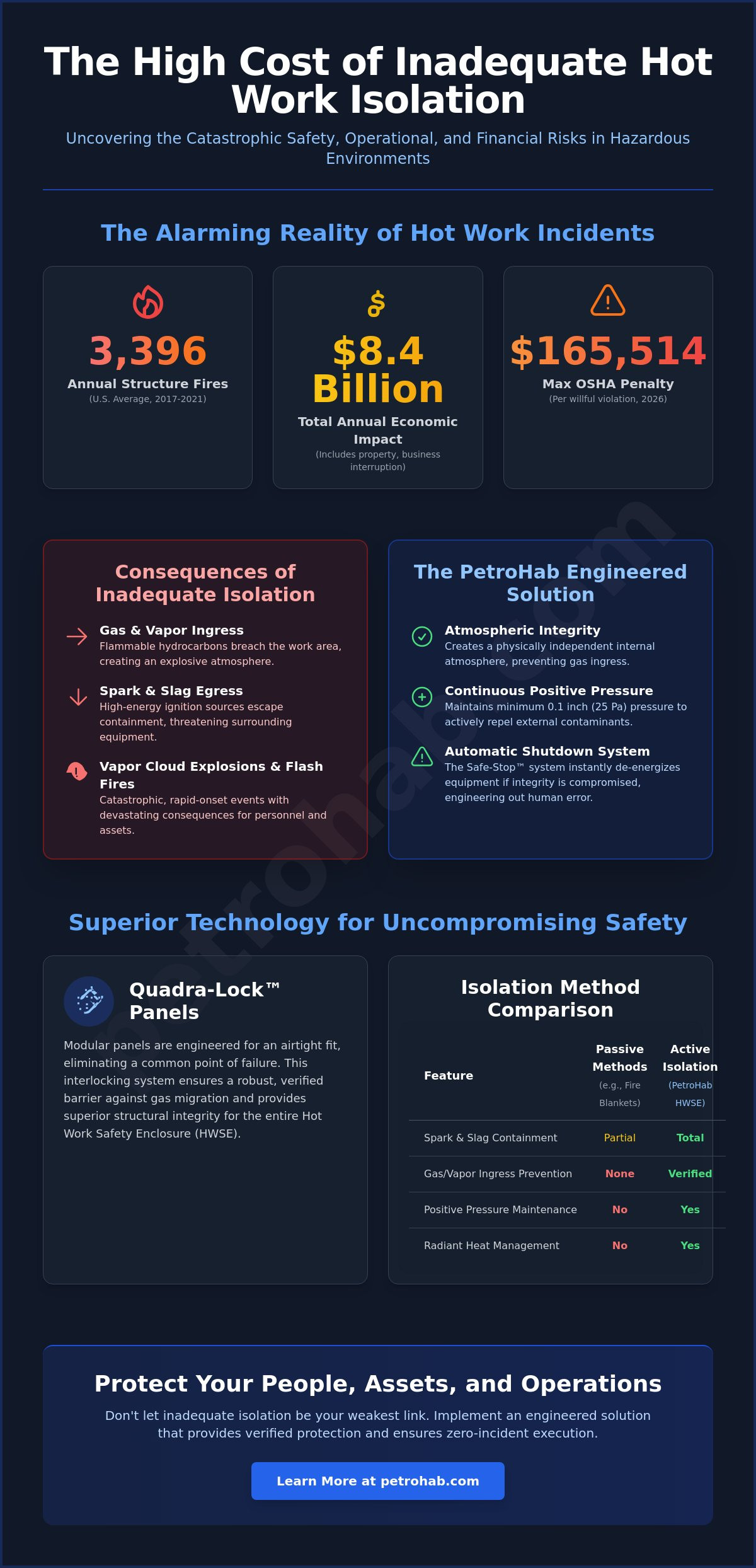
U.S. fire departments responded to an average of 3,396 structure fires involving hot work annually between 2017 and 2021, resulting in 19 civilian deaths and $292 million in direct property damage. These statistics reveal that the consequences of inadequate hot work isolation are both physically catastrophic and financially ruinous. In 2026, OSHA has increased the maximum penalty for willful violations to $165,514, while the total economic impact of workplace fires has reached an estimated $8.4 billion annually. For safety managers and engineers, these figures represent more than just data; they are a call for uncompromising vigilance in hazardous environments.
It’s understood that the pressure to minimize downtime often conflicts with the complexity of maintaining international compliance standards. This article details the catastrophic safety, operational, and regulatory risks of failing to properly isolate hot work in hydrocarbon-rich zones. You’ll learn how to justify safety investments through a clear understanding of failure modes and how to verify compliance with the updated NFPA 51B documented permit requirements. We will also explore how the PetroHab LLC Hot Work Safety Enclosure (HWSE) and Quadra-Lock panels provide a definitive technological remedy to ensure zero-incident execution during live operations.
Key Takeaways
- Identify the critical failure modes where barrier integrity fails to manage hydrocarbon ingress or spark egress in hazardous environments.
- Evaluate the catastrophic physical consequences of inadequate hot work isolation, specifically regarding Vapor Cloud Explosions (VCE) and Flash Fires.
- Quantify the operational risks and massive financial fallout associated with unplanned facility shutdowns and the immediate cessation of hot work permits.
- Establish atmospheric integrity through the implementation of modular Quadra-Lock panels and continuous positive pressure maintenance.
- Leverage the PetroHab HWSE and Safe-Stop Automatic Shutdown System to engineer out human error and ensure the protection of personnel and high-value assets.
Defining Inadequate Hot Work Isolation in Hazardous Zones
Isolation constitutes the absolute physical and atmospheric separation between an ignition source and potentially explosive vapors. In high-risk sectors, Hot work requires more than a simple partition. It demands a verified barrier that prevents the ingress of hydrocarbons and the egress of high-energy sparks. The consequences of inadequate hot work isolation typically stem from a failure to maintain this boundary, turning a routine maintenance task into a significant site risk.
To better understand the high-stakes nature of safety and the human factor in industrial environments, watch this presentation:
The industry distinction between passive and active isolation is critical. Passive methods like fire blankets provide a degree of spark protection but fail to address gas migration or radiant heat. Active isolation, facilitated by a pressurized PetroHab LLC Hot Work Safety Enclosure (HWSE), creates an internal atmosphere that’s physically independent of the surrounding hazardous zone. By 2026, operating in ATEX Zone 1 or 2 environments requires this active displacement to meet modern safety benchmarks.
The Mechanics of Isolation Failure
Habitat integrity relies on the technical precision of the enclosure components. Breaches often occur due to poor panel interlocking, which is why the Quadra-Lock system is engineered for an airtight fit. Failure to maintain the required 0.1 inch (25 Pa) of water gauge pressure allows external vapors to seep through gaps around penetrations like pipes or structural beams. Without constant monitoring, these minor leaks compromise the entire safety protocol.
Identifying High-Risk Igniters
High-energy sparks and molten slag are mobile threats that can travel long distances in industrial settings. Inadequate isolation fails to contain these igniters, allowing them to reach combustible materials outside the immediate work area. Radiant heat impingement also presents a risk, as it can elevate the temperature of nearby process equipment toward its auto-ignition point. If the enclosure’s integrity is lost, even non-intrinsically safe equipment inside becomes a potential trigger for an event.
Catastrophic Physical Consequences: Fire, Explosion, and Gas Ingress
The consequences of inadequate hot work isolation extend far beyond a localized spark. When a barrier fails, the ingress of flammable vapors into an area with an active ignition source creates the perfect conditions for a Flash Fire. Unlike a sustained blaze, a flash fire moves with incredible speed through a gas cloud, consuming oxygen and threatening anyone within its path. This risk is amplified in confined offshore spaces where escape routes are limited. Maintaining a pressurized environment with systems from PetroHab LLC is the primary defense against these rapid-onset disasters.
In vertical structures, the “chimney effect” presents a unique danger. Sparks and molten slag can migrate through structural openings, igniting materials on lower decks. This vertical migration often bypasses standard floor protection, leading to fires in areas considered remote from the work site. Simultaneously, inadequate ventilation within a breached enclosure leads to the rapid buildup of toxic fumes. Smoke inhalation can incapacitate personnel before they can react to an ignition event, making atmospheric integrity a dual-purpose safety requirement for both fire prevention and worker health.
Hydrocarbon Ignition and Vapor Cloud Risks
Inadequate isolation allows gas to breach the perimeter and reach the welding arc. Continuous Lower Explosive Limit (LEL) monitoring is essential to detect ingress before ignition occurs. In live refinery turnarounds, even a minor release can reach its flash point upon contact with high-temperature surfaces or open flames, triggering a chain reaction. Following OSHA hot work regulations ensures that these atmospheric risks are managed through rigorous site preparation and monitoring protocols that detect failures before they become catastrophic.
Thermal Expansion and Secondary Asset Failure
Heat impingement from an uncontained arc can cause the structural weakening of nearby pressurized lines. This thermal stress often leads to seal failure in valves and flanges, resulting in secondary chemical releases that fuel existing fires. Molten slag, which can retain heat for several minutes, poses a significant threat to high-value subsea cables or deck equipment. The consequences of inadequate hot work isolation manifest clearly when these secondary failures lead to total asset loss. Utilizing a pressurized welding enclosure from PetroHab LLC effectively traps these high-temperature particles, preventing secondary asset damage and ensuring the integrity of the facility’s process equipment.
Operational and Financial Fallout of Safety Breaches
The immediate aftermath of a containment breach is characterized by total operational paralysis. When a near miss or ignition event occurs, facility management typically enforces an immediate cessation of all hot work permits across the entire site. This reactive measure is necessary for incident investigation, yet it triggers a cascade of financial losses that are difficult to mitigate. The consequences of inadequate hot work isolation extend far beyond the immediate physical damage, impacting the very viability of the project. Adhering to established Hot Work Policies & Procedures is not merely a safety requirement; it’s a financial imperative for maintaining operational continuity.
Downtime and Production Loss
Unplanned shutdowns represent the most significant financial risk in heavy industry. In 2026, the hourly cost of a total platform shutdown averages $250,000 in lost revenue. For high-output offshore energy sectors, this figure can escalate to $416,000 per hour based on current industry benchmarks. These numbers don’t account for the ripple effect on multi-vessel offshore projects. A single isolation failure on a central platform can idle an entire fleet of support vessels, each accruing its own daily standing charges. Contractual penalties for project delays often exceed the direct costs of the repair itself. Every hour spent in investigation is an hour of lost production that can never be recovered. Safety managers must view isolation as a tool for production uptime, not just a line item in the safety budget.
Regulatory Sanctions and Legal Liability
Regulatory bodies like OSHA and BSEE have expanded their inspection capacity in 2026. As of January 2026, a single serious violation can result in a fine of up to $16,550. If the failure to deploy a proper hot work safety enclosure is deemed a willful or repeated violation, the penalty surges to $165,514 per instance. Beyond immediate fines, the long-term damage to a company’s Total Recordable Incident Rate (TRIR) can lead to the loss of future contracts and disqualification from bidding on major tenders. Non-compliance with hazardous environment standards also complicates insurance claims. Carriers often scrutinize the technical integrity of isolation barriers before approving payouts following an incident. In the most severe cases involving fatalities, safety managers face criminal negligence risks. Meticulous documentation and technical precision are the only defenses against these legal liabilities.
Technical Requirements for Adequate Isolation Integrity
Technical isolation requires a fundamental shift from passive shielding to active atmospheric control. The consequences of inadequate hot work isolation in oil and gas environments are too severe to rely on fire-retardant blankets alone. Effective isolation demands a pressurized environment that physically excludes flammable vapors while containing all sparks and slag. This proactive approach transforms the work area into a controlled environment, even within high-risk ATEX zones. It’s the only way to ensure operational safety during live production.
Modern safety protocols require a combination of physical barriers and electronic safeguards. Systems must utilize fire-retardant, modular panels featuring secure interlocking mechanisms to prevent gaps. Redundant gas detection is a non-negotiable technical requirement. Sensors must be placed at both the air intake and within the work zone to provide immediate alerts. Deploying advanced hot work safety systems automates the isolation process, removing the variability of manual monitoring and human error.
The Role of Positive Pressure
Constant overpressure acts as the primary defense against gas ingress. By maintaining an internal pressure higher than the external atmosphere, the enclosure creates a physical outflow that repels hydrocarbons. Safety teams must monitor pressure differentials continuously to detect early isolation failure before it escalates into an ignition event. A manometer provides a real-time visual validation of habitat integrity by measuring the precise pressure delta between the work area and the hazardous zone. If pressure drops below the 0.1 inch (25 Pa) threshold, the system must respond instantly to mitigate the risk.
Modular Integrity with Quadra-Lock Technology
Traditional habitats often suffer from “weak links” at the panel joints where heat or gas can bypass the barrier. The Quadra-Lock system eliminates these vulnerabilities through a proprietary interlocking design that ensures airtight integrity. These panels use specialized fire-resistant materials that exceed the current NFPA 51B standards for fire prevention during hot work. Superior sealing at every junction effectively prevents the ‘chimney effect’ noted in offshore structures; it ensures that hot particles remain trapped within the enclosure. This level of engineering precision is what separates a certified safety solution from a makeshift barrier.
Protect your assets and personnel with the industry’s most reliable pressurized welding enclosures from PetroHab.
The PetroHab Solution: Engineering Out Inadequacy
Engineering out the consequences of inadequate hot work isolation requires a shift from manual oversight to automated, fail-safe technology. The PetroHab Hot Work Safety Enclosure (HWSE) serves as the industry benchmark for modular isolation in high-stakes environments. It isn’t just a barrier; it’s a comprehensive risk mitigation system designed to protect personnel and high-value assets. By integrating physical containment with electronic surveillance, PetroHab ensures that refinery turnarounds remain zero-incident events. This system provides the reliability that safety managers demand when operating in proximity to live hydrocarbon streams.
PetroHab maintains a global network of certified technicians available for onsite setup and supervision. These experts ensure that every enclosure is commissioned according to the highest technical standards. Having a seasoned professional oversee the installation guarantees that the habitat remains a definitive technological remedy throughout the project’s duration. It’s this commitment to technical precision that allows for safe hot work execution without the need for costly facility shutdowns.
Safe-Stop Automatic Shutdown Integration
Isolation failure response times are critical. While human monitors might take several seconds to react to a breach, the Safe-Stop Automatic Shutdown System reduces that window to milliseconds. This system provides an immediate, automated response by cutting power to welding machines and closing gas solenoids the moment isolation is compromised. Whether the trigger is a loss of internal positive pressure or the detection of hazardous gases at the air intake, Safe-Stop acts as an active guardian of the site. This peace of mind is backed by ATEX and IECEx certified monitoring components, ensuring reliability in the world’s most volatile atmospheres. It eliminates the human error factor that often leads to catastrophic ignition events.
Custom Engineering for Complex Geometries
Industrial sites rarely consist of flat surfaces and simple right angles. Maintaining isolation around complex piping, bulkheads, and irregular offshore structures requires a flexible yet uncompromising solution. PetroHab technicians utilize modular panels to adapt the HWSE to these specific geometries without sacrificing atmospheric integrity. Secure sealing around structural penetrations prevents spark egress and gas ingress in even the most challenging layouts. This adaptability ensures that the ‘chimney effect’ is completely neutralized, even in vertical offshore deck configurations. Contact PetroHab to secure your next project with Quadra-Lock technology.
By choosing an integrated solution that combines Quadra-Lock panels with the Safe-Stop system, safety managers can focus on operational excellence. PetroHab manages the granular details of environmental containment, ensuring that every hot work permit is executed with the highest level of protection. It’s a partnership defined by competence, meticulousness, and a shared sense of duty to protect the workforce.
Securing the Future of Hazardous Site Operations
Maintaining operational continuity in hydrocarbon-rich zones requires a transition from reactive safety measures to proactive engineering controls. The consequences of inadequate hot work isolation extend beyond immediate physical hazards; they threaten the long-term financial and regulatory standing of your organization. By implementing active containment solutions, you replace the uncertainty of manual oversight with the precision of automated protection. It’s no longer enough to rely on passive barriers when the technology exists to engineer out the risk of ignition entirely.
PetroHab provides the definitive technological remedy through our patented Quadra-Lock technology and ATEX and IECEx certified Safe-Stop systems. Our global technical support teams are available to ensure your site operations meet the most stringent international standards for environmental containment. Protect your personnel and high-value assets by choosing a partner dedicated to zero-incident execution in the world’s most demanding environments.
Request a Quote for PetroHab Hot Work Safety Enclosures to fortify your next maintenance project against uncontrolled ignition risks. We’re committed to helping you lead the industry in risk mitigation and operational reliability.
Frequently Asked Questions
What is the most common cause of hot work isolation failure?
The most common cause of isolation failure is the loss of atmospheric integrity through breaches in the enclosure’s physical structure. These breaches typically occur at panel junctions or around structural penetrations where seals are insufficient. When seals fail, the habitat cannot maintain the overpressure necessary to repel external hydrocarbons. This compromise allows flammable vapors to enter the work area, creating an immediate ignition risk.
Can fire blankets replace a pressurized hot work safety enclosure?
Fire blankets cannot replace a pressurized hot work safety enclosure because they offer only passive protection. While blankets may deflect some sparks, they provide zero defense against gas ingress or radiant heat buildup. Active isolation through a PetroHab HWSE is the only way to manage environmental risks in ATEX Zone 1 or 2 areas. Pressurization creates a dynamic barrier that passive materials simply cannot replicate.
How much positive pressure is required for safe welding in a habitat?
Safe welding operations require the maintenance of at least 0.1 inch (25 Pa) of water gauge pressure within the enclosure. This specific pressure delta ensures that the internal atmosphere remains higher than the external environment, creating a physical outflow of air. Continuous monitoring via a manometer is essential to validate that this barrier remains intact. If pressure drops below this threshold, the integrity of the isolation is considered compromised.
What happens if gas is detected near the hot work habitat air intake?
Detection of gas at the air intake triggers an immediate, automated shutdown of all hot work activities. The Safe-Stop Automatic Shutdown System de-energizes welding equipment and closes fuel lines in milliseconds to ensure that no ignition source remains active. This rapid response is critical to prevent the intake fan from drawing flammable vapors into the pressurized habitat. It removes the ignition threat before the gas can reach the work zone.
Does OSHA require a pressurized habitat for all offshore welding?
OSHA standards don’t explicitly mandate a pressurized habitat for every offshore weld, but they do require the total elimination of fire hazards. In hydrocarbon-rich environments, failure to use a pressurized enclosure often leads to non-compliance with fire prevention regulations. Utilizing an HWSE is the industry benchmark for meeting the rigorous safety expectations of both OSHA and BSEE. It provides a documented, technical solution for risk mitigation.
How does the Safe-Stop system prevent ignition during an isolation breach?
The Safe-Stop system prevents ignition by removing the human error factor from the emergency response chain. It monitors both internal pressure and external gas levels, automatically killing power to the welding arc if a breach is detected. This automation is the most effective way to avoid the catastrophic consequences of inadequate hot work isolation during live production. It ensures the ignition source is neutralized before flammable gases can accumulate.
What are the specific NFPA 51B requirements for hot work isolation?
NFPA 51B requires that all hot work be documented and that ignition sources be isolated from flammable materials within a 35-foot radius. The 2024 edition emphasizes the use of fire-retardant barriers designed to contain sparks and slag effectively. It also mandates that these barriers be inspected to ensure they are free of gaps or openings. Compliance requires a combination of physical shielding and rigorous administrative controls to prevent fire spread.
How do Quadra-Lock panels improve safety compared to standard welding tents?
Quadra-Lock panels provide a superior seal through a proprietary interlocking mechanism that eliminates the gaps found in traditional welding tents. Standard tents rely on overlapping fabrics that frequently fail to maintain the necessary positive pressure. Quadra-Lock technology ensures an airtight, modular structure that withstands the high-pressure requirements of hazardous environment isolation. This engineering precision prevents the consequences of inadequate hot work isolation by maintaining a consistent atmospheric barrier.