
Blog Posts
Troubleshooting Habitat Pressure Fluctuations: A Technical Guide for HWSE Operators
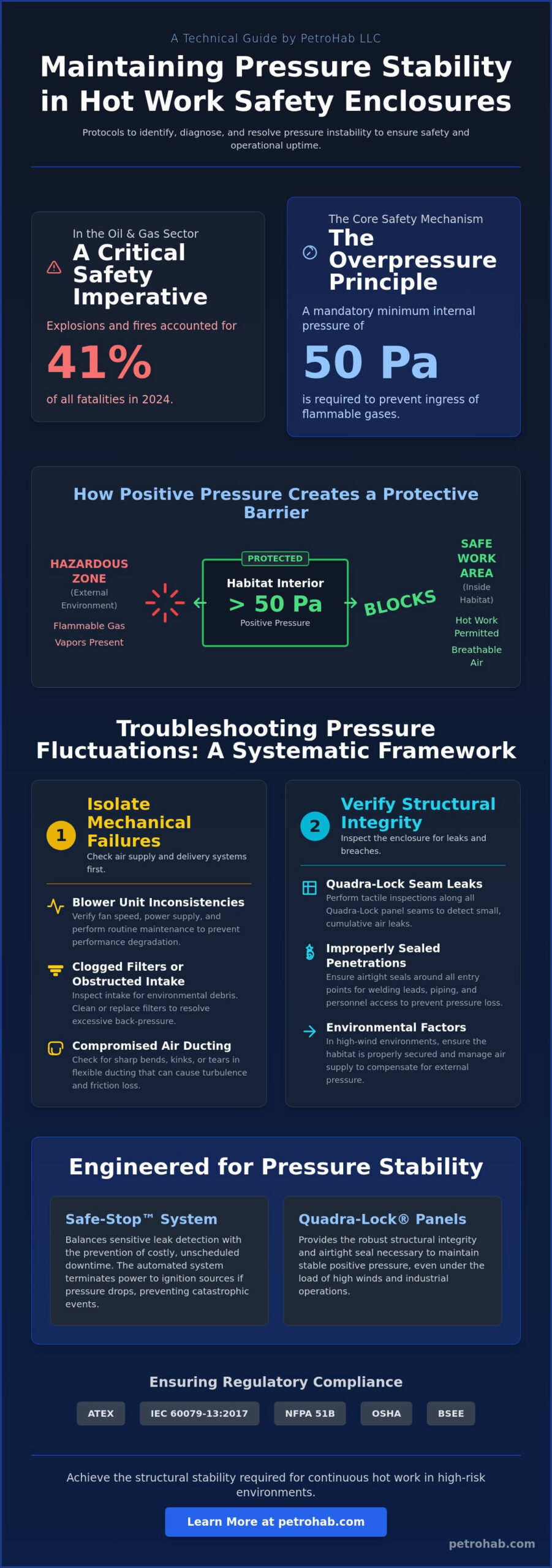
In 2024, explosions and fires accounted for 41% of fatalities in the oil and gas exploration sector. This stark reality underscores why maintaining a constant positive pressure of 50 Pascals within your pressurized habitat isn’t just a regulatory checkbox for ATEX or NFPA 51B compliance; it’s a critical life-safety requirement. When you’re troubleshooting habitat pressure fluctuations, the difference between a minor adjustment and a costly, unscheduled shutdown often comes down to technical precision. You understand that inconsistent manometer readings or a loss of pressure doesn’t just delay hot work. It puts personnel and high-value assets at risk.
This technical guide provides the protocols necessary to identify, diagnose, and resolve pressure instability within your Hot Work Safety Enclosure. We’ll move beyond basic fan speed adjustments to address the structural integrity of Quadra-Lock panels and the active monitoring capabilities of the Safe-Stop system. You’ll learn how to isolate small leaks in modular components and manage air supply management in high-wind environments. By the end of this article, you’ll have the expert knowledge required to maintain a stable, pressurized environment that meets BSEE and IEC 60079-13:2017 standards without compromising operational uptime.
Key Takeaways
- Define the overpressure principle to maintain the mandatory 50 Pascal barrier required for hazardous zone compliance.
- Implement a rigorous two-step framework for troubleshooting habitat pressure fluctuations that isolates mechanical failure from structural integrity issues.
- Execute precise manometer calibration and tactile inspections of Quadra-Lock seams to ensure an airtight environment.
- Configure the Safe-Stop Automatic Shutdown System to balance sensitive leak detection with the prevention of costly, unscheduled downtime.
- Leverage engineered PetroHab solutions to achieve the structural stability required for continuous hot work in high-risk environments.
The Criticality of Maintaining Habitat Pressure in Hazardous Zones
A Hot Work Safety Enclosure (HWSE) functions as a controlled micro-environment within a potentially explosive atmosphere. The core mechanism of this protection is the maintenance of a positive pressure enclosure. This means the internal air pressure is kept at a higher level than the surrounding atmospheric pressure, typically at a minimum of 50 Pascals. By creating this differential, the system ensures that any air movement occurs from the inside out, effectively preventing the ingress of flammable gases or vapors that may be present in Zone 1 or Zone 2 areas.
Maintaining this overpressure principle isn’t a suggestion; it’s a non-negotiable safety protocol. If the differential drops below the established threshold, the barrier fails. Operators tasked with troubleshooting habitat pressure fluctuations must recognize that even a momentary loss of pressure compromises the integrity of the entire site. It triggers an immediate work cessation protocol to prevent ignition sources from coming into contact with hazardous atmospheres.
To better understand this concept, watch this helpful video:
The consequences of a pressure breach are absolute. Most automated systems, such as the Safe-Stop, will immediately terminate power to welding equipment and ignition sources. This isn’t a nuisance trip; it’s a calculated response to prevent a catastrophic ignition event. Operators must approach the task of troubleshooting habitat pressure fluctuations with a focus on both mechanical performance and structural integrity to avoid these costly disruptions.
The Physics of Environmental Containment
Differential pressure works by establishing a kinetic barrier. As long as the internal pressure remains higher than the external environment, gas molecules cannot enter the enclosure. This is supplemented by high Air Changes Per Hour (ACPH), which flushes out welding fumes and heat while ensuring a constant supply of breathable air for personnel. The structural integrity of Quadra-Lock panels is vital here, as they provide the airtight seal necessary to maintain these physics under load. Positive pressure maintenance is the primary safeguard against Zone 1 hazards.
Regulatory Requirements for Pressure Stability
Compliance with NFPA 51B and OSHA standards requires rigorous monitoring of these pressure levels. International certifications like ATEX and IEC 60079-13:2017 mandate specific safety margins to account for environmental variables like wind or structural movement. These pressure readings are integrated directly into the Permit-to-Work (PTW) system, ensuring that hot work only proceeds when the habitat is verified as secure. For more detailed information on meeting these benchmarks, consult our guide on Hazardous Environment Standards. Rigorous adherence to these standards ensures that site safety isn’t left to chance but is instead managed through engineered reliability.
Common Causes of Habitat Pressure Fluctuations
Identifying the root cause of pressure loss is the first step in maintaining operational continuity. While a sudden drop often points to a mechanical failure, subtle variances are frequently the result of cumulative minor issues. Effective troubleshooting habitat pressure fluctuations involves a meticulous audit of the entire pressurized system, from the intake point to the enclosure seams. These variables must be addressed systematically to prevent the Safe-Stop system from initiating a shutdown.
Mechanical inconsistencies in the blower units or air intake often stem from neglected maintenance or environmental debris. Clogged filters or obstructed ducting create excessive back-pressure, reducing the volume of air delivered to the habitat. Sharp bends in the flexible ducting further exacerbate this issue by causing turbulence and friction loss. Additionally, improperly sealed penetration points for welding leads, gas lines, or piping allow pressurized air to escape. This forces the system to work harder to maintain the 50 Pascal threshold, leaving no margin for error if external conditions change.
Structural Integrity and Seal Failure
Structural breaches are a primary source of instability. In modular habitats, micro-leaks often occur at panel junctions where seal integrity has been compromised by age or physical wear. Traditional enclosure systems relying on worn velcro or degraded gaskets are prone to these failures, especially during heavy use. To mitigate these risks, Quadra-Lock Panels utilize a patented interlocking design that creates a superior mechanical seal. This engineering minimizes structural leakage, ensuring that the overpressure remains consistent even as the enclosure is subjected to internal movement or external stress.
External Environmental Factors
Environmental conditions, particularly on offshore platforms, introduce significant variables into the pressure equation. High-velocity winds blowing across the habitat can create a Venturi effect, effectively pulling air out of the enclosure and causing the manometer to register a drop. These fluctuations can lead to nuisance trips if the safety system is not calibrated to the environmental context. Adhering to the IEC 60079-13 standard requires that operators account for these atmospheric changes when setting their safety parameters. Shielding air intakes from direct wind turbulence and ensuring the manometer zero-point is calibrated to the local environment are essential strategies. If your site frequently experiences these challenges, you can consult with a PetroHab specialist to review your specific enclosure configuration and optimize your pressure stability.
Structural vs. Mechanical Troubleshooting Framework
Effective troubleshooting habitat pressure fluctuations requires a binary diagnostic approach. Operators must distinguish between a failure in the structural envelope and a deficiency in the mechanical air delivery system. This structured framework ensures that resources aren’t wasted on structural repairs when the root cause is a mechanical bottleneck, or vice versa. By following a logical sequence, you can isolate variables and restore pressure stability with minimal downtime.
- Verify manometer accuracy. Begin by checking the zero-point calibration to ensure the reading reflects actual internal conditions rather than instrument drift.
- Inspect Quadra-Lock seams. Perform a visual and tactile audit of all panel connections, focusing on areas where the enclosure meets existing site infrastructure.
- Evaluate blower performance. Monitor motor RPM and verify that intake filters are free from obstruction or moisture saturation.
- Audit air ducting. Trace the entire line to identify kinks, collapses, or internal debris that restrict airflow and increase back-pressure.
- Assess Safe-Stop integration. Determine if the pressure drop is an actual environmental event or a sensor calibration fault within the shutdown logic.
Structural Inspection: The Quadra-Lock Advantage
Structural integrity is the foundation of pressure stability. To identify elusive escape points, operators should employ the “smoke puff” test at panel junctions and floor seals. This method reveals micro-leaks that visual inspections might miss. When adjustments are necessary, the specific design of Quadra-Lock panels allows for precise tightening of connectors. Operators must ensure these are secure to maintain compliance with NORSOK standards, which define the safety benchmarks for offshore pressurized habitats. You must avoid over-stressing the fabric; the goal is a consistent mechanical seal that withstands the pressure differential without compromising material longevity. Ensuring that pipe penetrations are airtight is equally critical, as these are common failure points in complex industrial geometries.
Mechanical Diagnostics for Blower Units
If the structural envelope is verified as airtight, the focus must shift to mechanical delivery. Inconsistent power supply to electric blowers can cause RPM fluctuations, leading to erratic pressure readings. You should inspect the impeller for signs of wear or fatigue that could reduce aerodynamic efficiency. Regular maintenance of spark arrestors and intake filters is mandatory. A partially blocked spark arrestor increases resistance, forcing the motor to consume more power while delivering less air. This mechanical strain often manifests as a slow, progressive decline in habitat pressure. By isolating these mechanical variables, operators can resolve issues before they trigger an automatic shutdown, ensuring the HWSE remains a reliable guardian of site safety and personnel.
Calibrating the Safe-Stop Automatic Shutdown System
The Safe-Stop Automatic Shutdown System functions as the technical core of the habitat’s safety architecture. It continuously interprets data from internal manometers to ensure the 50 Pascal pressure differential is maintained. When you are troubleshooting habitat pressure fluctuations, it’s necessary to understand the interaction between these sensors and the system’s logic. If the internal pressure drops below the programmed safety threshold, the Safe-Stop immediately terminates power to the welding equipment. This prevents ignition sources from existing in a compromised environment. Proper calibration ensures that the system responds to genuine hazards while minimizing the risk of nuisance trips that disrupt production.
Sensor drift and signal interference are common challenges in high-EMI environments, such as offshore platforms with heavy electrical loads. Electrical noise can distort the low-voltage signals sent to the control unit, leading to erratic pressure readings. Operators must verify that all sensors are calibrated to a certified reference point and that the signal cables are properly shielded. Ensuring the Safe-Stop logic is correctly integrated with the welding power source is the final step in establishing a fail-safe environment. This integration must be tested regularly to confirm that the shutdown relay activates instantaneously upon pressure loss.
Sensor Placement and Signal Integrity
The accuracy of your pressure data depends heavily on sensor placement. Installing sensors in “dead zones” or near turbulent air intakes will result in inconsistent readings. You must position sensors in areas of stable, laminar airflow to capture a representative measurement of the enclosure’s internal pressure. Protecting signal cables from mechanical damage and electrical interference is also vital for maintaining system reliability. For more information on optimizing these configurations, consult our guide on Advanced Hot Work Safety Systems.
Emergency Response to Pressure Loss Alarms
Operators must distinguish between a low-pressure warning and an automatic shutdown event. A warning allows for immediate intervention, such as checking Quadra-Lock panel connectors for minor leaks. However, an automatic shutdown requires a full stop of all hot work. After resolving the cause of the pressure loss, the habitat must be re-pressurized and stabilized. A mandatory 5-minute purge cycle must be completed before resuming hot work to ensure any potential flammable gases are fully evacuated from the enclosure. If your system requires technical calibration or onsite support, contact the PetroHab engineering team to ensure your site remains compliant and secure.
The PetroHab Solution: Engineered for Pressure Stability
Achieving operational excellence in hazardous zones requires more than just reactive maintenance. It demands a system engineered to withstand the volatile conditions of heavy industry. PetroHab provides this through a synergy of structural integrity and automated control. While troubleshooting habitat pressure fluctuations is a necessary skill for operators, the PetroHab Hot Work Safety Enclosure (HWSE) is designed to minimize these occurrences through superior engineering. Our systems don’t just monitor risk; they actively mitigate it through proprietary technology that sets the industry benchmark for safety and reliability.
The Quadra-Lock Panels represent a significant advancement in environmental containment. Unlike standard modular enclosures that rely on high-wear fasteners, Quadra-Lock utilizes an interlocking design that creates a rigid, airtight barrier. This structural stability is essential in high-wind environments where traditional fabrics might flex and cause pressure drops. Additionally, PetroHab on-site supervision ensures that every enclosure is configured for maximum stability from the outset. Our technical experts identify potential pressure-loss variables during the assembly phase, preventing issues before they can impact your permit-to-work schedule.
The Safe-Stop system complements this structural strength with active monitoring. It acts as a rigorous guardian, governing the safety of the site with technical precision. For environments with extreme atmospheric variables, we offer customization options that include high-capacity blower units and reinforced ducting configurations. These enhancements ensure that your HWSE maintains the required overpressure regardless of external turbulence. This dual-layered approach, combining the mechanical seal of Quadra-Lock with the logic of Safe-Stop, ensures that your operations remain compliant with the strictest international safety standards.
Proprietary Technology and Reliability
The engineering behind Quadra-Lock interlocking panels is focused on eliminating the micro-leaks common in traditional systems. These panels are manufactured with fire-resistant materials certified to ANSI/FM 4950 standards, ensuring durability in the harshest environments. This technology has delivered field-proven performance in offshore platforms and refinery turnarounds globally. For a deeper understanding of how these components integrate into a complete safety solution, read our Definitive Guide to HWSE. Our commitment to innovation ensures that each component serves as a linguistic and technical anchor for quality and compliance.
Implementation and Support
Choosing between rental and purchase options allows safety managers to tailor their inventory to long-term pressure reliability needs. Regardless of the commercial model, the value of PetroHab certified training for habitat technicians cannot be overstated. Proper training ensures that your team can manage the granular details of industrial hazards with confidence. If you’re currently facing challenges with pressure instability or require a specialized enclosure configuration, you should request a technical consultation for your HWSE requirements. Partnering with an expert ensures that your site is protected by the most resilient equipment available in the energy sector today.
Securing Operational Continuity through Pressure Integrity
Maintaining a constant 50 Pascal differential is the cornerstone of hot work safety in hazardous environments. By distinguishing between structural breaches in the Quadra-Lock panels and mechanical failures in the blower units, operators can effectively avoid the costly downtime associated with unscheduled shutdowns. Precise calibration of the Safe-Stop automatic shutdown system ensures that protection remains active and reliable; this meticulous approach meets the rigorous demands of ATEX and IECEx certifications. Mastering the protocols for troubleshooting habitat pressure fluctuations transforms site safety from a manual observation into an engineered certainty.
Reliability in heavy industry is built on technical precision and an unwavering commitment to risk mitigation. Utilizing field-proven technologies provides the necessary defense against the unpredictable nature of offshore and refinery environments. If you require assistance with system configuration, sensor calibration, or onsite technician training, our engineering team is prepared to assist. Contact PetroHab for Expert HWSE Technical Support to ensure your operations remain compliant and secure. Your dedication to these rigorous safety standards is the most effective way to protect your personnel and high-value assets during critical hot work operations.
Frequently Asked Questions
What is the minimum required pressure for a hot work safety enclosure?
A minimum positive pressure of 50 Pascals is required to maintain compliance with international standards such as NFPA 51B and the 2026 ATEX Directive. This specific differential ensures that internal pressure remains higher than the surrounding atmosphere. It creates a physical barrier that prevents the ingress of flammable gases into the enclosure.
How do I identify a leak in my Quadra-Lock panels?
Identifying structural breaches involves a systematic visual and tactile audit of the panel junctions. Operators often use a “smoke puff” test at the seams of the Quadra-Lock panels to visualize air escape points. This method is the most effective way to pinpoint micro-leaks that aren’t immediately visible to the naked eye during a standard inspection.
Why does my Safe-Stop system keep tripping even when pressure looks stable?
Nuisance trips are often caused by sensor drift or electrical noise in high-EMI environments. When you’re troubleshooting habitat pressure fluctuations, check for turbulent air near the sensor intake or loose signal cable shielding. If the system detects rapid, millisecond-level drops that the manual manometer doesn’t show, the sensor placement may need adjustment to avoid “dead zones.”
Can high winds offshore cause pressure fluctuations inside the habitat?
Yes, high-velocity winds can create a Venturi effect that pulls air out of the enclosure. This atmospheric turbulence causes the internal pressure to oscillate, which may trigger automated alarms. Shielding the air intake and ensuring the habitat is structurally rigid with Quadra-Lock technology helps mitigate these environmental variables on offshore rigs.
How often should I calibrate the manometers in my pressurized habitat?
You should perform a zero-point calibration at the start of every shift to account for local atmospheric changes. A more comprehensive technical calibration should occur according to the project’s Permit-to-Work requirements or if the system shows signs of inaccuracy. Maintaining precise calibration is essential for preventing both safety breaches and unnecessary work stoppages.
What should I do if the blower motor fails during active welding?
The Safe-Stop system will automatically terminate power to all welding equipment the moment it detects a loss of overpressure. Personnel must immediately cease all hot work and evacuate the enclosure according to site safety protocols. Once the mechanical failure is resolved, a mandatory 5-minute purge cycle is required before operations can safely resume.
How does the Safe-Stop system integrate with gas detection?
The Safe-Stop system acts as an active guardian by monitoring both pressure and the presence of hazardous gases. If the integrated sensors detect flammable vapors at the air intake or within the enclosure, the system triggers an immediate shutdown. This integration ensures that ignition sources are neutralized before a hazardous atmosphere can reach the work area.
Are PetroHab habitats compatible with all ATEX zone requirements?
PetroHab habitats are engineered for use in Zone 1 and Zone 2 hazardous areas where explosive gas atmospheres may occur during normal operations. They aren’t designed for Zone 0 environments where such atmospheres are continuously present. This classification ensures that our equipment provides the highest level of protection in the high-stakes environments of refineries and offshore platforms.