Blog Posts
Welding Enclosure Safety Standards: The 2026 Guide to HWSE Compliance
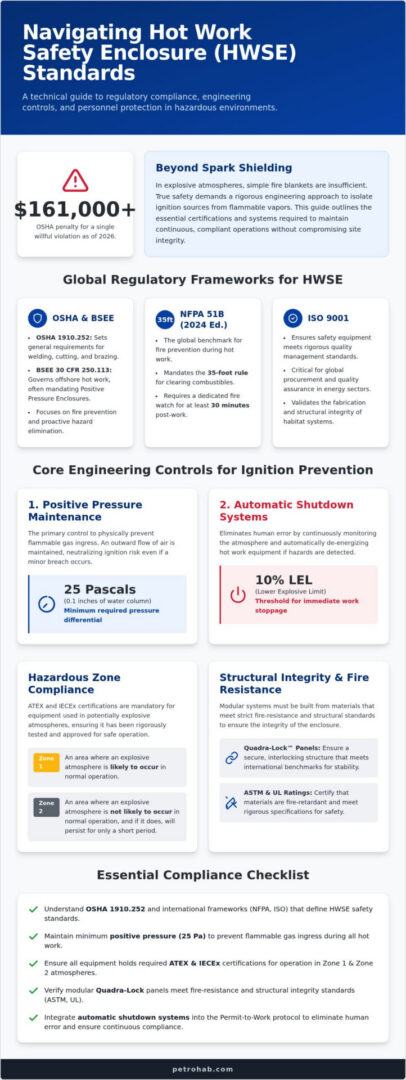
With OSHA penalties for willful violations exceeding $161,000 as of 2026, the cost of a single oversight in hot work safety is no longer just a line item on a risk assessment. It’s a definitive threat to your entire operation. You understand that shielding sparks isn’t enough when working in explosive atmospheres. Adhering to welding enclosure safety standards requires more than simple fire blankets; it demands a rigorous engineering approach to isolate ignition sources from flammable vapors effectively.
This guide provides the technical clarity you need to navigate the evolving regulatory landscape of Hot Work Safety Enclosures (HWSE). You’ll gain a definitive checklist of essential certifications like ATEX, IECEx, and NFPA 51B while learning why pressurized habitats are the only reliable defense against gas ingress. We’ll examine how modular systems utilizing Quadra-Lock panels and the Safe-Stop automatic shutdown system satisfy third party inspectors and protect your personnel in the most volatile environments. By the end of this guide, you’ll have the framework to maintain continuous operations without compromising site integrity or regulatory compliance.
Key Takeaways
- Understand the critical role of OSHA 1910.252 and international frameworks in defining current welding enclosure safety standards for hazardous environments.
- Learn the precise engineering requirements for maintaining positive pressure to prevent flammable gas ingress during hot work.
- Identify the specific ATEX and IECEx certifications required to operate safely within Zone 1 and Zone 2 explosive atmospheres.
- Evaluate the fire-resistance and structural integrity standards, including ASTM and UL ratings, that govern modular Quadra-Lock panels.
- Discover how integrating Safe-Stop automatic shutdown systems into your Permit-to-Work protocol eliminates human error and ensures continuous compliance.
Global Regulatory Frameworks for Hot Work Safety Enclosures
An HWSE is an engineered containment system designed to isolate hot work activities from potentially explosive atmospheres. Under international safety law, these systems represent a shift from administrative controls to proactive hazard elimination. Adherence to welding enclosure safety standards is mandatory for operators in the oil, gas, and petrochemical sectors. OSHA 29 CFR 1910.252 establishes the general requirements for welding, cutting, and brazing, focusing on fire prevention and personnel protection. ANSI Z49.1 complements this by providing specific technical guidance for allied processes, ensuring that the engineering of the habitat meets the highest safety benchmarks.
For offshore energy projects, the Bureau of Safety and Environmental Enforcement (BSEE) regulates hot work under 30 CFR 250.113. These regulations often mandate the use of Positive Pressure Enclosures to ensure that flammable gases can’t enter the workspace. This technology provides a definitive remedy for maintenance tasks in hazardous zones where a full facility shutdown isn’t feasible. By maintaining a controlled micro-environment, these enclosures allow for critical infrastructure repairs without compromising the safety of the entire platform.
The NFPA 51B Standard: Fire Prevention During Hot Work
The 2024 edition of NFPA 51B remains the global benchmark for fire prevention. It mandates the 35-foot rule, which requires the relocation of all combustible materials within that radius. If relocation isn’t possible, you must use fire-resistant guards or enclosures like the PetroHab HWSE. Modern safety protocols integrate these enclosures directly into the Permit-to-Work (PTW) system. Key requirements under this standard include:
- Verification of enclosure integrity and pressure levels before work begins.
- Mandatory use of fire-retardant materials that meet ASTM and UL specifications.
- A dedicated fire watch maintained for at least 30 minutes after welding concludes to monitor for smoldering hazards.
ISO Compliance for Industrial Safety Habitats
ISO standards provide the framework for global procurement and quality assurance. Major energy companies prioritize ISO 9001 certification to ensure that safety equipment manufacturing meets rigorous quality management requirements. For the fabrication of habitats, ISO standards regarding fire-resistant textiles and protective equipment are critical. Utilizing modular systems with Quadra-Lock technology ensures that the structural integrity of the enclosure meets these international benchmarks. This level of compliance isn’t just about passing an audit; it’s about providing a reliable, engineered barrier that protects high-value assets and lives in high-stakes environments.
Pressurization and Gas Detection Technical Standards
Positive pressure is the primary engineering control for hot work in hazardous zones. By maintaining a higher internal pressure than the surrounding environment, the enclosure physically prevents the ingress of flammable gases. According to current welding enclosure safety standards, a minimum positive pressure of 0.1 inches of water column (25 Pascals) relative to the external atmosphere must be maintained at all times. This differential ensures that even if a minor breach occurs in the structure, the airflow moves outward, neutralizing the risk of an internal explosion.
While basic containment systems merely shield sparks, a pressurized habitat provides active ignition prevention. This requires a continuous supply of fresh, over-pressurized air. Industry standards dictate specific air change rates to prevent the accumulation of welding fumes while maintaining the required pressure barrier. Compliance with OSHA 29 CFR 1910.252 demands rigorous attention to these ventilation requirements to protect personnel from both fire hazards and respiratory risks. Failure to maintain these pressure thresholds can lead to immediate site shutdowns and severe regulatory penalties.
Mandatory Gas Detection and Monitoring Protocols
Continuous atmospheric testing is a non-negotiable component of HWSE operations. Regulatory frameworks require that hot work must cease immediately if the concentration of flammable vapors reaches 10% of the Lower Explosive Limit (LEL). To eliminate the risk of human error, modern safety protocols favor integrated hardware solutions. The Safe-Stop Automatic Shutdown System serves as the industry benchmark for this requirement. It monitors pressure levels and gas concentrations in real-time, automatically de-energizing welding equipment if a hazard is detected. This multi-gas monitoring typically includes sensors for H2S, O2, and CO, ensuring comprehensive environmental control within the Quadra-Lock panels.
Ventilation and Air Quality Standards
Maintaining breathable air quality inside the enclosure is as critical as preventing external gas ingress. Ventilation systems must include high-efficiency intake filtration and certified spark arrestors to prevent ignition sources from escaping the habitat. For a deeper technical analysis of these systems, consult our article on Pressurized Welding Habitats: The Definitive Guide to HWSE Technology. These systems ensure that welders operate in a controlled environment where toxic fumes are extracted and fresh air is replenished. If you are preparing for a safety audit, ensuring your ventilation hardware meets these specific welding enclosure safety standards is essential. For a reliable solution, consider integrating a PetroHab HWSE into your next maintenance project.
ATEX and IECEx Standards for Hazardous Zones
Operating in explosive atmospheres requires a rigorous understanding of area classifications. Zone 0 represents areas where explosive gas is present continuously. Zone 1 identifies locations where hazards are likely to occur during normal operations. Zone 2 covers areas where flammable concentrations are unlikely but possible during equipment failure. For safety managers, selecting a habitat that aligns with these classifications is the baseline for welding enclosure safety standards. The ATEX Directive 2014/34/EU mandates that equipment used in these environments must prevent ignition. While ATEX is a legal requirement in Europe, the IECEx system provides a global framework for conformity, ensuring equipment is safe for use in offshore platforms and refineries worldwide.
Compliance doesn’t end with the enclosure panels. Every electrical component within the habitat, from lighting to the Safe-Stop system, must adhere to these rigorous benchmarks. Aligning with the NFPA 51B Standard ensures that fire prevention protocols are as durable as the hardware itself. This dual focus on electrical safety and fire prevention is what distinguishes a professional HWSE from a basic containment shroud. In high-stakes environments, these certifications aren’t optional; they’re the linguistic anchors of your site’s safety integrity.
Equipment Marking and Certification Categories
Technical precision is vital when inspecting HWSE components. ATEX labels provide a specific code that identifies the equipment group, category, and type of protection. The “Ex” marking is the definitive signature of safety for electrical shutdown systems. It confirms the device won’t spark or reach temperatures capable of igniting the surrounding atmosphere. When assembling a habitat using Quadra-Lock panels, you must verify that the entire system, including the ventilation fans and gas sensors, meets the specific requirements of the designated zone. This meticulous approach prevents the introduction of ignition sources into potentially volatile areas.
Global Compliance and Certification Alignment
Safety engineers often face the challenge of bridging the gap between North American (NEC) and International (IEC) standards. While the NEC uses a Class and Division system, the IEC/ATEX Zone system is increasingly becoming the global preference for energy projects. Third party certification bodies like UL, CSA, and Intertek act as critical auditors in this process. They verify that the engineering behind the HWSE matches the theoretical safety claims. For a comprehensive look at how these regulations interact, read our guide on Hazardous Environment Standards: The 2026 Guide to Global Compliance and Hot Work Safety. Ensuring your equipment meets these welding enclosure safety standards is the only way to satisfy technical inspectors and maintain operational continuity in high-risk zones.
Fire Resistance and Structural Integrity Standards
High-performance habitats must withstand extreme thermal stress while maintaining mechanical stability. Compliance with welding enclosure safety standards hinges on the fire-resistance of the materials used. Standards like ASTM E84 for flame spread and smoke development ensure that the panels won’t contribute to a fire’s progression. UL 214 and NFPA 701 provide additional benchmarks for the flame propagation of textiles. These certifications prove that the enclosure acts as a definitive barrier, containing slag and sparks within the work area and preventing them from reaching external hazardous atmospheres.
Structural integrity is equally vital under pressurized conditions. As established in earlier sections, maintaining a constant pressure differential requires an enclosure that doesn’t leak or deform significantly. The frame and panels must resist the constant outward force of the over-pressurization without compromising the seal. If the structure fails, the positive pressure barrier vanishes. This allows hazardous gases to enter the workspace immediately. Engineering these systems requires a focus on panel interlocking and seam strength to ensure continuous protection for personnel and high-value assets.
Quadra-Lock Panels: Setting the Standard for Integrity
The technical advantage of patented Quadra-Lock technology lies in its interlocking design. These panels create a gas-tight seal without the use of hazardous adhesives or tapes. This is a critical safety feature. Adhesives can degrade or release toxic fumes when exposed to high welding temperatures. Quadra-Lock panels provide a mechanical connection that remains stable and reliable throughout the duration of the hot work. Their durability also supports multiple reuses, making them a sustainable and reliable choice for industrial sites that prioritize long-term safety and asset protection.
Slag and Spark Containment Requirements
Enclosures must pass rigorous testing protocols against molten metal splashes. These tests verify that the material won’t melt through or ignite when struck by high-temperature slag. Thermal insulation is another key requirement. The panels must prevent heat transfer to protect equipment located just outside the enclosure. Standardized testing for seam strength and tear resistance ensures the habitat remains intact even in high-wind offshore environments. For a system that meets every one of these welding enclosure safety standards, explore the technical capabilities of the PetroHab HWSE today.
Implementing a Compliant Hot Work Safety Program
Implementing a robust safety program requires more than just high-quality hardware. It demands a systematic integration of the HWSE into the facility’s Permit-to-Work (PTW) system. Before hot work begins, the safety lead must verify that the enclosure meets all applicable welding enclosure safety standards. This includes a verified leak test of the Quadra-Lock panels and a functional test of the Safe-Stop system. The PTW should explicitly outline the required pressure differential and the specific gas detection thresholds that will trigger an automatic shutdown, ensuring no ambiguity exists during high-stakes maintenance.
Training and competency are the pillars of a compliant program. Habitat technicians must demonstrate a deep understanding of the equipment’s operational limits. They aren’t just laborers; they’re safety-critical personnel responsible for environmental control. This includes the ability to interpret multi-gas sensor readings and perform emergency procedures if the system detects a breach or an atmospheric hazard. If the Safe-Stop system de-energizes the welding equipment, the technician must follow a pre-defined protocol to evacuate the habitat and investigate the source of the alarm before work can resume. There is no room for human error when working in Zone 1 or Zone 2 environments.
The Role of On-Site Supervision
Effective supervision ensures that engineering controls remain active throughout the work shift. A certified safety supervisor must monitor the pressure differential and LEL levels at regular intervals. These readings must be documented in a compliance log to provide a clear audit trail for third-party inspectors. The supervisor acts as the final authority on site, with the power to halt operations if the enclosure’s integrity is compromised or if environmental conditions shift beyond the certified safety parameters. This rigorous oversight is essential for maintaining site-wide compliance and protecting personnel.
Maintenance and Recertification Standards
Reliability depends on a rigorous maintenance schedule. Fire-resistant panels and monitoring hardware require routine inspection to detect signs of thermal fatigue or mechanical wear. Sensors must undergo periodic calibration to ensure accuracy in hazardous zones. You should establish clear criteria for retiring components that no longer meet structural or fire-retardant benchmarks. Maintaining these high welding enclosure safety standards is the only way to guarantee the long-term protection of your personnel and high-value assets. To ensure your next project is compliant, Consult with PetroHab’s safety experts today.
Achieving Absolute Compliance in Hazardous Environments
Maintaining site integrity in volatile atmospheres requires a transition from passive shielding to active engineering controls. You’ve seen how positive pressure habitats act as a definitive barrier against gas ingress. This protection is only as reliable as the certifications backing it. Adhering to welding enclosure safety standards ensures your facility meets the rigorous demands of ATEX and IECEx frameworks while satisfying third party inspectors. It’s a calculated approach to risk mitigation that keeps your operations moving forward.
By integrating patented Quadra-Lock Technology with automated monitoring systems like Safe-Stop, you eliminate the risks associated with manual fire watches and administrative delays. These systems are trusted by global energy leaders because they prioritize the protection of personnel and high-value assets without requiring facility shutdowns. Reliability is built through technical precision and an uncompromising commitment to international safety law. Your role as a safety guardian is supported by these definitive technological remedies.
Take the next step in securing your industrial site. Download our 2026 HWSE Compliance Checklist to verify your site’s preparedness and ensure your next project meets the highest benchmarks of safety excellence. You can operate with absolute confidence when your equipment is engineered for total control.
Frequently Asked Questions
Is a welding enclosure required by OSHA for all hot work?
No, but it’s required when combustibles can’t be moved 35 feet away from the work site. OSHA 29 CFR 1910.252 mandates fire-resistant guards or enclosures if relocation isn’t possible. In hazardous energy environments, these enclosures are the standard engineering control to prevent ignition. Failing to provide adequate protection can result in willful violation penalties exceeding $161,000. Using an HWSE ensures compliance when working in these restricted zones.
What is the difference between ATEX and IECEx for welding habitats?
ATEX is a mandatory European directive for equipment used in explosive atmospheres. IECEx is an international certification system that provides a common technical language for conformity. While ATEX is legally required in the EU, IECEx is often the preferred benchmark for offshore platforms in international waters. Both certifications ensure that HWSE components won’t ignite surrounding flammable gases. They provide the technical assurance safety managers need for high-stakes projects.
How does a pressurized habitat meet NFPA 51B standards?
Pressurized habitats satisfy NFPA 51B by providing an engineering control that isolates hot work from flammable materials. The 2024 edition emphasizes fire prevention during welding and cutting. By maintaining a positive pressure of 0.1 inches of water column, the habitat ensures that sparks and slag stay inside while preventing external vapors from entering. This satisfies the requirement for fire-resistant covers when relocation isn’t feasible for essential maintenance tasks.
Can welding enclosures be used in Zone 1 hazardous areas?
Yes, provided they’re specifically certified and pressurized. Zone 1 areas have a high probability of explosive atmospheres during normal operations. To operate safely, welding enclosure safety standards require the use of ATEX/IECEx certified components and an automatic shutdown system. The enclosure must maintain a constant pressure barrier to ensure that flammable concentrations stay below 10% of the Lower Explosive Limit (LEL) at all times. This prevents ignition in volatile environments.
What are the ventilation requirements for a welding enclosure?
Enclosures must provide a continuous supply of fresh air while maintaining over-pressurization. Standards require specific air change rates to extract toxic welding fumes and prevent heat buildup. Intake air must be sourced from a non-hazardous area and pass through certified spark arrestors and filtration systems. This dual-purpose ventilation protects the welder’s respiratory health while simultaneously serving as the primary engineering control against gas ingress into the pressurized workspace.
How often should gas detection systems in a habitat be calibrated?
Calibration intervals follow the manufacturer’s specifications and site-specific risk assessments. Typically, multi-gas sensors for H2S, O2, and CO require a bump test before every shift and full calibration at least every six months. In high-stakes industrial environments, the Safe-Stop system provides real-time monitoring. If a sensor drifts or fails, the system must automatically de-energize hot work equipment to prevent any potential ignition in a hazardous zone during maintenance operations.
What materials are approved for fire-resistant safety enclosures?
Approved materials must meet ASTM E84 and UL 214 standards for flame spread and smoke development. Panels like the Quadra-Lock system use advanced fire-retardant textiles designed to withstand molten slag and high-temperature sparks. These materials must provide thermal insulation to protect adjacent equipment. Using uncertified fire blankets or non-interlocking panels violates welding enclosure safety standards and increases the risk of structural failure during a high-heat thermal event.
What happens if a pressurized habitat loses positive pressure?
If internal pressure drops below 0.1 inches of water column, hot work must stop immediately. An integrated Safe-Stop Automatic Shutdown System will detect the pressure loss and de-energize all welding equipment. This prevents the ignition of any flammable gases that might enter the habitat during the breach. Personnel must evacuate and the supervisor must verify the integrity of the Quadra-Lock panels before the system can be safely restarted for work.