Blog Posts
Insurance Requirements for Hot Work in Hazardous Areas: A 2026 Risk Mitigation Guide
Regulatory compliance is merely the baseline for industrial safety; insurance-grade risk mitigation requires a far more rigorous approach to physical isolation. You likely understand the frustration of balancing critical maintenance with the complex insurance requirements for hot work in hazardous areas, especially when facing the threat of policy voidance or skyrocketing premiums. Navigating the overlapping demands of ATEX, IECEx, and OSHA protocols shouldn’t feel like a gamble with your facility’s liability. It’s a high-stakes environment where a single oversight can compromise your entire operation and the safety of your personnel.
This guide demonstrates how to satisfy even the most stringent insurance mandates by deploying advanced PetroHab Hot Work Safety Enclosures (HWSE) and integrated Safe-Stop systems. We’ll examine how utilizing Quadra-Lock panels and automated shutdown logic provides the definitive technological remedy needed to reduce liability. You’ll learn to maintain 100% safety compliance while minimizing facility downtime. This ensures your operations remain both protected and productive through 2026. By prioritizing engineered containment, you’ll secure the confidence of underwriters and protect your high-value assets from ignition risks.
Key Takeaways
- Understand why standard regulatory compliance is often insufficient for private underwriters and how adopting Best Available Technology protects your policy standing.
- Learn how to satisfy specific insurance requirements for hot work in hazardous areas by deploying pressurized PetroHab Hot Work Safety Enclosures.
- Examine the engineering logic of positive pressure and Quadra-Lock panels in preventing hydrocarbon ingress during high-risk maintenance operations.
- Discover how the Safe-Stop Automatic Shutdown System provides the automated safety logic necessary to reduce liability and prevent catastrophic ignition events.
- Integrate modular safety solutions into your Permit-to-Work workflow to ensure continuous compliance and minimize costly facility downtime.
The Financial and Operational Stakes of Hot Work in Hazardous Zones
Hot work encompasses welding, grinding, and thermal cutting operations that generate sparks, flames, or intense heat. In the volatile environments of oil and gas facilities, these activities act as a potential ignition source in the presence of flammable vapours. For a foundational perspective, reviewing a hot work safety overview clarifies why these tasks are strictly regulated. Insurers categorize hot work as a catastrophic risk because the proximity of high-energy ignition sources to hydrocarbon streams creates an environment where failure is not an option. This risk profile is the primary driver behind the rigid insurance requirements for hot work in hazardous areas.
To better understand this concept, watch this helpful video:
The financial stakes involve more than just the immediate cost of fire suppression or equipment replacement. Direct damage is often eclipsed by the indirect costs of business interruption and lost production during lengthy investigations and repairs. Insurance underwriters vet offshore and refinery safety protocols to ensure that risk mitigation is built into the physical infrastructure. They prioritize facilities that move beyond administrative controls toward engineered solutions that isolate the ignition source from the hazardous atmosphere. Demonstrating this level of control is essential for maintaining coverage and managing premiums.
Classifying Hazardous Areas (Zone 0, 1, and 2)
Hazardous area classification depends on the frequency and duration of explosive gas or dust atmospheres. Zone 0 represents a continuous hazard, whereas Zone 1 identifies areas where an explosive atmosphere is likely to occur during normal operation. Insurance requirements for hot work in hazardous areas tighten significantly as the risk profile shifts from Zone 2 to Zone 1, necessitating more robust containment and monitoring systems. Higher hazardous zone classifications directly correlate to increased insurance premiums due to the elevated probability of a catastrophic loss event.
The Consequences of Non-Compliance
Non-compliance with underwriter mandates can result in total policy voidance under gross negligence clauses. If an incident occurs and the operator hasn’t utilized recognized safety technology like pressurized habitats, the insurer may legally refuse to pay the claim. This creates a ripple effect that damages future insurability and corporate reputation within the global energy sector. Legal liability also extends to heavy regulatory fines from OSHA or international equivalents, proving that the cost of compliance is always lower than the price of a failure.
Navigating Regulatory Compliance vs. Insurance Underwriter Expectations
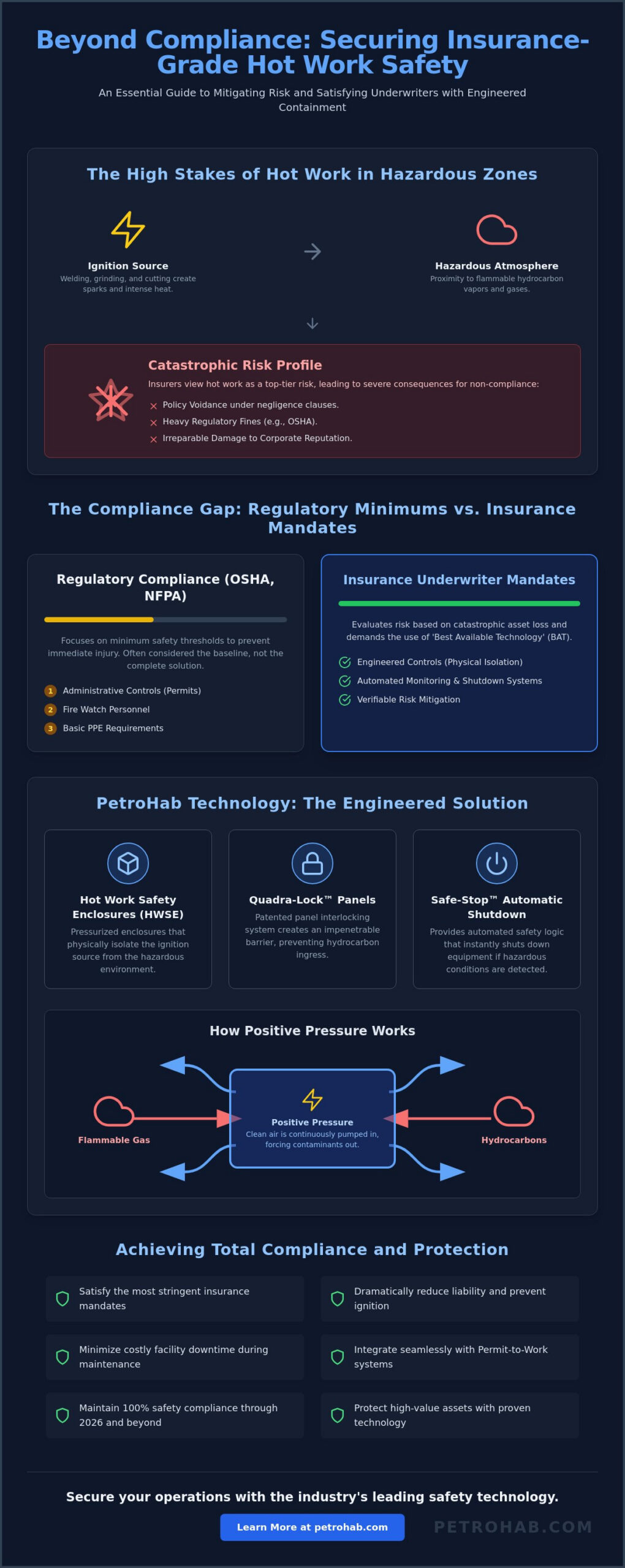
Meeting mandatory OSHA hot work regulations and NFPA 51B standards is a legal necessity, but it rarely satisfies the exhaustive insurance requirements for hot work in hazardous areas. While regulators focus on minimum safety thresholds to prevent immediate injury, private insurers evaluate risk through the lens of catastrophic asset loss and business interruption. They demand more than just a fire watch and a paper permit. Underwriters frequently look for the implementation of hazardous environment standards that exceed local laws; they often require the use of ‘Best Available Technology’ (BAT) to isolate high-energy ignition sources from volatile atmospheres.
Underwriters use the BAT principle to determine if an operator has taken every reasonable step to prevent a loss. If a pressurized Hot Work Safety Enclosure (HWSE) is available but the operator chooses to rely solely on administrative controls, the insurer may view this as an unacceptable risk profile. This gap between ‘legal compliance’ and ‘insurability’ is where many maintenance projects face delays. You must demonstrate documented, repeatable safety processes during annual audits to prove that your risk mitigation strategies align with the physical reality of the site. High-quality documentation serves as the primary evidence that your facility maintains operational control over its hazardous zones.
Global Standards: ATEX, IECEx, and NFPA
The intersection of equipment certification and operational insurance is critical for multinational energy firms. Insurers prioritize ATEX-certified components in pressurized habitats because these certifications provide a verified benchmark for ignition prevention. Using IECEx or ATEX-certified systems ensures that the equipment itself won’t become a hazard if the external atmosphere changes. Standardizing safety across international borders allows firms to maintain consistent policy terms regardless of the specific jurisdiction. This global consistency simplifies the underwriting process and helps secure more favorable premium structures for offshore and onshore assets.
The “Reasonable Care” Clause
In the context of welding on live platforms, underwriters define ‘reasonable care’ as the adoption of current industry best practices. The industry has shifted away from using fire blankets as a primary containment method in high-risk zones. Today, the standard is pressurized containment. Systems utilizing Quadra-Lock panels provide a physical and atmospheric barrier that fire blankets cannot match. Documenting the maintenance and deployment of this equipment is the key to successful insurance renewals. It proves that you aren’t just following a checklist but are actively managing the integrity of your safety barriers. Engineers often assess their site’s compliance readiness by reviewing how these engineered solutions integrate into their existing Permit-to-Work workflows.
How Pressurized Habitats (HWSE) Satisfy Hazardous Area Clauses
Pressurized enclosures represent the definitive engineering solution for managing ignition risks in high-hazard zones. While generic fire curtains might offer basic spark protection, they fail to address the atmospheric hazards central to insurance requirements for hot work in hazardous areas. A hot work safety enclosure (HWSE) functions by creating a controlled internal environment that’s physically isolated from the external hazardous zone. This isolation is achieved through positive pressure, which ensures the internal pressure remains higher than the ambient atmospheric pressure. Consequently, flammable gases and hydrocarbons cannot enter the enclosure, effectively eliminating the risk of ignition during welding or grinding operations.
Adhering to the NFPA 51B standard provides a regulatory framework, but insurers often demand the higher level of protection provided by HWSE in Zone 1 and Zone 2 environments. These systems satisfy the ‘Ignition Prevention’ clause by maintaining a barrier that’s both physical and pneumatic. This dual-layer protection distinguishes a professional risk mitigation strategy from a basic compliance exercise. It provides underwriters with the technical assurance that the ignition source is fully contained and isolated from any potential fuel source, regardless of external conditions.
Quadra-Lock Technology: Ensuring Enclosure Integrity
Enclosure integrity depends entirely on the seal between individual components. The Quadra-Lock interlocking system provides the necessary structural resilience to prevent gas leakage, even in high-wind offshore conditions. By replacing outdated concepts with high-integrity Quadra-Lock panels, operators ensure the enclosure remains an impenetrable barrier. These modular systems withstand external environmental factors far better than traditional soft-wall habitats. They provide a reliable, stable solution for long-term maintenance projects where enclosure collapse or leakage would result in immediate work stoppage and potential policy violation.
Thermal Insulation and Spark Containment
The science of fire-resistant materials is central to modular habitat design. HWSE panels undergo rigorous testing protocols to satisfy the data requirements of risk engineers and insurance underwriters. These panels prevent heat transfer and contain all sparks or slag generated during hot work, protecting high-value assets outside the habitat. To ensure absolute safety, the HWSE maintains a 50-Pascal pressure differential, creating a constant outflow of air that prevents any ingress of hazardous vapours. This pressurized state is monitored continuously, providing the documented proof of control that insurers require during safety audits to verify that the facility is actively managing its high-risk activities.
Implementing an Insurance-Compliant Hot Work Permit System
A Permit-to-Work (PTW) system acts as the administrative backbone of industrial maintenance, yet underwriters require these procedures to be anchored by physical, engineered controls. Integrating a PetroHab Hot Work Safety Enclosure (HWSE) into your standard workflow transforms a paper-based procedure into a verifiable safety barrier. This integration ensures that the insurance requirements for hot work in hazardous areas are met through active environmental management rather than passive observation. Before any arc is struck, technicians must complete a pre-work checklist that verifies the pressure integrity of the Quadra-Lock panels. This step confirms that the internal atmosphere is fully isolated from external hazards.
Clear division of responsibility is essential for maintaining compliance throughout the project. While the Fire Watch remains focused on the immediate vicinity to detect stray sparks, the Habitat Technician manages the enclosure’s life-support and monitoring systems. This specialized oversight ensures that the positive pressure differential remains constant. It’s a dual-layered approach that provides the redundancy insurers expect. You shouldn’t rely on a single person to manage both fire safety and atmospheric integrity when the stakes involve high-value energy assets.
Continuous Monitoring and Data Logging
Insurers demand a digital or physical paper trail of gas levels during the entire work window. This documentation proves that the hot work occurred within a strictly controlled environment. Real-time safety verification relies on manometers and gas detectors that log data continuously. These logs act as an audit trail, showing that the enclosure maintained its protective barrier. On-site supervision plays a critical role here, as they verify that monitoring protocols are followed without exception. This data-driven approach maintains the integrity of the insurance agreement and simplifies the annual renewal process.
Emergency Shutdown Protocols
Work must stop immediately if specific trigger points are reached, such as a drop in internal pressure or the detection of flammable gas at the air intake. Automated systems remove human error from this critical response phase. When a sensor detects a breach, the system instantly terminates power to the welding or cutting equipment. Fail-safe logic ensures that the asset remains protected during a total power loss by defaulting the system to a deactivated state. To ensure your facility meets these rigorous standards, invest in automated safety systems that align with modern risk mitigation requirements.
PetroHab Technology: Engineered for Compliance and Risk Reduction
PetroHab provides the physical and electronic infrastructure necessary to satisfy the most complex insurance requirements for hot work in hazardous areas. The PetroHab Hot Work Safety Enclosure (HWSE) serves as a modular, adaptable barrier designed specifically for the rigors of global oil and gas operations. By deploying these engineered systems, operators present a significantly reduced risk profile to underwriters. This technical evidence of risk mitigation often allows clients to negotiate more favorable insurance terms and lower premiums. Proven technology shifts the conversation from theoretical risk to documented control.
The value of this technology extends beyond the physical panels. Certified training and professional on-site supervision ensure that every enclosure is deployed according to rigorous manufacturer standards. This level of oversight is a critical component of liability management. It provides a final layer of assurance that the insurance requirements for hot work in hazardous areas are being met with meticulous precision. When a safety partner manages the habitat’s integrity, the facility’s management can focus on the primary maintenance task with absolute confidence in their safety barriers.
The Safe-Stop Advantage
The Safe-Stop Automatic Shutdown System represents the industry benchmark for hot work safety systems. It provides the fail-safe logic that insurers demand by automatically isolating ignition sources the moment gas is detected or pressure is lost. Underwriters specifically look for this automation because it removes the variable of human reaction time during an emergency. All components are ATEX and IECEx certified, which instills maximum confidence in risk engineers during the vetting process. Safe-Stop also interfaces directly with facility-wide emergency shutdown (ESD) systems. This ensures that the hot work operation is never an isolated hazard but a fully integrated part of the site’s comprehensive safety architecture.
Modular Versatility with Quadra-Lock
Structural obstructions frequently complicate enclosure setup on offshore platforms and in refineries. Quadra-Lock panels allow for precise customization around complex piping and structural members, ensuring the enclosure’s integrity isn’t compromised by the site’s layout. These panels are engineered for durability in harsh offshore environments where high winds and salt spray degrade inferior materials. The interlocking design maintains the required pressure differential without the gaps common in soft-wall habitats. Operators can choose between leasing and purchase options to satisfy project-specific insurance mandates. This flexibility allows for the immediate deployment of high-integrity habitats without the delays associated with traditional capital expenditure cycles.
Securing Operational Integrity Through Engineered Risk Mitigation
Satisfying the evolving insurance requirements for hot work in hazardous areas requires a transition from administrative oversight to engineered certainty. You’ve seen how pressurized containment and automated shutdown logic serve as the definitive remedy for high-stakes ignition risks. By utilizing PetroHab Hot Work Safety Enclosures, you ensure that your facility meets the highest international safety standards while protecting personnel and high-value assets. These systems provide the technical documentation and physical isolation that underwriters demand in Zone 1 and Zone 2 environments. Relying on proven technology is the most effective way to stabilize your risk profile.
As a Houston-based authority with extensive global offshore experience, PetroHab delivers the resilience your operations require. Our patented Quadra-Lock technology ensures superior enclosure integrity; similarly, our Safe-Stop systems provide the fail-safe automation necessary for absolute liability management. Don’t leave your compliance to chance when you can deploy the industry benchmark in risk reduction. We’re ready to support your next maintenance window with equipment that’s as durable as your mission. You can achieve total operational confidence with the right safety partner at your side.
Request a Quote for PetroHab HWSE Rental or Purchase
Frequently Asked Questions
What are the primary insurance requirements for welding in a refinery?
The primary insurance requirements for hot work in hazardous areas typically include the use of engineered containment systems, rigorous permit-to-work protocols, and continuous atmospheric monitoring. Underwriters prioritize the physical isolation of ignition sources from hydrocarbon streams to prevent catastrophic asset loss. Facilities must demonstrate that they have implemented the Best Available Technology (BAT) to mitigate the specific risks associated with refinery maintenance and operation.
How does a pressurized habitat reduce my liability during hot work?
A pressurized habitat reduces liability by providing a certified physical and pneumatic barrier between a welding arc and a potentially explosive atmosphere. By utilizing Quadra-Lock panels, the enclosure maintains a 50-Pascal pressure differential that prevents the ingress of flammable gases. This engineered solution moves the operation beyond administrative controls, providing underwriters with technical assurance that the ignition source is fully contained and isolated from any potential fuel source.
Is an automatic shutdown system mandatory for insurance compliance?
While local regulations may only require manual fire watches, many private insurers view an automatic shutdown system as a mandatory condition for high-risk coverage. The Safe-Stop Automatic Shutdown System provides fail-safe logic that removes human error from the emergency response process. Implementing this technology demonstrates a commitment to the highest safety standards; it’s often a prerequisite for securing coverage in Zone 1 environments where explosive atmospheres are likely.
Can using an HWSE lower my annual insurance premiums?
Using an HWSE can lower annual insurance premiums by significantly reducing the facility’s overall risk profile. When underwriters assess a site, they evaluate the probability and potential severity of an incident. Proactively deploying PetroHab enclosures and Safe-Stop systems proves that you’re managing hazards with technical precision. This objective reduction in risk gives your broker leverage to negotiate more favorable policy terms and lower deductibles during annual renewals.
What is the difference between Zone 1 and Zone 2 insurance mandates?
Zone 1 mandates require more robust and redundant safety systems because an explosive atmosphere is likely to occur during normal operations. In contrast, Zone 2 mandates reflect a lower probability of hazard presence. Insurers typically demand pressurized containment and automated monitoring for any hot work in Zone 1. They might accept less stringent controls in Zone 2 depending on the specific asset value and the proximity of the work to hydrocarbon lines.
How do I document hot work safety for an insurance audit?
Effective documentation for an insurance audit must include real-time gas monitoring logs, pressure differential records, and completed pre-work checklists. These records provide a digital or physical audit trail proving that the enclosure maintained its integrity throughout the work window. Maintaining organized data from manometers and gas detectors is the primary way to verify compliance with the insurance requirements for hot work in hazardous areas during a professional safety audit.
Are PetroHab enclosures certified for use in ATEX/IECEx zones?
Yes, PetroHab enclosures and their integrated electronic systems are engineered to meet and exceed international ATEX and IECEx standards. These certifications provide the technical anchors for quality that global energy firms and their insurers require. Using certified components ensures that the safety equipment itself doesn’t become an ignition source in a volatile environment. This certification is critical for maintaining underwriter confidence in offshore and onshore facilities.
What happens if a habitat loses pressure during a welding operation?
If an enclosure loses pressure, the Safe-Stop system instantly terminates power to all welding and cutting equipment within the habitat. This fail-safe response occurs before hazardous gases can enter the enclosure. This automated intervention protects the facility from ignition risks and ensures that the operation remains compliant with the emergency shutdown protocols specified in your insurance agreement. It removes the reliance on manual intervention during a critical safety breach.