Blog Posts
Maintaining Positive Pressure: A Technical Guide to HWSE Integrity
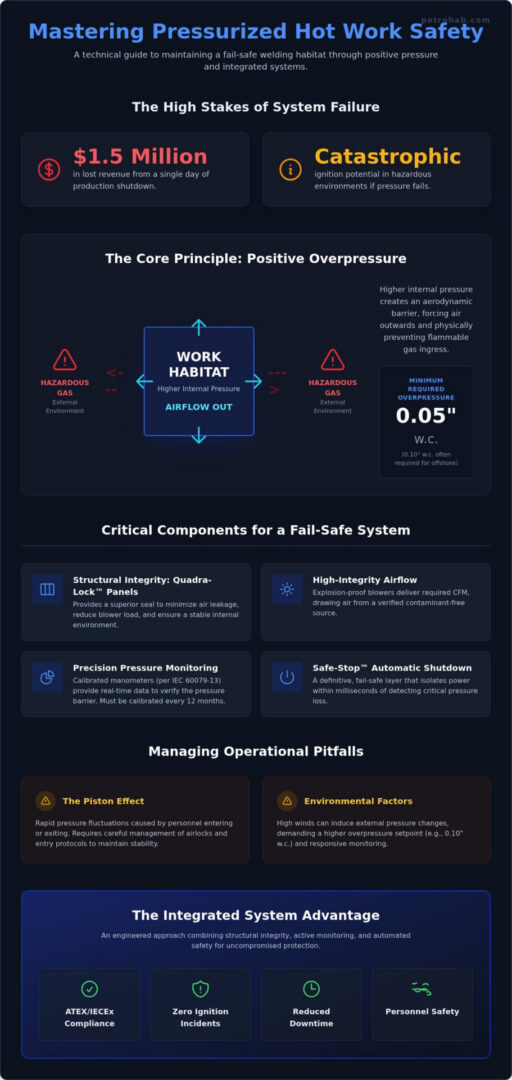
A single day of production shutdown on an offshore platform can result in approximately $1.5 million in lost revenue. This financial risk is surpassed only by the catastrophic potential of an ignition incident in a hazardous environment. You understand that maintaining the integrity of a Hot Work Safety Enclosure (HWSE) isn’t just about airflow; it’s about engineering a definitive barrier against combustible gases. Effective welding habitat pressure monitoring is the primary line of defense that prevents hydrocarbon ingress when the stakes are at their highest.
You’ve likely faced the challenges of pressure fluctuations in high-wind offshore settings or the constant worry of equipment failure during critical path activities. This guide provides the technical protocols and equipment requirements necessary to maintain a fail-safe pressurized environment. You’ll learn how to achieve absolute ATEX/IECEx compliance and zero ignition incidents through calculated risk mitigation. We’ll explore the integration of Safe-Stop automatic shutdown systems and the structural advantages of Quadra-Lock panels to ensure your site remains both productive and protected. By following these rigorous standards, you can eliminate the variables that lead to costly downtime and personnel risk.
Key Takeaways
- Master the overpressure principle to maintain a calculated barrier that forces air outward and prevents hazardous gas ingress into the work area.
- Establish precise welding habitat pressure monitoring using calibrated manometers to ensure continuous compliance with international safety standards like IEC 60079-13.
- Verify the structural integrity of Quadra-Lock panels and seals during pre-work inspections to identify and eliminate potential leak points before operations begin.
- Proactively manage the Piston Effect and other operational pitfalls that cause pressure fluctuations during personnel transit or high-wind conditions.
- Integrate the Safe-Stop automatic shutdown system to provide a definitive, fail-safe layer of protection that isolates power within milliseconds of detecting pressure loss.
The Fundamentals of Maintaining Positive Pressure in Hazardous Zones
A Positive pressure enclosure, commonly referred to as a welding habitat, operates on a definitive aerodynamic principle: maintaining an internal atmosphere at a higher pressure than the surrounding hazardous environment. By creating this differential, the system ensures that air only flows from the inside out. This overpressure principle acts as a physical barrier, forcing internal air through any microscopic gaps and preventing the ingress of flammable hydrocarbons or toxic gases. Continuous welding habitat pressure monitoring is the only way to verify that this barrier remains intact during high-stakes hot work.
The physics of gas ingress are unforgiving. Gases naturally migrate from areas of high pressure to areas of low pressure. If the internal pressure of a habitat drops to match the external atmosphere, the safety barrier vanishes instantly. Even a minor pressure drop constitutes a critical safety breach, as it allows potentially explosive mixtures to penetrate the workspace. Industrial standards typically mandate a minimum overpressure of 0.05 inches of water column (w.c.), though some offshore protocols require 0.10 inches w.c. to account for wind-induced fluctuations. Rigorous welding habitat pressure monitoring identifies these minute fluctuations before they manifest as hazardous conditions.
Why Positive Pressure is Non-Negotiable for Hot Work
In ATEX Zone 1 and Zone 2 areas, the presence of hydrocarbons is either a constant risk or an expected occurrence. Maintaining positive pressure is the primary method for isolating ignition sources from these volatile atmospheres. Beyond ignition prevention, the system guarantees a continuous supply of fresh, breathable air for technicians working within the enclosure. This dual-purpose functionality is essential for personnel safety and operational continuity. Adhering to these Hazardous Environment Standards ensures your facility meets global compliance requirements while protecting high-value assets from fire or explosion.
The Relationship Between Airflow and Enclosure Integrity
Intake blowers must deliver a specific volume of air, measured in cubic feet per minute (CFM), to achieve and sustain overpressure. The effectiveness of these blowers is directly tied to the structural integrity of the enclosure. Utilizing Quadra-Lock panels provides a superior seal that minimizes air leakage, which reduces the mechanical load on blowers and ensures a more stable internal environment. To comply with international safety standards, the enclosure must maintain a minimum positive pressure differential of 0.05 inches of water column relative to the external environment.
Critical Components for Active Pressure Regulation
Maintaining a pressurized environment requires a synchronized array of specialized hardware designed to withstand the rigors of heavy industry. The process begins with explosion-proof blowers. These intake systems must be rated for hazardous locations to ensure the equipment itself does not become an ignition source. Sourcing air from verified areas far from potential fuel sources is mandatory; therefore, high-integrity air ducting must be routed to intake points where the atmosphere is confirmed to be free of contaminants. This mechanical foundation provides the necessary cubic feet per minute to sustain overpressure.
Monitoring Tools: Manometers and Gauges
Verification of the pressure barrier relies on precision instruments. Magnehelic gauges and digital manometers provide the real-time data necessary for welding habitat pressure monitoring. While analog gauges offer reliable, power-free visual checks, digital systems allow for remote monitoring and data logging, which is essential for comprehensive safety audits. Sensors must be placed strategically to eliminate dead spots, ensuring that the pressure reading represents the entire enclosure volume rather than just the area near the air intake. To maintain regulatory compliance and technical accuracy, these instruments require calibration at regular intervals, typically every twelve months, as specified by manufacturer standards and international safety protocols such as IEC 60079-13:2017.
The Enclosure Structure: Quadra-Lock Panel Sealing
The structural integrity of the enclosure determines the efficiency of the pressurization system. Traditional habitats often struggle with air loss at the seams, but Quadra-Lock technology utilizes a patented interlocking system to provide a superior, airtight seal. These panels are constructed from silicone-coated fiberglass cloth capable of withstanding continuous temperatures of 1,000°F. This thermal resistance prevents structural warping that could lead to sudden pressure drops. By maintaining a high-integrity seal within the pressurized welding habitat, the system reduces the mechanical load on intake blowers and ensures a stable, protected environment for hot work.
The final layer of defense is the automatic shutdown system. If welding habitat pressure monitoring detects a breach below the 0.05 inches of water column threshold, the Safe-Stop system isolates power to the welding equipment within 0.5 seconds. This fail-safe mechanism removes the variable of human error, ensuring that ignition sources are neutralized before hazardous gases can ingress. Consider exploring the technical specifications of PetroHab systems to understand how these components integrate into a unified safety solution for your next offshore project.
Step-by-Step: Establishing and Verifying Pressure Integrity
Procedural rigor is the definitive factor that separates a compliant operation from a hazardous one. Establishing pressure integrity begins with a meticulous pre-work inspection of the enclosure structure. Technicians must examine every Quadra-Lock panel for structural defects and ensure that all interlocking seams are flush and secure. Ducting requires a similar level of scrutiny; any punctures or kinks can significantly reduce the volume of air delivered to the workspace, compromising the overpressure barrier before work even begins.
Once the physical structure is verified, system startup follows a strict sequential protocol. Blowers are activated before any hot work equipment is energized to ensure the environment is fully purged and pressurized. A smoke test is then conducted for visual verification. By introducing non-toxic smoke into the pressurized unit, technicians can identify minute escape points around complex pipe penetrations or floor interfaces. This method is far superior to informal field fixes and ensures that the enclosure reaches baseline stabilization, maintaining a steady internal state of at least 0.05 inches of water column.
Initial Setup and Blower Activation
Positioning intake ducts is a critical safety task that requires careful environmental assessment. Ducts must be placed in verified clean air areas, typically upwind and at a safe distance from potential hydrocarbon release points. Technicians calculate the required internal pressure based on specific external wind conditions; high-wind offshore environments often necessitate increasing the internal pressure to 0.10 inches of water column to prevent the wind from overcoming the overpressure barrier. Baseline stabilization is only confirmed through consistent welding habitat pressure monitoring data.
Continuous Monitoring During Hot Work
Active safety management requires constant vigilance throughout the duration of the task. A dedicated Habitat Watch must be assigned to monitor manometers and gas detection readouts without interruption. This individual is responsible for logging pressure readings at regular intervals as specified by the Permit-to-Work (PTW), typically every 30 to 60 minutes. This creates a verifiable record of the welding habitat pressure monitoring process and ensures the enclosure remains within safe operating parameters.
Every hot work safety enclosure must be fully integrated into the facility’s broader emergency response plan. If pressure drops below the mandatory threshold, the Habitat Watch and the automatic shutdown system work in tandem to neutralize all ignition sources instantly. This structured approach ensures that personnel can focus on their technical tasks with the confidence that their environment is being actively guarded by proven safety protocols.
Troubleshooting Pressure Loss and Operational Pitfalls
Operational integrity in a pressurized environment is not a static state. It requires continuous vigilance to identify and rectify pressure loss before it compromises safety. Common leak points often emerge at door seals, floor interfaces, and cable glands where the enclosure meets existing infrastructure. Effective welding habitat pressure monitoring identifies these drops in real-time, allowing for immediate remedial action. If a significant breach occurs, such as a blower failure, protocols must mandate the immediate cessation of all hot work to prevent ignition in the event of gas ingress.
Managing Modular Seal Breaches
The flexibility of the Quadra-Lock system allows for rapid adjustments, but technicians must address leaks around complex pipe geometries and structural beams with precision. Re-sealing panels during active operations involves verifying the interlocking seams and applying high-temperature sealing materials to any identified gaps. Caution is required; over-pressurizing the unit to compensate for leaks can cause panel separation or structural stress, potentially leading to a catastrophic seal failure. Maintaining the internal pressure within the validated range of 0.05 to 0.10 inches of water column is essential for structural stability.
Environmental factors in offshore settings present unique challenges. Wind fluctuations can create external pressure spikes that momentarily overcome the internal overpressure. To mitigate this, monitoring teams must adjust blower speeds to maintain a stable differential. Additionally, the Piston Effect occurs when technicians enter or exit the enclosure, causing a sudden, temporary drop in pressure. Utilizing an airlock system or increasing airflow during transit periods helps stabilize the internal atmosphere and prevents the Safe-Stop system from triggering an unnecessary shutdown.
Addressing Human Error in Pressure Management
Human behavior is often the weakest link in environmental containment. Strict rules must be enforced against propping doors open for ventilation or convenience, as this bypasses the overpressure barrier entirely. Specialized training for all personnel entering the HWSE is non-negotiable; they must understand how their movements affect the internal pressure. Ensuring that air intake and exhaust vents remain unobstructed is also critical. If these vents are blocked by tools or materials, the system can’t maintain the required cubic feet per minute to sustain safety. For more information on maintaining high-performance safety systems, consult with PetroHab’s technical experts today.
The PetroHab Advantage: Integrated Systems for Unfailing Pressure
PetroHab defines the industry benchmark by unifying structural engineering with automated safety logic. While individual components are essential for containment, the synergy between Quadra-Lock panels and the Safe-Stop system creates a redundant safety barrier that manual setups cannot match. This integration ensures that welding habitat pressure monitoring isn’t just a passive observation; it’s an active, responsive defense mechanism. By removing the reliance on manual intervention, the system eliminates the primary variable in industrial accidents: human error.
Safe-Stop: The Ultimate Pressure Watchdog
The Safe-Stop system functions as the central nervous system of the enclosure, integrating real-time gas detection with precision pressure loss sensors. If sensors detect gas at 10% of the Lower Explosive Limit (LEL) or a pressure drop below the required 0.05 inches of water column, the system triggers a full power isolation within 0.5 seconds. This instantaneous response is vital for preventing ignition in volatile environments. To understand the full scope of these protective layers, you can explore the Comprehensive Guide to Advanced Hot Work Safety Systems.
Engineering Excellence with Quadra-Lock
PetroHab’s engineering proves that modularity doesn’t necessitate a loss in pressure integrity. The patented Quadra-Lock technology ensures a superior seal through interlocking panels that resist structural warping even under intense heat. These panels utilize silicone-coated fiberglass capable of withstanding continuous temperatures of 1,000°F, ensuring the enclosure remains airtight during prolonged welding tasks. For organizations looking to upgrade their safety infrastructure, it’s advisable to consult with hot work safety enclosure suppliers to ensure procurement meets specific facility requirements.
Beyond the hardware, PetroHab provides global technical support and specialized training programs designed for safety managers and engineers. We ensure your technicians aren’t just operators; they’re pressure maintenance experts capable of managing complex facility layouts and obstructed workspaces. Our customizable air ducting solutions are tailored for specific site geometries, allowing for clean air intake even in the most congested industrial environments. This holistic approach to welding habitat pressure monitoring ensures hot work operations proceed without incident. By choosing an integrated solution, you protect both your personnel and your high-value assets with a system that has a proven global track record in offshore facilities.
Securing Operational Integrity Through Advanced Pressurization
Maintaining the integrity of a pressurized environment is a continuous engineering challenge that requires more than just airflow. It demands a rigorous commitment to technical protocols and the use of integrated safety systems. By prioritizing welding habitat pressure monitoring, safety managers ensure that every hot work task is shielded by a definitive overpressure barrier that physically prevents the ingress of hazardous gases. This calculated approach to risk mitigation is what separates a compliant operation from a catastrophic incident.
PetroHab provides the industry standard through our Patented Quadra-Lock Sealing Technology and ATEX/IECEx Compliant Safe-Stop Systems. These technologies work in tandem to eliminate the variables of environmental stress and human error. Our equipment is Trusted by Global Supermajors to protect personnel and high-value assets in the most hazardous offshore environments. Securing your site requires a partner who understands the granular details of ignition prevention and technical compliance.
We invite you to Request a Technical Consultation on PetroHab HWSE Systems to evaluate your specific facility requirements. Implementing these advanced protocols ensures your operations remain compliant, productive, and safe. We look forward to supporting your next critical project with our field-proven solutions.
Frequently Asked Questions
What is the minimum positive pressure required for a welding habitat?
The standard minimum positive pressure required for an industrial welding habitat is 0.05 inches of water column (w.c.). This differential ensures that internal air is forced outward through any gaps, physically preventing the ingress of flammable gases. In offshore environments with significant wind challenges, safety managers often increase this threshold to 0.10 inches w.c. to maintain a stable overpressure barrier. Adhering to these specific metrics is essential for regulatory compliance.
How often should manometers be calibrated in offshore environments?
Manometers and Magnehelic gauges should be calibrated at least once every twelve months to ensure technical accuracy. In harsh offshore environments, more frequent verification may be required by specific facility safety protocols. Precision instruments are susceptible to drift over time; therefore, using calibrated hardware is a critical component of effective welding habitat pressure monitoring. Always refer to manufacturer specifications and international standards like IEC 60079-13:2017 for mandatory maintenance intervals.
Can I maintain positive pressure in high-wind conditions?
Maintaining positive pressure in high-wind conditions is achievable by increasing the volume of air delivered to the enclosure. Technicians must adjust intake blower speeds to counteract the external pressure spikes caused by wind gusts. Utilizing high-integrity Quadra-Lock panels also helps by minimizing air leakage, which allows the system to sustain the required overpressure more efficiently. Constant monitoring is necessary to ensure the internal atmosphere remains stable during these environmental fluctuations.
What happens to the hot work if the pressure drops below the threshold?
If internal pressure drops below the 0.05 inches w.c. threshold, all hot work must cease immediately. This breach indicates that the overpressure barrier is no longer sufficient to prevent gas ingress. When using a Safe-Stop system, power to the welding equipment is automatically isolated within 0.5 seconds of the breach. This fail-safe response removes the risk of an ignition incident by neutralizing heat sources before hazardous gases can penetrate the workspace.
How do PetroHab’s Quadra-Lock panels improve pressure maintenance?
PetroHab’s Quadra-Lock panels utilize a patented interlocking system that provides a superior, airtight seal compared to traditional modular habitats. The panels are constructed from silicone-coated fiberglass cloth that resists structural warping at temperatures up to 1,000°F. This durability ensures the enclosure remains airtight even under intense thermal stress. By reducing air loss at the seams, these panels decrease the mechanical load on blowers and simplify the process of maintaining a pressurized environment.
Is an automatic shutdown system mandatory for maintaining positive pressure?
While manual monitoring is possible, an automatic shutdown system is considered the industry benchmark for high-risk environments. International standards like IEC 60079-13 emphasize the need for continuous operational integrity. A system like Safe-Stop removes the variable of human error by integrating gas detection with pressure sensors. This provides a definitive layer of protection that ensures all ignition sources are isolated instantly if the safety barrier is compromised.
How do I prevent pressure loss when workers enter or exit the HWSE?
Preventing pressure loss during technician transit requires managing the Piston Effect. This is achieved by utilizing airlock systems or temporarily increasing the airflow from intake blowers when doors are opened. Personnel must receive specialized training to ensure they don’t prop doors open or obstruct air vents. Managing these transit periods carefully is a vital part of welding habitat pressure monitoring to prevent unnecessary shutdowns triggered by momentary pressure fluctuations.
What is the role of air ducting in maintaining a pressurized environment?
Air ducting is the conduit that delivers clean air from verified sources to the enclosure. It must be routed to intake points located in areas confirmed to be free of hydrocarbons, typically upwind of the work site. The integrity of the ducting is as important as the enclosure itself; any punctures or kinks will reduce the cubic feet per minute of air delivered. This loss of volume directly impacts the system’s ability to sustain overpressure.