Blog Posts
Mastering Hazardous Environments: A Deep Dive into Quadra-Lock Panel Technology (2026)
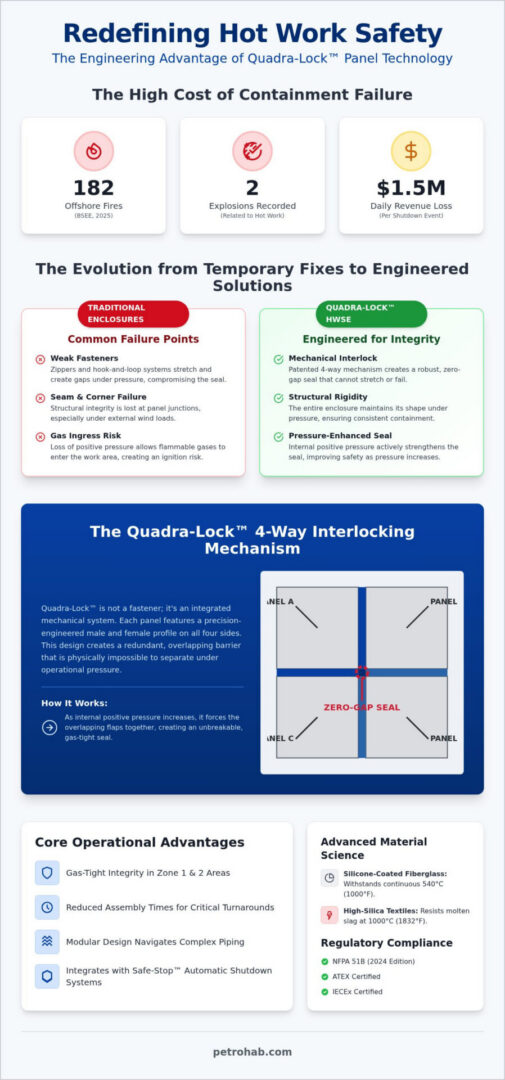
In 2025, the U.S. Bureau of Safety and Environmental Enforcement (BSEE) recorded 182 fires and two explosions related to offshore hot work, proving that even a minor containment breach can have catastrophic consequences. You understand that maintaining habitat integrity isn’t just a regulatory checkbox; it’s the thin line between operational continuity and a $1.5 million daily revenue loss during a production shutdown. When habitat integrity fails or assembly times lag during critical refinery turnarounds, the risk to your personnel and assets becomes unacceptable, necessitating a move toward advanced Quadra-Lock panel technology.
This guide explores how patented Quadra-Lock technology redefines hot work safety by providing superior structural integrity and gas-tight containment in the most volatile industrial settings. We’ll analyze the engineering behind the zero-gap seal, examine compliance with the 2024 edition of NFPA 51B, and demonstrate how these modular systems ensure a 100% safety record while meeting the most stringent ATEX and IECEx standards. By the end, you’ll see why the industry’s most rigorous experts rely on this system to protect high-value assets and ensure absolute regulatory compliance.
Key Takeaways
- Analyze the engineering of the 4-way interlocking mechanism designed to maintain gas-tight integrity where traditional fasteners fail.
- Learn how Quadra-Lock panel technology provides a superior structural foundation for pressurized enclosures in Zone 1 and Zone 2 hazardous areas.
- Evaluate the operational benefits of modular configurations, including reduced assembly times and the ability to navigate complex industrial piping.
- Review the critical alignment with international safety standards, specifically NFPA 51B and the latest ATEX and IECEx regulatory requirements.
- Understand the strategic integration of Hot Work Safety Enclosures with Safe-Stop technology to automate ignition source control and mitigate human error.
The Evolution of Hot Work Safety: Why Panel Integrity Matters
Hot work in refineries and offshore platforms presents a constant ignition risk. A single spark meeting a hydrocarbon leak leads to catastrophic failure. To mitigate this, engineers rely on a positive pressure enclosure to isolate ignition sources from the surrounding atmosphere. However, the effectiveness of these systems depends entirely on the structural integrity of the panels. Traditional designs often rely on zippers or basic hook-and-loop fasteners. These lack the mechanical strength to withstand high-pressure differentials or extreme weather conditions common in heavy industry.
To better understand the shift toward high-integrity mechanical connections, watch this overview of precision locking mechanisms:
From Temporary Tents to Engineered Enclosures
Early safety measures involved simple fire blankets or temporary canvas tents. These provided minimal protection against gas ingress and were prone to collapse. As safety standards evolved, particularly with the NFPA 51B 2024 edition, the industry shifted toward engineered Hot Work Safety Enclosures (HWSE). Modern oil and gas operations demand modularity to fit around complex piping and structural steel. This evolution led to the development of Quadra-Lock panel technology, a system designed to replace inferior interlocking methods with a robust, gas-tight mechanical seal. These systems must withstand continuous exposure to molten slag at temperatures reaching 1000°C without compromising the internal atmosphere.
Identifying the Weak Points in Standard HWSE
Standard habitat panels often fail at the corners and seams. Under the required internal pressure of 0.05 to 0.1 inches of water column, weak junctions stretch and create gaps. External wind loads on offshore platforms exacerbate this problem, causing the structure to lose its shape and allowing pressurized air to escape. When air leakage occurs, the Safe-Stop Automatic Shutdown System must work harder to maintain pressure, increasing the risk of a safety trip or gas ingress. Structural failure at these panel junctions doesn’t just stop work; it compromises the entire safety barrier. Modern Quadra-Lock panel technology eliminates these failure points by ensuring structural rigidity through a 4-way interlocking design that maintains a zero-gap seal under load.
What is Quadra-Lock Panel Technology?
Quadra-Lock panel technology represents a fundamental shift in how we approach environmental isolation in heavy industry. It isn’t a secondary fastener like a zipper or a hook-and-loop strip. Instead, it’s a patented mechanical system integrated into the very structure of the panel. The engineering philosophy centers on creating a mechanical bond that utilizes the physics of a pressurized environment to enhance its own seal. This design ensures that as internal positive pressure increases, the integrity of the enclosure actually strengthens, providing a reliable barrier between ignition sources and flammable gases.
The 4-Way Interlocking Mechanism Explained
The connection points utilize a precision-engineered male and female interlocking profile on all four sides of every panel. This configuration allows for rapid, tool-free assembly, which is critical during high-stakes refinery turnarounds where every hour of downtime impacts revenue. The 4-way overlap creates a redundant barrier that traditional fasteners cannot match. When the enclosure is pressurized to the required 0.05 to 0.1 inches of water column, the internal air forces the overlapping flaps against each other. This creates a gas-tight seal that effectively isolates the work area, ensuring that sparks and slag remain contained while preventing gas ingress.
Material Science: Beyond the Lock
Beyond the mechanical strength, Quadra-Lock panel technology relies on advanced material science to maintain safety in extreme conditions. The panels use premium silicone-coated fiberglass cloth, certified to withstand continuous temperatures of up to 1,000°F (540°C). For heavy-duty welding or grinding, high-silica textiles are available, which are capable of resisting molten slag at 1000°C. These materials aren’t just fire-resistant; they’re built for the corrosive reality of offshore salt spray and high UV exposure. Adhering to OSHA hot work regulations requires this level of material durability to ensure the enclosure remains a reliable safety barrier throughout the project duration.
Every component, from the flexible silicon-coated vermiculite fiberglass floor tiles rated to 1,500°F (815°C) to the reinforced seams, works in unison with the interlocking mechanism. This creates a resilient system that maintains compliance with ANSI/FM 4950 and international standards. If you’re planning a complex maintenance schedule, reviewing the available HWSE configurations can help you determine the best modular setup for your specific piping geometry.
Operational Advantages of Quadra-Lock Habitats
Operational efficiency in the energy sector is measured by the reduction of non-productive time (NPT). Quadra-Lock panel technology facilitates this by streamlining the deployment of pressurized habitats in high-stakes environments. While previous sections detailed the material science and technical locking mechanisms, the true value of the system lies in its performance during active maintenance cycles. Unlike traditional systems that require specialized tools or complex fastening sequences, this system prioritizes rapid, secure assembly to minimize the logistical burden on site crews.
Modularity and Customization in the Field
Industrial environments are rarely uniform. Pipes, valves, and structural beams create complex geometries that a standard box habitat cannot accommodate. The modular nature of Quadra-Lock panels allows technicians to build enclosures of any size or shape, adapting to the specific infrastructure of an offshore platform or onshore refinery. This flexibility is essential for creating an effective Petro-Habitat around existing obstructions. If a single panel sustains damage from excessive slag or mechanical impact, it’s easily replaced without dismantling the entire Hot Work Safety Enclosure (HWSE). This granular repair capability ensures the safety barrier remains intact while minimizing material waste and labor costs.
Reducing Turnaround Downtime
Refinery turnarounds are high-pressure events where a full production shutdown can result in a daily revenue loss of approximately $1.5 million. Reducing setup time for safety equipment is critical to returning to operational status. The tool-free assembly of the Quadra-Lock system significantly reduces the time required for habitat construction. By simplifying the physical build, safety managers can streamline the Permit-to-Work (PTW) process. When the enclosure consistently meets the required internal pressure of 0.05 to 0.1 inches of water column on the first attempt, it eliminates the need for repeated adjustments and re-testing that often plague inferior interlocking methods.
Investing in Quadra-Lock panel technology provides a superior return on investment compared to disposable or lower-grade alternatives. These panels are designed for repeated deployment in harsh offshore conditions, resisting salt spray and UV degradation that typically weaken standard fabrics. In ATEX Zone 1 and Zone 2 environments, this reliability is paramount. It ensures that personnel working inside the habitat are protected by a structural foundation that won’t fail under pressure, maintaining a 100% safety record during critical welding and grinding operations. The result is a system that acts as a durable, resilient guardian of both personnel and high-value assets.
Compliance and Standards for Quadra-Lock Systems
Regulatory compliance in heavy industry isn’t a mere administrative formality; it’s the baseline for operational survival. Quadra-Lock panel technology provides the engineering foundation necessary to meet the most stringent global safety mandates. By shifting the focus from procedural reliance to robust engineering controls, this system helps operators manage the high-stakes risks inherent in hydrocarbon-rich environments. Whether you’re operating an offshore platform in the Gulf of Mexico or a refinery in the North Sea, adhering to international standards is the only way to ensure 100% safety during hot work operations.
ATEX and IECEx: Global Safety Compliance
In ATEX Zone 1 and Zone 2 environments, the presence of flammable gases is either likely or a constant risk. Quadra-Lock panels are designed to maintain the atmospheric isolation required by IEC 60079-13 for pressurized rooms. The gas-tight seal prevents spark escape and gas ingress, allowing welding and grinding to proceed safely. This level of containment is critical for maintaining a 0.05 to 0.1 inches of water column pressure differential. By utilizing these certified components, you ensure that your Hot Work Safety Enclosure (HWSE) acts as a definitive barrier against catastrophic ignition in explosive atmospheres.
Adhering to NFPA and OSHA Guidelines
The 2024 edition of NFPA 51B sets rigorous benchmarks for fire prevention during hot work. Quadra-Lock systems meet these requirements by integrating materials tested to ANSI/FM 4950 standards. This includes high-silica textiles capable of withstanding continuous exposure to molten slag at 1000°C. For offshore operators, this technology is essential for complying with BSEE regulations, which prohibit hot work within 10 feet of pressurized equipment unless a certified enclosure is utilized. The mechanical integrity of the 4-way interlocking seal provides the physical proof of protection that safety auditors demand during site inspections.
Engineering controls are prioritized in OSHA-compliant hot work programs because they mitigate the 85% of industrial incidents caused by human error. Quadra-Lock technology provides a traceable, repeatable safety solution that doesn’t rely on the variable quality of manual sealing methods. ISO-certified manufacturing processes guarantee that every panel provides the same structural rigidity and thermal resistance, ensuring your facility remains in full compliance with local and international law. To ensure your site meets these rigorous benchmarks, you can consult with our technical team to review the certification data for your specific region.
Implementing PetroHab’s Quadra-Lock HWSE Solutions
Transitioning from regulatory theory to site-level execution requires a system where hardware and electronic monitoring work in perfect alignment. Quadra-Lock panel technology serves as the physical foundation for this integration, ensuring that the structural integrity of the enclosure supports the sophisticated sensors used in modern hot work. When the habitat maintains a consistent internal pressure, the entire safety protocol becomes more predictable and manageable. This reliability is essential for safety managers who must account for both environmental hazards and the procedural complexities of large-scale industrial projects.
The Synergy of Quadra-Lock and Safe-Stop
The true strength of an engineered safety solution lies in the synergy between the enclosure and the Safe-Stop Automatic Shutdown System. While the panels provide the physical barrier, the Safe-Stop system provides the electronic oversight necessary for a closed-loop safety environment. Because the 4-way interlocking mechanism creates a superior gas-tight seal, the system’s pressure monitors and gas detectors can function with high precision. If habitat integrity is breached or if the internal pressure falls below the required 0.05 inches of water column, the Safe-Stop system initiates an automatic shutdown of all ignition sources in milliseconds. This eliminates human latency and ensures that welding tools are de-energized before a hazardous atmosphere can enter the work area.
Sourcing and Technical Support
Determining whether to lease or purchase a Hot Work Safety Enclosure (HWSE) depends on your facility’s long-term maintenance schedule. Leasing provides a flexible, cost-effective solution for short-term refinery turnarounds, giving you access to the latest technology without a permanent capital commitment. For offshore platforms with ongoing repair needs, purchasing ensures that critical safety assets are always available on-site. PetroHab supports both models through a global network with operations in Houston, Brazil, and the UK, ensuring that equipment and technical expertise are available for rapid deployment to any major energy hub.
Implementation success is further guaranteed through on-site technical supervision and certified training programs. These initiatives ensure that your personnel can assemble and maintain the modular panels to the highest standards, effectively designing out the 85% of industrial incidents typically attributed to human error. For safety directors looking to optimize their facility’s risk mitigation strategy, requesting a technical consultation is the next logical step in the procurement process. To broaden your understanding of these systems, consult The Definitive Guide to Hot Work Safety Enclosures (HWSE) in 2026 for a comprehensive look at the evolution of pressurized habitat standards.
Advancing Industrial Safety Through Engineering Excellence
Maintaining habitat integrity in volatile environments requires more than procedural caution; it demands a structural foundation that cannot fail. You’ve seen how Quadra-Lock panel technology replaces unreliable fasteners with a patented 4-way mechanical seal, ensuring gas-tight containment in Zone 1 and Zone 2 areas. By integrating these modular panels with automated monitoring systems, you effectively design out the human error that contributes to 85% of industrial safety incidents. This proactive engineering approach is the benchmark for modern hot work safety.
PetroHab remains a committed guardian of your operations, providing ATEX and IECEx compliant systems designed for the most demanding offshore and onshore facilities. Our global 24/7 technical support and patented Quadra-Lock technology ensure your team can execute critical welding and grinding with absolute confidence in personnel protection and asset security. We stand ready to help you navigate evolving safety standards while minimizing downtime during your most critical turnarounds.
Ready to elevate your facility’s safety standards and protect your high-value assets? Request a Technical Consultation for Your Next HWSE Project. We look forward to partnering with you to achieve operational excellence and a 100% safety record on your next site deployment.
Frequently Asked Questions
What makes Quadra-Lock technology different from other welding habitat panels?
Quadra-Lock panel technology utilizes a patented 4-way interlocking mechanical seal that differs fundamentally from traditional zippers or hook-and-loop fasteners. It creates a gas-tight bond that strengthens under internal positive pressure. This eliminates common failure points at the corners and seams where generic panels often leak. It provides the structural rigidity necessary to maintain the enclosure’s shape even under extreme wind loads on offshore platforms.
Can Quadra-Lock panels be used in ATEX Zone 1 environments?
Yes, these panels are engineered specifically for deployment in Zone 1 and Zone 2 hazardous environments. They meet the atmospheric isolation requirements outlined in IEC 60079-13. By ensuring a zero-gap seal, the system prevents the ingress of flammable gases and the escape of sparks. This makes it a reliable barrier for hot work in hydrocarbon-rich areas where safety is the highest priority.
How quickly can a PetroHab HWSE using Quadra-Lock technology be assembled?
Assembly is significantly faster than traditional systems because of the tool-free, interlocking design. Technicians can connect panels rapidly without specialized hardware or complex fastening sequences. This efficiency reduces habitat setup time during critical refinery turnarounds where a production shutdown can cost $1.5 million daily. While exact durations depend on the habitat’s complexity, the modular nature allows for streamlined deployment to minimize non-productive time.
Are Quadra-Lock panels resistant to high-temperature welding slag?
Yes, the panels are constructed from high-performance materials designed for extreme thermal resistance. The standard silicone-coated fiberglass cloth withstands continuous temperatures of up to 1,000°F (540°C). For heavy-duty welding, PetroHab provides high-silica textiles capable of resisting molten slag and sparks at temperatures reaching 1000°C. These materials ensure that the enclosure remains a functional safety barrier throughout the duration of the welding or grinding operation.
Does PetroHab offer training for the assembly of Quadra-Lock enclosures?
PetroHab provides professional training programs and on-site supervision to ensure proper system assembly. Certified technicians can oversee the initial setup or train your facility’s personnel on the technical details of the modular system. This ensures that every Hot Work Safety Enclosure (HWSE) is erected according to manufacturer specifications and international safety standards, effectively mitigating the risk of human error during deployment.
What is the lifespan of a Quadra-Lock panel in an offshore environment?
Quadra-Lock panels are engineered for long-term durability and multiple reuses in corrosive offshore settings. The premium silicone coating protects the fiberglass core from salt spray, high UV exposure, and mechanical wear. Unlike disposable habitats that degrade quickly, these high-integrity panels maintain their fire-resistant properties and structural strength over several maintenance cycles. This longevity offers a superior return on investment for long-term facility maintenance and asset protection.
How does Quadra-Lock technology assist in maintaining positive pressure?
The 4-way interlocking mechanism utilizes internal pressure to enhance its own seal. When the habitat is pressurized to the required 0.05 to 0.1 inches of water column, the internal air forces the overlapping flaps against each other. Quadra-Lock panel technology creates a gas-tight foundation that minimizes air leakage. This ensures the Safe-Stop system can maintain the pressure differential with high precision and reduced mechanical strain on the fans.
Is Quadra-Lock technology compatible with other safety shutdown systems?
While designed to integrate with the Safe-Stop Automatic Shutdown System, the modular panels provide a universal physical barrier. The primary function of Quadra-Lock panel technology is to create a controlled environment that isolates ignition sources from flammable gases. This structural foundation supports any safety protocol requiring positive pressure integrity and gas detection. Using the proprietary Safe-Stop system ensures the most responsive automatic shutdown in milliseconds when habitat integrity is breached.