Blog Posts
Minimizing Downtime During Refinery Maintenance: The HWSE Strategy
For a typical mid-sized refinery, every 24 hours of an outage translates to a loss exceeding $500,000 in lost production and overhead. These figures make minimizing downtime during refinery maintenance the primary objective for every turnaround manager and safety engineer. You’re well aware that the critical path is frequently dictated by the slow, sequential nature of traditional safety protocols. The necessity of shutting down entire units to perform a single weld in a hazardous area creates a massive resource bottleneck that drains capital. It’s a high-stakes environment where every delayed hour compromises the facility’s bottom line.
You’ll discover how pressurized hot work safety enclosures (HWSE) provide a definitive technological remedy to these operational constraints. By utilizing our patented Petro-Wall modular panels and Safe-Stop ignition source control systems, you can safely conduct hot work in Zone 1 and Zone 2 areas while adjacent units remain live. This guide details how integrating ATEX and IECEx certified habitats into your maintenance strategy shortens the turnaround window and ensures 100% safety compliance. We’ll examine the technical specifications and real-world applications that allow you to maintain operational integrity without sacrificing production.
Key Takeaways
- Quantify the multi-million dollar daily impact of refinery shutdowns and identify why traditional “cold” maintenance schedules often fail to meet critical deadlines.
- Discover how pressurized hot work safety enclosures (HWSE) facilitate welding on live or near-live units, effectively minimizing downtime during refinery maintenance.
- Compare the operational efficiency of modular habitats against traditional shutdowns to optimize resource allocation and reduce the need for massive fire-watch teams.
- Execute a strategic implementation plan by conducting pre-turnaround risk assessments and selecting the ideal procurement model for your facility’s specific needs.
- Evaluate the engineering advantages of patented Quadra-Lock technology and Safe-Stop systems in maintaining uncompromising operational integrity and asset protection.
The Economic Impact of Refinery Maintenance and Shutdowns
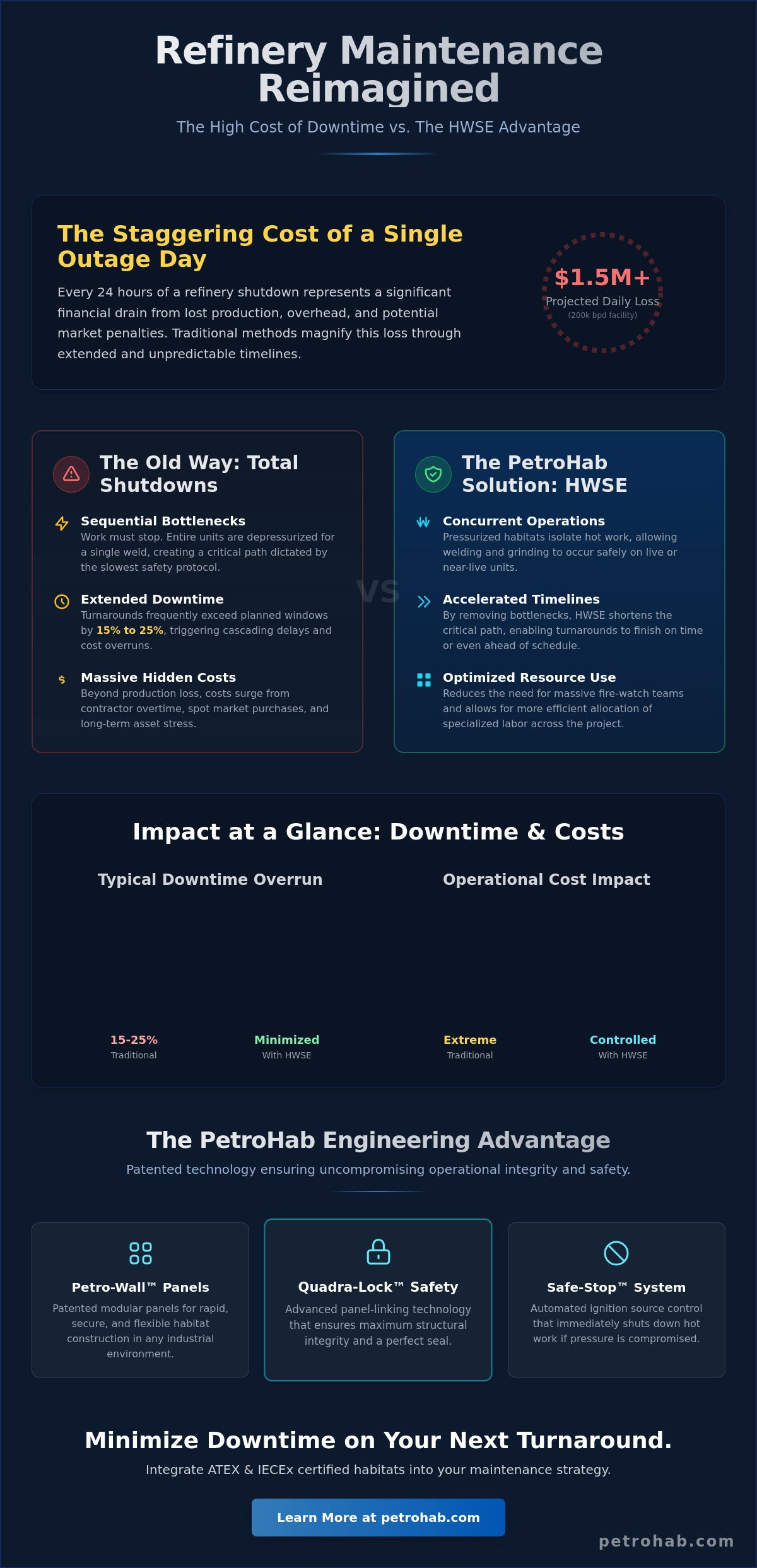
Refinery operators face staggering financial pressures during scheduled turnarounds. For a typical 200,000 barrel-per-day facility, daily revenue losses in 2026 markets are projected to average $1.5 million. This figure doesn’t even account for the escalating costs of specialized labor and materials. Traditional “cold” maintenance strategies often fail because they rely on total unit depressurization before any ignition source is introduced. These rigid schedules frequently exceed planned windows by 15% to 25%, primarily due to the complexity of managing Hot Work Safety protocols. When a turnaround extends beyond its deadline, the financial hemorrhage impacts the entire supply chain.
Achieving the goal of minimizing downtime during refinery maintenance requires a precise understanding of why schedules slip. Most delays aren’t caused by a lack of manpower but by the sequential nature of traditional safety permits. PetroHab’s approach emphasizes that every hour spent waiting for a gas test or a permit clearance is an hour of lost profitability. By integrating advanced ignition source control, facilities can move away from these stagnant workflows.
Identifying the Critical Path in Turnaround Management
The critical path represents the sequence of essential tasks that determines the minimum duration of a refinery outage. In most downstream environments, welding and structural metalwork dictate this timeline. These activities are inherently hazardous; therefore, they’re often scheduled for the very end of a shutdown. This creates a bottleneck. If a single welding task is delayed by atmospheric changes or equipment failure, it triggers a cascading effect. Downstream activities like non-destructive testing (NDT) and insulation cannot proceed, pushing the restart date further into the future. Effective turnaround management demands that these high-risk tasks be isolated so they don’t stall the entire project.
The Hidden Costs of Extended Facility Outages
Beyond immediate production losses, extended shutdowns expose refineries to extreme market volatility. A 14-day overrun can force a facility to purchase refined products at spot market prices to meet existing contractual obligations. Labor costs also surge. Overtime rates for contractors typically increase by 50% once a project moves past its scheduled completion date. Long-term facility reliability suffers too. Repeated cooling and heating cycles during extended outages stress metallurgical integrity. By using pressurized habitats to maintain a controlled environment, operators protect both the asset and the schedule. Minimizing downtime during refinery maintenance isn’t just about speed; it’s about maintaining the operational integrity of the entire site while managing costs that can exceed $10 million for a single week of delay.
Accelerating Maintenance with Hot Work Safety Enclosures (HWSE)
Hot Work Safety Enclosures (HWSE) represent a critical engineering control for hazardous environments. These modular, fire-resistant structures are pressurized habitats designed to isolate ignition sources from flammable atmospheres. By establishing a controlled environment, HWSE allows for welding and grinding on live or near-live units. This technological intervention is a primary driver for minimizing downtime during refinery maintenance, as it bypasses the traditional requirement for total unit depressurization during minor repairs.
The system operates on the principle of positive pressure. An integrated blower system maintains an internal pressure higher than the external atmosphere. This gradient ensures that even if a leak occurs in the habitat wall, air moves out rather than allowing hazardous gases in. Adherence to OSHA Hot Work Regulations ensures that these operations meet stringent safety benchmarks while maintaining high-value asset integrity. It’s a method that transforms a high-risk zone into a manageable workspace without halting the entire facility’s production flow.
How Pressurized Habitats Enable Concurrent Work
PetroHab habitats facilitate hot work in IECEx and ATEX Zone 1 and Zone 2 areas while adjacent equipment remains fully operational. Traditional safety protocols often require a 35-foot buffer for spark-producing activities; however, the HWSE containment system drastically reduces this required distance. This capability supports 24/7 maintenance cycles regardless of ambient gas risks. Refinery managers can schedule critical repairs without waiting for a full plant turnaround. This approach has been shown to save facilities significant operational hours by allowing maintenance teams to work alongside active production lines safely.
Ignition Source Control in Hazardous Zones
Effective ignition source control relies on the science of containment. PetroHab’s patented Petro-Wall panels are engineered to keep sparks and heat inside the enclosure. The system continuously monitors differential pressure to ensure habitat integrity. If the pressure drops below a set threshold, typically 0.05 inches of water gauge, the Safe-Stop system triggers an automatic shutdown of all hot work equipment. This integration of gas detection and automated response ensures that the risk of ignition remains near zero. These systems provide a definitive technological remedy for the hazards inherent in minimizing downtime during refinery maintenance. For more technical specifications on these systems, review the PetroHab product range.
Strategic Comparison: Traditional Shutdowns vs. HWSE-Enabled Maintenance
Refinery operators often view maintenance as a binary choice: complete shutdown or delayed repair. This logic is outdated. Traditional “cold” maintenance requires total unit depressurization, steaming, and nitrogen purging. These steps alone can account for 15% of the total turnaround duration. By integrating Hot Work Safety Enclosures (HWSE), facilities transition to a surgical maintenance model. This shift is fundamental to minimizing downtime during refinery maintenance while maintaining the highest safety protocols.
Reducing the Scope of Operational Halt
Isolating specific work areas allows for online repairs that were previously considered impossible. In a 2021 industrial application, a Gulf Coast refinery utilized pressurized habitats to repair a cracked flare line header while the rest of the unit remained at 85% capacity. Without this isolation, the entire facility would’ve faced an unplanned 10-day outage. Our modular Petro-Wall panels provide a physical and atmospheric barrier against hydrocarbon ingress. This isolation ensures that hot work doesn’t compromise the surrounding hazardous atmosphere. It’s a method that aligns strictly with OSHA’s Process Safety Management standards, providing a documented layer of protection that satisfies both internal safety audits and federal inspectors.
Mitigating Resource and Labor Bottlenecks
Labor availability is a primary bottleneck in refinery turnarounds. Traditional hot work requires a significant contingent of fire-watch personnel to monitor every potential ignition point. PetroHab’s Safe-Stop system changes this dynamic. By automating gas detection and ignition source control, the system provides a redundant safety layer that human observers cannot match. This technological integration is a core component of minimizing downtime during refinery maintenance by allowing personnel to be redeployed to other critical path tasks.
- Automated Monitoring: The Safe-Stop system triggers an immediate shutdown of power and welding gases if it detects a 10% Lower Explosive Limit (LEL) concentration, ensuring immediate risk mitigation.
- Permit Efficiency: Standardizing work within a pressurized enclosure can increase Permit-to-Work (PTW) approval speed by 30% because the safety parameters are fixed, documented, and predictable.
- Specialized Labor Optimization: Welders work in climate-controlled, well-lit environments, which reduces fatigue-related errors and increases weld pass rates by up to 12% based on field reports.
Reducing contractor standby time is critical for budget integrity. When permits are delayed, specialized welding crews sit idle, costing thousands of dollars per hour. PetroHab ensures that once the habitat is certified, the work begins immediately. This reliability makes us the gold standard in hot work safety, providing a seasoned approach to risk management that protects both human life and high-value assets. Our systems don’t just facilitate repairs; they provide a disciplined framework for operational excellence.
Implementation Guide: Integrating HWSE into Your Maintenance Schedule
Successful integration of Hot Work Safety Enclosures (HWSE) requires a disciplined, five-step execution model. This framework is essential for minimizing downtime during refinery maintenance by allowing ignition-risk activities to proceed alongside live production. Engineering teams must first conduct a comprehensive pre-turnaround risk assessment to identify specific hot work zones. This assessment dictates the scope of protection required for each maintenance task.
Selecting between rental and purchase depends on your turnaround frequency. Facilities with more than two major maintenance events per year typically find that purchasing a permanent fleet of enclosures yields a higher return on investment. Once the procurement strategy is set, coordinate the habitat setup with the specialized equipment rental schedule to avoid idle labor costs. This synchronization ensures that the pressurized environment is ready the moment the welding team arrives on-site.
On-site supervision remains a non-negotiable requirement for habitat integrity. Dedicated safety leads must monitor gas levels and internal pressure continuously. After the hot work concludes, a post-work inspection precedes rapid modular disassembly. PetroHab’s modular design allows teams to strike a habitat in under 90 minutes, which accelerates the transition to the next phase of the turnaround schedule.
Pre-Turnaround Planning and Risk Assessment
Mapping hazardous zones, specifically Zone 0, 1, and 2 areas, against the maintenance list is the first priority. This mapping determines the required number of patented Quadra-Lock panels needed to accommodate custom geometries around complex refinery piping. It’s vital to consult with hot work safety enclosure suppliers early in the planning phase. Initiating this dialogue 120 days before the turnaround prevents logistical bottlenecks and ensures all technical specifications meet IECEx or ATEX standards.
Training and On-site Supervision Protocols
Habitat pressurization demands certified technicians who understand the mechanics of ignition source control. These experts manage the initial inflation and verify that the enclosure maintains the required overpressure. Local personnel must also undergo training on Safe-Stop system responses. If the system detects a loss of pressure or the presence of hydrocarbons, it’ll automatically shut down the welding equipment. Technicians must maintain a rigorous log of pressure differentials and gas sensor readings every 30 minutes. This data provides a verifiable audit trail of the work environment’s stability.
Secure your facility with the industry’s most reliable pressurized habitats. Contact PetroHab for a technical consultation.
The PetroHab Advantage: Engineering for Maximum Operational Integrity
PetroHab provides the rigorous engineering required for high-stakes oil and gas operations. Our global reach extends from the energy hubs of Houston to the North Sea support centers in Dundee. This international presence ensures that refinery managers have access to elite safety technology regardless of their geographic location. We focus on minimizing downtime during refinery maintenance by deploying systems that assemble with speed and technical precision. Every component we manufacture serves a specific role in risk mitigation and asset protection. Our approach replaces uncertainty with calculated, technological safeguards.
Quadra-Lock Technology and Fire-Resistant Durability
The patented Quadra-Lock technology is the industry’s gold standard for rapid, modular assembly. Traditional habitats often use zippers or hook-and-loop fasteners that degrade over time and create potential failure points. PetroHab’s interlocking panel system creates a mechanical bond that eliminates the gaps found in legacy enclosures. This design ensures a pressurized environment that remains impenetrable to external hazards. The panels utilize specialized silicone-coated fiberglass that surpasses international fire-resistant standards, such as ISO 11612. These materials are tested to withstand molten slag and extreme thermal radiation during heavy-duty welding operations. Because the system is modular, it adapts to complex refinery piping and vessel geometries that would otherwise require custom, time-consuming solutions. This flexibility is essential for minimizing downtime during refinery maintenance cycles where every hour impacts the bottom line.
Safe-Stop Automatic Shutdown Systems for Unrivaled Protection
Safety shouldn’t rely solely on manual intervention. The Safe-Stop Automatic Shutdown System provides a redundant layer of protection for personnel and high-value assets. This system acts as the central intelligence of the enclosure, monitoring gas concentrations, internal pressure, and airflow in real time. If the sensors detect a pressure drop or a hydrocarbon concentration exceeding 10% of the Lower Explosive Limit (LEL), the system triggers an instantaneous isolation of the ignition source. This response happens in less than one second; it prevents potential disasters before they escalate. It’s a foundational element of modern hot work safety systems. By integrating ATEX and IECEx certified hardware, PetroHab ensures that every enclosure functions as a strictly controlled environment. This technical rigor allows hot work to proceed safely alongside live processes, maintaining the facility’s operational momentum.
- Patented Quadra-Lock panels for gap-free, modular assembly.
- Response times under one second for ignition source isolation.
- Compliance with ISO, ATEX, and IECEx global safety standards.
- Scalable designs for intricate refinery layouts and vessel geometries.
Our commitment to engineering excellence means we don’t just provide equipment; we provide a partnership in risk management. PetroHab systems are designed to be as durable and resilient as the industrial sites they protect. By choosing a system that prioritizes technical precision and redundant safety loops, operators can focus on their maintenance objectives with absolute confidence in their site’s integrity.
Securing Operational Integrity for the 2026 Turnaround Cycle
Refineries lose significant revenue for every hour of non-productive time during a full shutdown. Transitioning to HWSE-enabled maintenance allows critical hot work to occur safely during live operations. PetroHab’s patented Quadra-Lock technology provides a modular, interlocking panel system that maintains structural integrity in high-pressure environments. These systems are ATEX and IECEx compliant, ensuring they meet rigorous international safety standards for ignition source control. By integrating these engineered solutions, facility managers succeed in minimizing downtime during refinery maintenance without sacrificing site safety. Our global support teams in Houston and Dundee offer the technical expertise needed to manage complex logistics and deployment. It’s time to replace outdated safety protocols with proven, certified technology that protects both personnel and high-value assets. We’re ready to help you optimize your next maintenance window for maximum efficiency. Your facility’s resilience depends on rigorous planning and superior engineering.
Request a technical consultation for your 2026 refinery turnaround
Frequently Asked Questions
How does a hot work safety enclosure actually reduce refinery downtime?
A hot work safety enclosure reduces downtime by allowing welding and grinding to occur while the rest of the refinery remains operational. By isolating ignition sources, PetroHab eliminates the need for total facility shutdowns. In a 2023 case study, a Gulf Coast refinery reduced scheduled maintenance windows by 15% through the implementation of pressurized habitats. This method directly addresses the goal of minimizing downtime during refinery maintenance by parallel-tracking maintenance and production.
Can HWSE be used for welding on live high-pressure lines?
Yes, HWSE systems are engineered for hot work on live pressurized lines when integrated with standard industry safety protocols. PetroHab’s Petro-Wall panels withstand temperatures up to 1000°C, providing a controlled environment for critical repairs. While the enclosure manages the external ignition risk, engineers must still adhere to ASME B31.3 standards for piping integrity. This dual approach ensures that high-pressure maintenance doesn’t compromise the safety of the surrounding facility or its personnel.
What is the difference between a pressurized habitat and a standard welding screen?
A pressurized habitat provides active ignition source control, whereas a standard welding screen only offers passive line-of-sight protection. PetroHab units use a continuous flow of air to maintain a positive pressure of 0.05 mbar, preventing flammable gases from entering the workspace. Standard screens lack gas detection and automatic shutdown capabilities. This technological gap means habitats are suitable for Zone 1 and Zone 2 hazardous areas, while screens are restricted to non-hazardous locations.
What certifications should I look for in a refinery maintenance habitat?
You must prioritize habitats that carry ATEX and IECEx certifications for use in explosive atmospheres. PetroHab systems meet these international standards, ensuring all electrical components are spark-proof. Look for ISO 9001:2015 certification to verify manufacturing quality and compliance with ANSI/ASSP Z117.1 for confined space safety. These credentials provide the technical assurance required by safety managers when minimizing downtime during refinery maintenance across global operations.
How long does it take to set up a modular PetroHab enclosure?
A standard 2x2x2 meter PetroHab enclosure typically requires 2 technicians and approximately 2 to 3 hours for complete assembly. The modular design uses a patented interlocking system that eliminates the need for specialized tools. This rapid deployment allows maintenance teams to begin hot work within a single shift. Compared to custom-built timber structures, these modular units reduce preparation time by 70%, facilitating faster return-to-service for critical refinery assets.
Is on-site supervision required for the entire duration of the hot work?
Continuous monitoring by a qualified technician is mandatory to ensure the integrity of the pressurized environment. PetroHab’s Safe-Stop system automates many safety functions, but a dedicated habitat technician monitors gas levels and pressure differentials in real time. OSHA 1910.252 requires a fire watch for at least 30 minutes after hot work is completed. This human oversight, combined with automated controls, maintains the highest safety threshold for complex refinery operations.
What happens if the positive pressure in the habitat is lost?
If positive pressure falls below the 0.05 mbar threshold, the Safe-Stop system immediately terminates power to all ignition sources. This automatic shutdown occurs in less than 1 second, preventing potential ignition of fugitive emissions. The system also triggers an audible and visual alarm to alert the crew. Once the pressure is restored and the atmosphere is cleared, the system allows for a controlled restart of the hot work activities under strict supervision.
Can HWSE be used in offshore refinery environments?
PetroHab habitats are specifically designed for the corrosive and high-wind conditions of offshore platforms and FPSOs. The Petro-Wall panels are constructed from heavy-duty, silicone-coated fiberglass that resists salt spray and UV degradation. These systems have been deployed on over 500 offshore installations globally since 2001. Their ability to withstand 60 mph wind gusts ensures that maintenance schedules remain on track, even in the challenging environments of the North Sea or Gulf of Mexico.