Blog Posts
Demonstrating Due Diligence in Hot Work Safety: A 2026 Regulatory Guide
In 2026, a signed hot work permit is no longer a legal shield. It’s merely a piece of paper if it isn’t backed by verifiable engineering containment and automated risk mitigation. You recognize the immense pressure of maintaining live plant operations while navigating the 2026 OSHA National Emphasis Program and the digital documentation requirements of NFPA 51B. Relying on administrative controls alone leaves your personnel and high-value assets exposed to catastrophic ignition risks. Demonstrating due diligence in hot work safety now requires a transition from manual oversight to automated, engineered protection.
It’s vital to move beyond basic compliance to achieve true operational excellence. This guide provides a clear framework for establishing a defensible safety posture through advanced containment and rigorous documentation. You’ll learn how integrating the PetroHab Hot Work Safety Enclosure and the Safe-Stop automatic shutdown system can mitigate risk while potentially reducing insurance premiums. We’ll analyze how utilizing Quadra-Lock panels and pressurized habitats creates a controlled environment that satisfies the most stringent ATEX and OSHA mandates. This methodical approach ensures your facility remains productive without compromising its unwavering commitment to zero-incident execution.
Key Takeaways
- Understand the 2026 legal standard for due diligence, moving beyond simple permits toward the “Reasonable Person” standard in high-hazard industrial zones.
- Identify critical updates to NFPA 51B and OSHA 1910.252 to ensure your safety documentation meets the latest federal digital and procedural requirements.
- Learn why prioritizing engineering controls over administrative fire watches is essential for demonstrating due diligence in hot work safety within live plant environments.
- Discover the technical requirements for establishing a verifiable safety protocol, including the implementation of site-specific Job Safety Analyses and baseline pressure monitoring.
- Explore how utilizing the PetroHab Hot Work Safety Enclosure and Quadra-Lock panels provides a superior, gap-free barrier against ignition to maintain operational uptime.
What is Due Diligence in Hot Work Safety?
Due diligence in industrial safety isn’t an abstract concept. It’s a strictly defined legal and moral obligation to exercise every reasonable precaution to protect personnel and high-value assets. In the high-stakes environment of 2026, the “Reasonable Person” standard has evolved alongside technological advancements. For a safety manager or engineer, this means that merely meeting the minimum regulatory floor is no longer a sufficient defense. Demonstrating due diligence in hot work safety requires proving that your organization implemented the highest level of protection available to mitigate foreseeable risks. This foundational hot work safety overview clarifies that these activities create a permanent threat of ignition that demands rigorous oversight.
To understand the practical application of these standards and the necessity of engineered containment, review the following technical overview:
Reliable safety management requires a shift from reactive fire-fighting to proactive ignition prevention. Relying on a fire extinguisher after a spark lands on a flammable surface represents a failure of planning. True diligence centers on environmental containment. By isolating the ignition source from the surrounding hazardous atmosphere, you eliminate the possibility of a catastrophic event before it can begin. This transition from administrative hope to engineered certainty is the hallmark of a modern safety program.
The Legal Stakes of Hot Work Negligence
A finding of “lack of diligence” after an incident leads to severe financial penalties and irreparable reputational damage. Regulatory bodies like OSHA evaluate safety efforts post-incident by looking for documented “Best Practicable Means.” Investigators examine whether the site utilized advanced engineering controls, such as pressurized habitats, or if they relied on cheaper, less effective methods. Proving that you chose a superior technological remedy like the PetroHab Hot Work Safety Enclosure provides a robust legal defense. It demonstrates that the organization prioritized the protection of personnel over cost-cutting measures.
Moving Beyond the Permit-to-Work (PTW)
A signed Permit-to-Work is a necessary administrative step, but it’s not a physical barrier. It’s often the weakest link in the safety chain because it relies on human compliance rather than mechanical reliability. Human fire watches have inherent limitations; they can’t detect odorless, invisible flammable gases that may drift into the work area. Transitioning to a containment-first safety culture means utilizing systems like Quadra-Lock panels to create a gap-free barrier. These pressurized welding enclosures provide a verifiable, engineered remedy that functions independently of human error, ensuring that demonstrating due diligence in hot work safety is backed by physical evidence rather than just paperwork.
Regulatory Frameworks: NFPA 51B, OSHA, and ATEX
Adherence to international safety standards provides the technical foundation for any defensible safety program. In 2026, regulatory bodies have shifted toward digital documentation and more stringent engineering requirements. NFPA 51B remains the primary standard for fire prevention during welding and cutting operations. The 2024 edition of NFPA 51B modernized the permit process by transitioning from “written” to “documented” permits, facilitating the use of digital safety management systems. This shift ensures that safety data is verifiable and tamper-proof. Demonstrating due diligence in hot work safety requires a comprehensive understanding of how these standards interact with physical containment systems on site.
Federal oversight in the United States is governed by OSHA 1910.252, which mandates specific fire prevention measures for all hot work activities. These OSHA hot work regulations provide the legal baseline for industrial operations. Compliance involves more than just a fire watch; it requires the isolation of welding sparks and slag from any flammable materials. When work occurs in high-hazard environments, the integration of pressurized welding enclosures becomes a primary method for meeting these federal mandates. Global organizations must also account for the January 2026 update to the ATEX Directive 2014/34/EU guidelines. This 6th Edition emphasizes digital safety instructions and refined scope for simple products, reinforcing the need for certified, high-integrity equipment in explosive atmospheres.
NFPA 51B and the 35-Foot Rule
NFPA 51B dictates a 35-foot (11-meter) clearance zone for all combustible materials surrounding hot work. In congested live plant environments, clearing this radius is often operationally impossible. A hot work safety enclosure provides a definitive solution by containing all ignition sources within a non-combustible, pressurized environment. This engineered control allows for critical maintenance to proceed without the need for extensive plant shutdowns. Documenting the use of these enclosures as a deviation from the standard 35-foot rule is a key step in demonstrating due diligence in hot work safety.
ATEX Zone Classifications and Equipment Integrity
Navigating Zone 1 and Zone 2 requirements is essential for maintaining site integrity. Using equipment that lacks proper ATEX or IECEx certification in these hazardous areas is a direct breach of safety protocols. Every component of a pressurized habitat, including the automatic shutdown system, must be verified for its specific zone rating. The Safe-Stop Automatic Shutdown System serves as a critical guardian, monitoring internal pressure and gas levels to ensure the habitat remains a safe environment. For those seeking to upgrade their facility’s safety infrastructure, exploring PetroHab specialized containment systems ensures that your equipment meets the highest global certification standards.
Engineering Controls vs. Administrative Controls
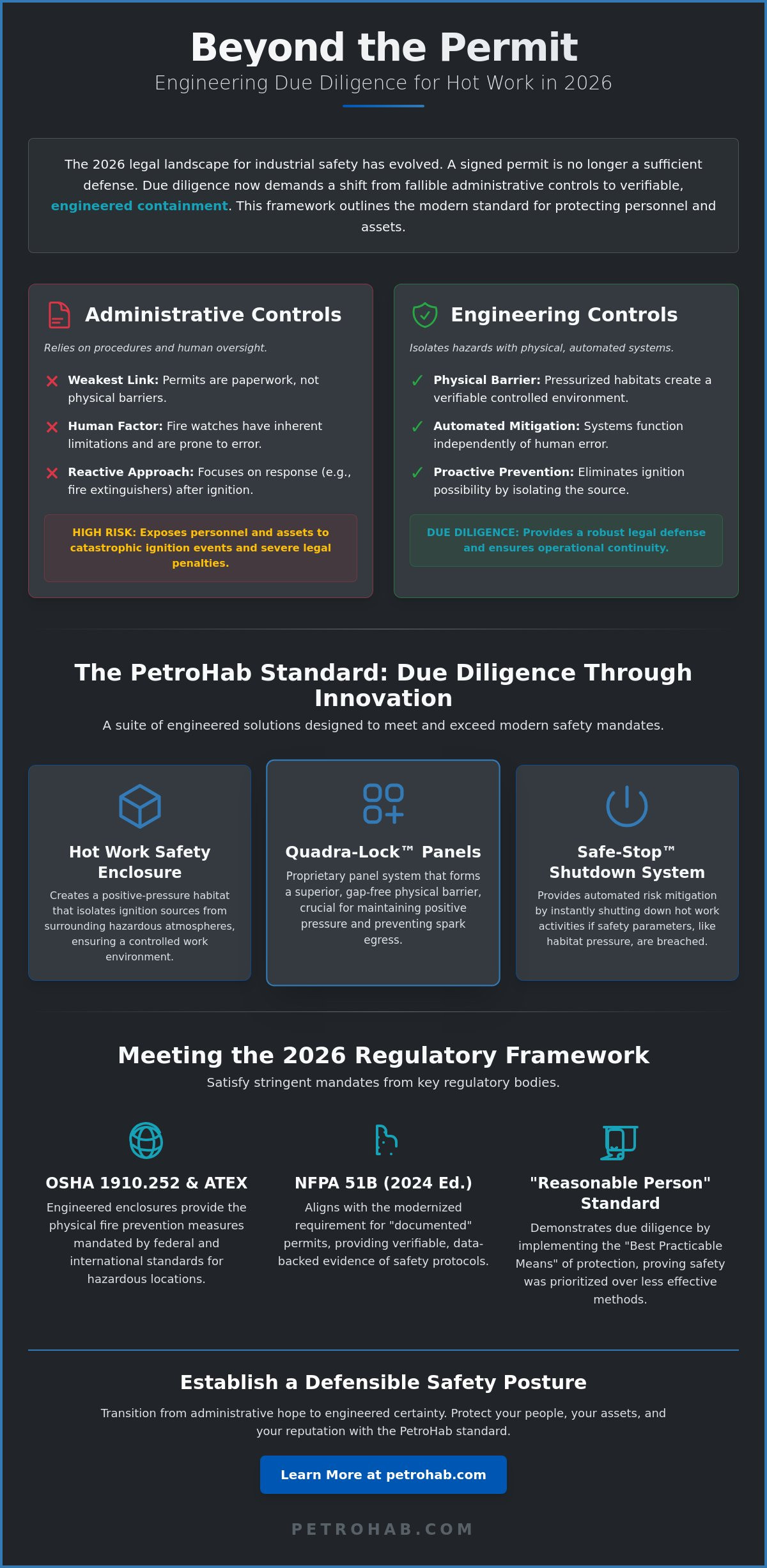
The hierarchy of hazard control dictates that engineering remedies provide a higher degree of reliability than administrative procedures. While permits, training, and signage serve as essential organizational layers, they don’t physically prevent ignition. Administrative controls rely on human compliance and consistent behavior, which are inherently variable and prone to failure. In contrast, engineering controls like pressurized welding enclosures and automatic shutdown systems provide a technological solution that remains constant regardless of personnel changes or shift duration. Demonstrating due diligence in hot work safety requires a strategic shift toward these higher-level controls to ensure that safety isn’t dependent on the absence of human error.
Automated fail-safes offer a level of precision that manual oversight cannot achieve. A Safe-Stop Automatic Shutdown System monitors environmental conditions in real time, reacting to pressure drops or gas detection within milliseconds. This rapid response eliminates the lag time associated with human intervention. By integrating these systems, safety managers move from a reactive posture to a proactive one, establishing a verifiable safety framework that stands up to regulatory scrutiny. This methodical approach to risk mitigation defines the modern standard for heavy industry operations.
The Fallibility of the Fire Watch
Manual fire monitoring is subject to the limitations of human biology. During extended shifts in high-temperature environments, cognitive fatigue reduces situational awareness. A fire watch might fail to notice a smoldering spark or a slow gas leak until an incident occurs. These human senses simply can’t compete with advanced hot work safety systems that utilize continuous gas monitoring and automated sensors. From a cost-benefit perspective, utilizing a PetroHab HWSE reduces the long-term overhead of dedicated personnel while providing a significantly higher margin of safety and a more robust due diligence record.
Verifiable Containment with Pressurized Habitats
Pressurized habitats operate on the principle of positive pressure. By maintaining a higher internal pressure than the surrounding atmosphere, the system creates a physical barrier that prevents flammable vapors from entering the work area. The integrity of this barrier depends entirely on the construction of the enclosure. Modular systems that utilize Quadra-Lock technology eliminate the gaps common in inferior panel designs. This ensures a verifiable, spark-tight seal that contains all hot work byproducts. Using these systems is a definitive method of demonstrating due diligence in hot work safety, as it provides a documented, engineered remedy that actively guards against ignition risks in Zone 1 and Zone 2 environments.
Implementing a Verifiable Safety Protocol
A robust safety protocol begins with a site-specific Job Safety Analysis (JSA) conducted prior to equipment deployment. This analysis identifies localized hazards that generic permits often overlook. Once the PetroHab HWSE is assembled, technicians must establish baseline environmental parameters. This process involves setting specific thresholds for internal positive pressure and gas concentration levels. These baselines act as the operational benchmark for the Safe-Stop system, ensuring that any deviation from the established safety window triggers an immediate response. Demonstrating due diligence in hot work safety requires this level of granular, pre-operational planning to mitigate foreseeable risks.
Integrating third-party on-site supervision provides an additional layer of objective oversight. These experts verify that all protocols are followed precisely, which strengthens the organization’s legal and moral standing. Following the completion of the work, a comprehensive post-work review is essential. All documentation, from the initial JSA to the final inspection report, must be archived in a centralized digital system. This creates a permanent, legally defensible record of the safety measures taken. By maintaining these archives, you provide clear evidence that every reasonable precaution was taken to protect personnel and high-value assets during live plant operations.
Automated Data Logging for Compliance
Modern due diligence relies on verifiable data rather than subjective observations. The Safe-Stop Automatic Shutdown System provides a continuous digital audit trail of environmental conditions throughout the hot work duration. This telemetry logs every pressure fluctuation and gas detection event, offering an indisputable record of habitat integrity. Integrating this data into enterprise safety management systems allows for real-time monitoring and historical analysis. In 2026, these digital signatures are the cornerstone of a defensible safety posture. They prove that engineering controls were active and effective, providing the “verifiable data” that regulatory bodies now expect during audits.
Training and Competency Verification
Technology is only as effective as the personnel operating it. Organizations must ensure that all operators are fully certified in the use of pressurized welding habitats. Documenting this competency serves as a critical defense against claims of improper use or negligence. Utilizing OEM-led on-site training sessions ensures that your team understands the granular technical details of the Quadra-Lock panels and the Safe-Stop interface. This commitment to training reinforces the organization’s role as a proactive guardian of site safety. To secure your facility with these industry-leading systems, consult with the experts at PetroHab to establish your verifiable safety framework.
The PetroHab Standard: Due Diligence Through Innovation
The PetroHab Standard defines the peak of industrial safety engineering. By integrating the PetroHab Hot Work Safety Enclosure (HWSE) into live plant operations, organizations move beyond basic compliance into a state of verifiable protection. These systems exceed international standards for fire resistance, providing a resilient barrier against the extreme temperatures generated during welding and grinding. Demonstrating due diligence in hot work safety requires this level of technical commitment, where every component is engineered to eliminate the possibility of ignition in hazardous zones. Relying on outdated containment methods is a risk that modern safety managers can no longer afford to take.
Global support and certified on-site supervision further enhance the due diligence record. PetroHab doesn’t just provide hardware; it offers a comprehensive safety partnership. This includes expert oversight to ensure that every enclosure is deployed according to the most rigorous safety protocols. This service-level commitment provides a significant boost to an organization’s risk mitigation profile, ensuring that assets and personnel remain protected under the most challenging operational conditions. This methodical approach to safety excellence is why the PetroHab name is synonymous with reliability in the energy and safety sectors.
Quadra-Lock: Engineering Out the Risk
The patented Quadra-Lock panel interlocking system represents a fundamental advancement in habitat integrity. Unlike inferior systems that rely on fasteners or flaps that can leave dangerous gaps, Quadra-Lock Panels create a continuous, spark-tight seal. This mechanical certainty is the highest form of verifiable due diligence. These panels are manufactured from durable, high-specification materials specifically designed to withstand the corrosive atmospheres of offshore environments. By engineering out the risk of spark escape, PetroHab ensures that the habitat remains an isolated environment, regardless of the surrounding atmosphere. This level of precision is essential for maintaining site integrity during high-stakes maintenance activities.
Safe-Stop and Automatic Risk Mitigation
The Safe-Stop Automatic Shutdown System acts as the final, uncompromising layer of protection. It removes the human element from emergency decision-making by monitoring the Lower Explosive Limit (LEL) and internal habitat pressure in real time. If gas is detected or pressure falls below the established baseline, the system immediately terminates power to the hot work equipment. This automated risk mitigation provides an indisputable record of safety excellence that stands up to the most rigorous audits. Demonstrating due diligence in hot work safety is made possible through this marriage of high-integrity containment and intelligent automation. Contact PetroHab to secure your hazardous work site today.
Achieving Operational Excellence Through Engineered Containment
The landscape of industrial safety in 2026 demands more than administrative compliance. It requires a definitive shift toward automated engineering controls that physically eliminate ignition risks. By prioritizing high-integrity containment and real-time environmental monitoring, you establish a defensible safety posture that protects both personnel and high-value assets. Demonstrating due diligence in hot work safety is no longer a subjective claim; it’s a verifiable outcome achieved through technical precision and the elimination of human error. Relying on the hierarchy of controls ensures that your facility remains productive while meeting the most stringent global mandates.
PetroHab provides the necessary framework for this transition. Our ATEX and IECEx certified systems, featuring patented Quadra-Lock technology, ensure a gap-free barrier in the most hazardous environments. With global on-site supervision available, your facility gains a seasoned partner dedicated to zero-incident execution. Secure your operations and validate your commitment to safety excellence by choosing systems engineered for the highest stakes. Request a Quote for PetroHab HWSE Systems to integrate the industry benchmark in pressurized habitat technology. Your path to a resilient, incident-free work site begins with proven engineering.
Frequently Asked Questions
What are the four pillars of hot work due diligence?
The four pillars consist of rigorous risk assessment, implementation of engineering controls, verified personnel competency, and comprehensive documentation. These elements work together to create a defensible framework for demonstrating due diligence in hot work safety. By addressing each pillar, safety managers ensure that hazards are identified, physically contained, managed by trained professionals, and recorded for future regulatory audits. This structured approach ensures no safety gaps remain during hazardous operations.
How does a pressurized welding habitat prove due diligence better than a fire watch?
A pressurized welding habitat offers a physical, fail-safe barrier that human oversight cannot replicate. While a fire watch relies on visual detection and manual response, a habitat actively prevents flammable gases from entering the work area through positive pressure. This shift from administrative to engineering controls provides a higher degree of reliability. It demonstrates that the organization chose the most effective technological remedy available to protect its personnel and assets.
Is an automatic shutdown system required by OSHA for hot work?
OSHA 1910.252 mandates that fire prevention measures must be taken, but it doesn’t name specific technologies. However, in hazardous environments where explosive gases may be present, an automatic shutdown system like Safe-Stop is considered a best practice for meeting the “Reasonable Person” standard. In 2026, failing to utilize automated risk mitigation in high-hazard zones may be interpreted as a lack of due diligence during a post-incident investigation by federal authorities.
What is the difference between Zone 1 and Zone 2 in hot work safety?
Zone 1 and Zone 2 classifications define the frequency and duration of explosive atmospheres. Zone 1 identifies areas where flammable gases are likely to be present during normal operations. Zone 2 covers areas where such atmospheres are unlikely but may occur for short durations. Both environments demand the use of ATEX or IECEx certified pressurized habitats to ensure that any hot work remains isolated from potential ignition sources at all times.
How often should hot work safety enclosures be inspected for compliance?
Enclosures must be inspected at the start of every shift and continuously monitored during use. Technicians should verify the integrity of all Quadra-Lock panels and check for any signs of wear or breach in the seal. Continuous electronic monitoring of internal pressure and gas levels provides the most reliable data. Documenting these frequent checks is a critical component of demonstrating due diligence in hot work safety during a regulatory audit or insurance review.
Can a hot work permit alone protect a company from legal liability?
A permit is merely an administrative gateway and does not constitute a physical defense against ignition. Legal liability often hinges on whether the employer took every “reasonable precaution” beyond simple paperwork. If an incident occurs, regulatory bodies will examine the physical safeguards in place, such as pressurized welding enclosures. Relying solely on a permit without active engineering containment is often viewed as insufficient in high-risk industrial environments where the stakes are extreme.
What role does Quadra-Lock technology play in habitat safety?
Quadra-Lock technology provides the patented interlocking mechanism required for a gap-free, spark-tight enclosure. Standard panel systems often leave vulnerable points where sparks or slag could escape. Quadra-Lock Panels eliminate these risks by ensuring a mechanical seal that maintains habitat integrity under pressure. This innovation is essential for protecting high-value assets and ensuring that the containment system meets the highest international safety certifications. It represents the industry benchmark for environmental isolation.
How do I document the use of an HWSE for a safety audit?
Effective documentation requires the use of automated data logging from systems like Safe-Stop. These systems generate digital audit trails that record internal pressure and gas concentrations at regular intervals throughout the operation. You should archive these logs alongside the initial Job Safety Analysis and operator competency certificates. This collection of verifiable data proves that the safety enclosure functioned correctly, providing the documented evidence required to satisfy 2026 regulatory standards.