Blog Posts
Pressurized Welding Enclosure Benefits: Maximizing Safety and Operational Efficiency in 2026
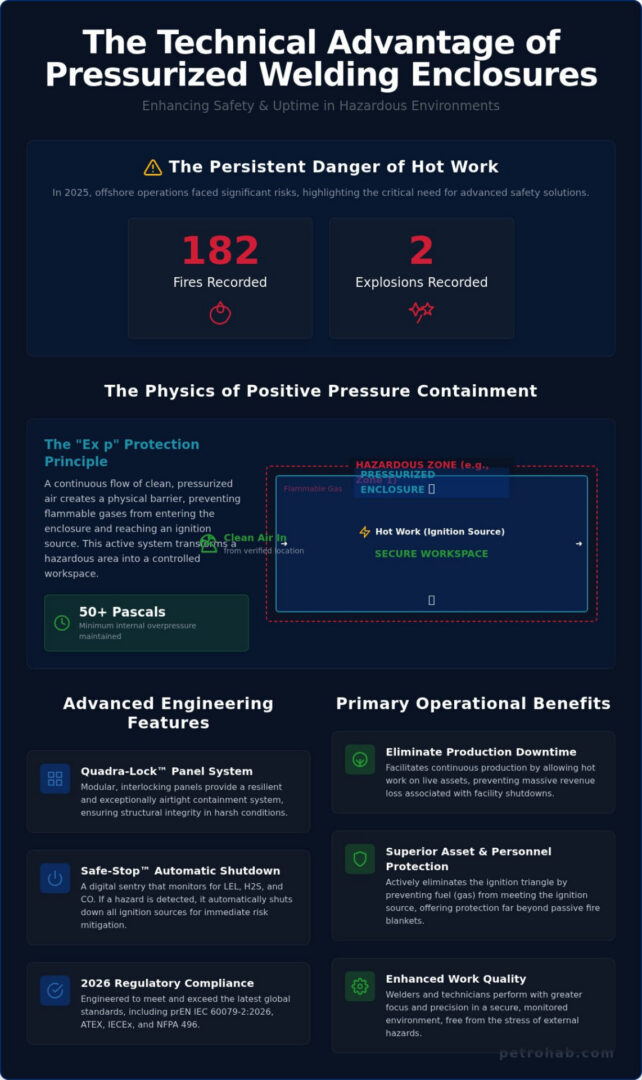
In 2025, the Bureau of Safety and Environmental Enforcement recorded 182 fires and two explosions across offshore operations, highlighting the persistent danger of hot work in volatile environments. You understand the immense pressure of maintaining a zero-incident safety record while facing the threat of massive revenue loss during production shutdowns. Understanding pressurized welding enclosure benefits is no longer just about safety. It’s about operational survival in 2026. By utilizing the “Ex p” protection principle, these systems maintain a minimum internal pressure of 50 Pascals to prevent the ingress of flammable gases. This ensures that critical maintenance doesn’t compromise your facility’s integrity.
This guide examines how the latest prEN IEC 60079-2:2026 standards and updated ATEX guidelines redefine hazardous area management. You’ll discover how modular Quadra-Lock panels and the Safe-Stop Automatic Shutdown System eliminate ignition risks and allow for continuous production during hot work. We’ll analyze the technical specifications required for full regulatory compliance, including the NFPA 496 standard, and demonstrate how these engineered solutions protect your personnel and high-value assets. Our methodical approach provides the technical precision necessary to manage high-stakes industrial sites with absolute confidence.
Key Takeaways
- Understand how maintaining controlled overpressure prevents flammable gas ingress in high-risk zones.
- Discover the primary pressurized welding enclosure benefits that facilitate continuous production and eliminate the need for facility shutdowns.
- Examine the technical advantages of Quadra-Lock panels for creating a more resilient and airtight containment system.
- Learn why the Safe-Stop Automatic Shutdown System is critical for monitoring environmental hazards and ensuring immediate risk mitigation.
- Review the 2026 regulatory framework to ensure your hot work protocols meet the latest international safety standards.
The Critical Role of Pressurized Welding Enclosures in Hazardous Zones
A PetroHab Hot Work Safety Enclosure (HWSE) provides a strictly controlled environment for executing high-risk maintenance tasks in potentially explosive atmospheres. In sectors like oil, gas, and petrochemicals, where Zone 1 and Zone 2 classifications are standard, these systems are essential. They serve as more than just physical barriers; they are active atmospheric management tools. One of the primary pressurized welding enclosure benefits is the ability to isolate a hot work ignition source from surrounding flammable gases. Traditional barriers, such as fire blankets or welding screens, offer zero protection against gas ingress. In contrast, an HWSE creates a localized environment where ignition risks are technically mitigated through engineered containment.
The Physics of Positive Pressure Containment
The efficacy of a Positive pressure enclosure relies on a fundamental pressure differential. By maintaining an internal atmosphere at a higher pressure than the external environment, the system physically prevents the entry of hydrocarbons or other flammable vapors. High-capacity air blowers draw clean air from a remote, verified location and force it into the enclosure. This constant air exchange ensures that even if the external atmosphere becomes hazardous, the workspace remains protected. Manometers are integrated into the system to provide continuous verification of the internal-to-external pressure ratio. This ensures the system maintains the required 50 Pascal (Pa) minimum baseline mandated by 2026 safety protocols.
Meeting International Safety Standards in 2026
Compliance with global hazardous environment standards is a critical operational requirement for 2026. Regulatory bodies and facility operators now demand rigorous certification for all hot work equipment. PetroHab systems integrate hardware that adheres to ATEX and IECEx certifications, providing a verified safety layer for both the enclosure and the associated monitoring electronics. These pressurized welding enclosure benefits align directly with complex Permit-to-Work (PTW) protocols. By providing a certified and monitored environment, safety managers can authorize hot work on live assets without triggering the mandatory facility shutdowns often associated with traditional maintenance methods. This technical alignment ensures that safety doesn’t come at the expense of operational continuity. The system functions as a critical safety partner, protecting personnel and high-value assets during essential repairs.
Primary Safety Benefits: Beyond Simple Fire Suppression
Traditional fire containment relies on passive barriers like fire blankets. These methods fail to address the core risk in hazardous zones: the presence of flammable vapors. Transitioning to active, pressurized habitats represents a fundamental shift in risk mitigation. One of the key pressurized welding enclosure benefits is the technical elimination of the “Ignition Triangle.” By maintaining a positive pressure barrier, the system ensures that fuel source gases never meet the ignition source. This active guardianship protects high-value assets from slag and sparks that passive barriers might let through. It transforms a high-risk area into a controlled workspace where maintenance occurs without threatening the facility’s overall safety profile.
Beyond the mechanical protections, there’s a significant psychological advantage. Welders working within a secure, monitored environment perform with greater focus and precision. When technicians aren’t constantly scanning for external hazards, their weld quality improves. This confidence is anchored in the knowledge that the system is engineered to meet or exceed OSHA hot work regulations. A secure environment allows for meticulousness that isn’t possible under the stress of inadequate containment.
Automated Gas Detection and the Safe-Stop System
Modern pressurized welding enclosure benefits include the integration of advanced monitoring hardware. The Safe-Stop Automatic Shutdown System acts as a digital sentry. It utilizes sensors to monitor for Lower Explosive Limits (LEL) and toxic gases like H2S or CO. If the system detects a breach in pressure or the presence of hazardous gases, it triggers an immediate power isolation. This fail-safe mechanism cuts electricity to all welding equipment inside the enclosure instantly. Such redundancy is a hallmark of sophisticated hot work safety systems. By removing the heat source before a hazard can escalate, the system ensures a zero-incident environment.
Environmental and Personnel Protection
Enclosures provide a dual layer of protection for personnel. First, they contain harmful welding fumes and extract them through dedicated ventilation while simultaneously pumping in fresh, breathable air. Second, they shield the workforce from harsh external conditions. Whether it’s high winds on an offshore platform or extreme heat in a refinery, the HWSE creates a stable microclimate. Visual contact remains a priority; integrated window panels allow welders to maintain a line of sight with external safety observers. This ensures that communication and oversight are never compromised during critical tasks. For organizations seeking to upgrade their site safety protocols, investing in PetroHab HWSE solutions provides a definitive technological remedy to atmospheric hazards.
Operational Efficiency: Minimizing Production Downtime
While safety remains the primary directive, the most significant commercial driver for adopting these systems is the total avoidance of facility shutdowns. In heavy industry, a single day of lost production can equate to millions in lost revenue. Implementing “Live Plant” welding allows operators to perform critical repairs while the facility remains online. This stands in stark contrast to traditional turnaround-based maintenance, which requires extensive venting, purging, and the complete cessation of operations. One of the most tangible pressurized welding enclosure benefits is this ability to maintain continuous cash flow during essential structural or piping repairs.
The cost-benefit ratio of habitat rental is overwhelmingly favorable when compared to the revenue loss of a 24-hour production halt. By isolating the ignition source, operators can schedule maintenance tasks parallel to production cycles rather than waiting for scheduled outages. This flexibility ensures that minor defects don’t escalate into catastrophic failures due to deferred maintenance. Adhering to EPA hot work permit requirements becomes a streamlined process when the technology provides a verified, non-hazardous environment within a high-risk area.
Streamlining the Permit-to-Work Process
The presence of a PetroHab HWSE simplifies the approval of high-risk permits by providing a documented, engineered barrier against gas ingress. It reduces the logistical burden of “fire watch” personnel because the Safe-Stop system provides automated, continuous monitoring that human observation can’t match. HWSE technology eliminates the administrative friction typically associated with multi-departmental hot work approvals by providing a standardized safety baseline. This efficiency allows teams to move from permit application to execution with significantly less delay.
Versatility Across Onshore and Offshore Assets
Operational requirements vary significantly between offshore platforms, FPSOs, and onshore refineries. The modularity of the Quadra-Lock panels allows technicians to construct enclosures around complex piping geometries and structural obstructions that would impede traditional containment. This technical adaptability ensures that pressurized welding enclosure benefits are accessible regardless of the site’s physical constraints. For a deeper analysis of these systems, refer to the Definitive Guide to Hot Work Safety Enclosures (HWSE) in 2026. By integrating modularity with automated safety, operators secure both their assets and their production schedules.
The Quadra-Lock Advantage: Technical Superiority and Integrity
The integrity of a pressurized habitat depends entirely on the seal between its individual components. Traditional containment systems often rely on zippers, hook-and-loop fasteners, or adhesive tapes; all of these methods are prone to degradation and leakage under pressure. Quadra-Lock technology has established itself as the industry benchmark for panel interlocking integrity. This patented system utilizes a mechanical interlock that ensures a significantly more airtight seal than conventional fasteners. By creating a rigid, uniform connection between panels, the system maintains the required internal overpressure with greater efficiency and less strain on air delivery hardware.
Operational speed is a critical metric in heavy industrial maintenance. The modular nature of these panels allows for rapid assembly, which significantly reduces the labor hours required for initial setup and subsequent decommissioning. These systems are engineered for resilience. In offshore environments where high-UV exposure and salt-spray corrosion quickly compromise standard materials, Quadra-Lock panels retain their structural and pneumatic integrity. This durability ensures that the pressurized welding enclosure benefits remain consistent throughout the duration of a project, regardless of the environmental severity.
Modular Configuration for Complex Geometries
Industrial sites rarely offer flat, unobstructed surfaces for enclosure placement. The PetroHab system provides a “Lego-like” versatility that allows technicians to build enclosures around complex intrusions, such as structural beams, piping manifolds, and electrical conduits. Specialized panels facilitate these custom configurations without compromising the pressure seal. This adaptability ensures that hot work can be performed exactly where it’s needed, rather than where space permits. For detailed technical specifications regarding these configurations, safety managers should consult Pressurized Welding Habitats: The Definitive Guide to HWSE Technology.
Material Engineering and Fire Resistance
The engineering behind Quadra-Lock extends to the technical properties of the panel fabric itself. Each panel is constructed from high-spec, fire-retardant materials designed to withstand extreme temperatures without melting or structural failure. This thermal resistance is vital when containing high-amperage welding arcs and molten slag. Despite their technical strength, the panels remain lightweight. This reduces the logistical burden of transport and improves manual handling safety for on-site personnel. To secure your facility with the most advanced containment technology, explore the full range of Quadra-Lock panel systems today. The system acts as a durable guardian, ensuring that high-heat tasks never compromise the surrounding asset’s integrity.
Strategic Implementation: Maximizing the Value of Your HWSE
Strategic implementation requires a rigorous assessment of both technical capabilities and long-term support infrastructure. Safety procurement officers must evaluate systems not just on immediate availability, but on the supplier’s ability to provide global technical assistance. Selecting hot work safety enclosure suppliers with established footprints in key energy hubs like the USA, Brazil, and the UK ensures that certified personnel and replacement components are accessible without logistical delays. This global support network is essential for maintaining the pressurized welding enclosure benefits across diverse geographical assets. Beyond equipment, the integration of certified on-site supervision ensures that system integrity is never compromised during complex shifts. These experts verify that every Quadra-Lock connection and Safe-Stop sensor functions according to the latest 2026 international standards.
Rental vs. Purchase: A Strategic Comparison
Organizations must choose between rental and purchase models based on their specific operational cadence. Short-term maintenance projects or infrequent turnarounds typically favor a rental model. This categorizes the cost as OPEX and eliminates long-term storage and maintenance duties. Conversely, purchasing an HWSE as a facility asset shifts the investment to CAPEX. This model is ideal for sites with continuous hot work requirements or remote locations where mobilization costs are prohibitive. Ownership necessitates a dedicated protocol for the inspection, cleaning, and climate-controlled storage of Quadra-Lock panels to ensure their longevity. Each model has distinct tax implications that your financial department should analyze against your project’s duration.
The Human Element: Supervision and Training
Technological redundancy through the Safe-Stop system is only one component of a zero-incident strategy. Expert supervision is critical for managing the atmospheric variables inherent in heavy industry, particularly when working near live process equipment. Certified supervisors monitor pressure gradients and gas levels in real-time. This provides an additional layer of human oversight that responds to site-specific anomalies. Comprehensive personnel training empowers internal teams to manage basic habitat operations safely. It’s a method that builds institutional knowledge and reinforces a culture of safety. The PetroHab approach combines this technical training with elite supervision, creating a full-service safety partnership that protects personnel and high-value assets.
Securing the Future of Hazardous Area Operations in 2026
The evolution of hot work safety has shifted from passive containment to active, atmospheric management. Implementing these systems ensures that ignition risks are technically eliminated while facility uptime is maintained. One of the most significant pressurized welding enclosure benefits is the ability to execute critical repairs on live assets without the revenue loss associated with facility shutdowns. By integrating patented Quadra-Lock technology with the Safe-Stop Automated Shutdown System, operators achieve a zero-incident safety record that meets the most rigorous 2026 international standards.
PetroHab remains the industry benchmark for technical precision and safety excellence. Our global on-site support and training programs empower your teams to manage high-stakes environments with absolute confidence. Reliability in hazardous zones is built on uncompromising engineering and meticulous risk mitigation. We invite you to Request a Technical Consultation and Quote for PetroHab HWSE Systems to secure your high-value assets. Take the definitive step toward operational excellence and personnel protection today.
Frequently Asked Questions
What are the primary benefits of using a pressurized welding enclosure?
One of the primary pressurized welding enclosure benefits is the ability to conduct hot work without shutting down high-value assets. These systems isolate ignition sources from flammable gases, ensuring personnel safety and asset integrity. By maintaining a controlled environment, facilities avoid the multi-million dollar costs associated with production stops. This technical remedy allows for maintenance to occur parallel to production cycles, meeting the rigorous safety demands of 2026 industrial operations.
How does a positive pressure habitat prevent explosions during hot work?
Explosion prevention relies on the “Ex p” protection principle, which maintains an internal pressure of 50 Pascals higher than the external atmosphere. This pressure gradient physically blocks the entry of hydrocarbons or flammable vapors into the workspace. By technically eliminating the fuel source from the “Ignition Triangle,” the habitat ensures that sparks or arcs cannot trigger a catastrophic event. Continuous monitoring by manometers verifies this barrier remains constant during all hot work activities.
Can welding enclosures be used on live offshore platforms?
Yes, pressurized welding enclosures are specifically engineered for use on live offshore platforms and FPSOs. They allow for essential maintenance within 10 feet of pressurized process equipment, which typically requires a facility shut-in under BSEE rules. By providing a certified, non-hazardous work area, operators maintain continuous production. The modular Quadra-Lock panels adapt to the complex structural geometries and piping common in offshore environments, ensuring a secure seal regardless of site constraints.
What is the Safe-Stop automatic shutdown system?
The Safe-Stop Automatic Shutdown System is a redundant safety mechanism that continuously monitors for gas ingress and pressure loss. It utilizes high-precision sensors to detect Lower Explosive Limits (LEL) and toxic gases like H2S. If conditions deviate from safety parameters, the system immediately isolates power to all welding equipment inside the enclosure. This rapid response removes the heat source before a hazard can escalate, acting as an active guardian for the site.
How long does it take to assemble a modular hot work enclosure?
Assembly duration depends on the enclosure’s volume and structural complexity, but modular Quadra-Lock panels allow for significantly faster setup than traditional containment. A standard-sized PetroHab HWSE can often be commissioned within a single shift. This speed reduces labor hours and minimizes the footprint of maintenance crews on-site. The interlocking mechanism ensures that panels are joined securely without the need for specialized tools or extensive manual handling, making it an efficient solution.
Are pressurized habitats compliant with ATEX and IECEx standards?
All PetroHab systems are engineered to comply with the latest ATEX and IECEx standards, which are mandatory for equipment used in explosive atmospheres. Compliance ensures that both the enclosure materials and the monitoring electronics, like the Safe-Stop system, meet international safety benchmarks. Adherence to these standards is a key component of pressurized welding enclosure benefits, providing safety managers with verified proof of the system’s reliability and technical precision in Zone 1 and Zone 2 areas.
What is the difference between a traditional fire blanket and an HWSE?
A traditional fire blanket is a passive barrier designed only to contain sparks and slag. It provides no protection against the ingress of flammable gases. In contrast, a Hot Work Safety Enclosure (HWSE) is an active containment system that utilizes positive pressure to prevent gas entry. While fire blankets are suitable for non-hazardous areas, only a pressurized HWSE creates a controlled environment capable of mitigating ignition risks in potentially explosive atmospheres common in the energy sector.
Is it better to rent or buy a hot work safety enclosure for a 30-day turnaround?
For a 30-day turnaround, renting a hot work safety enclosure is generally the more efficient strategic choice. Rental models categorize the cost as OPEX and eliminate the long-term responsibilities of maintenance, certified inspection, and climate-controlled storage. This approach provides immediate access to the latest technology and certified on-site supervision without a large capital expenditure. It allows procurement officers to align safety costs directly with the specific duration and scope of the maintenance project.