
Blog Posts
Safe Habitat Entry and Exit Protocol: Ensuring Integrity in Pressurized Hot Work Environments
A single door cycle during hot work represents the most vulnerable moment in your containment strategy. You already know that maintaining positive pressure isn’t just a regulatory requirement; it’s the definitive barrier between a controlled welding environment and a catastrophic ignition event. Mastering a rigorous safe habitat entry and exit protocol is essential for safety managers who refuse to compromise on site integrity.
This article provides the technical precision needed to manage pressurized environments effectively. You’ll learn how to maintain constant pressure during personnel transfers and prevent the ingress of flammable gases according to the latest 2024 NFPA 51B and April 2026 OSHA standards. We’ll examine the mechanics of air-lock transitions, the structural reliability of Quadra-Lock panels, and the systematic training required to achieve zero ignition incidents. By the end of this guide, you’ll have a standardized framework to ensure your PetroHab Hot Work Safety Enclosure remains an impenetrable fortress against external hazards.
Key Takeaways
- Establish the ‘One-Door-At-A-Time’ mandate as the primary defense against internal overpressure loss and external gas ingress during personnel transfers.
- Coordinate atmospheric testing protocols with documented Permit-to-Work (PTW) requirements to ensure compliance with 2024 NFPA 51B standards before habitat commissioning.
- Execute a standardized safe habitat entry and exit protocol that utilizes real-time manometer data to verify atmospheric stability before every door cycle.
- Leverage the Safe-Stop Automatic Shutdown System to automate habitat monitoring and provide definitive protection against ignition risks during critical entry sequences.
- Utilize Quadra-Lock panel technology to secure the door frame, ensuring that structural integrity remains uncompromised during high-frequency transitions.
The Critical Role of Entry and Exit Protocols in Hot Work Safety Enclosures
A safe habitat entry and exit protocol serves as the operational backbone for any pressurized hot work environment. It’s a rigorous, step-by-step procedure designed to facilitate the transfer of personnel and equipment while maintaining constant internal overpressure. In high-stakes industrial settings, the entrance of a PetroHab Hot Work Safety Enclosure (HWSE) represents the most significant vulnerability. Every door cycle introduces a potential failure point where flammable gases could infiltrate the workspace if the pressure differential isn’t strictly managed.
The primary function of hot work safety enclosures is to isolate ignition sources from the surrounding hazardous atmosphere. This isolation isn’t static; it requires active management of the habitat’s integrity during every transition. If the protocol isn’t followed, the “virtual air-lock” collapses, immediately exposing the hot work site to external hazards.
To visualize these critical procedural steps, watch this technical review:
Maintaining the Pressure Barrier
Effective containment relies on the physical principles of a Positive pressure enclosure. Industry standards generally mandate a minimum overpressure of 0.05 inches of water column to ensure that air only flows outward. An air-lock system facilitates this by using two sets of doors that are never opened simultaneously. This mechanical barrier prevents atmospheric bypass, ensuring that the internal atmosphere remains gas-free even when workers move in or out. Failure to maintain this pressure leads to an immediate loss of containment, transforming a controlled environment into a high-risk ignition zone.
Regulatory Foundations: OSHA and ATEX Compliance
Rigorous entry protocols aren’t just best practices; they’re mandated by international safety standards. Aligning your safe habitat entry and exit protocol with OSHA 1910.146 ensures that pressurized welding enclosures meet permit-required confined space standards. This regulation focuses on the safety of entrants and the necessity of continuous atmospheric monitoring.
In European markets or offshore environments, ATEX Zone 1 and Zone 2 classifications dictate the engineering requirements for entry and exit transitions. A designated “Habitat Watcher” or “Safety Standby” must remain stationed at the entrance at all times. This individual’s sole responsibility is to monitor manometer readings, manage the door cycles, and initiate emergency egress if an alarm state occurs. Their role is critical in preventing human error from compromising the structural and atmospheric integrity provided by Quadra-Lock panels and the Safe-Stop Automatic Shutdown System.
Pre-Entry Requirements: Atmospheric Testing and Permit Compliance
Rigorous safety begins long before a technician crosses the threshold. Every Petro-Habitat deployment requires a mandatory gas-free certification as the final step of commissioning. This process validates that the internal atmosphere is devoid of hydrocarbons or toxic contaminants. Integrating these pre-entry steps into the facility’s Permit-to-Work (PTW) system creates a layered defense, ensuring that hot work only commences when every environmental variable is controlled. This systematic approach transforms the habitat into a definitive barrier against external hazards.
Atmospheric Monitoring Protocols
Continuous vigilance is the industry standard for high-risk environments. Technicians must conduct initial testing for Lower Explosive Limit (LEL), Hydrogen Sulfide (H2S), and Oxygen levels specifically at the air-lock threshold. While some general safety standards only require a pre-entry check, compliance with OSHA hot work regulations necessitates continuous gas detection at both the air intake and the entry point. Portable gas detectors used by entrants must undergo daily bump tests and regular calibration to maintain technical precision. This proactive monitoring ensures that any atmospheric shift is identified before it threatens personnel safety.
Entrants must wear full fire-retardant clothing and appropriate respiratory protection as dictated by the site’s hazard assessment. Before entry, the Safety Standby conducts a mandatory briefing to review the specific air-lock mechanics. This ensures every individual understands the safe habitat entry and exit protocol and the critical nature of the “one-door” rule. If you’re currently evaluating safety vendors, consider how their equipment supports these rigorous standards by reviewing our hot work habitat training and procurement resources.
Documentation and Access Control
Accountability is maintained through a robust access control system, typically utilizing T-Cards or a digital equivalent to track personnel counts inside the HWSE. The Safety Standby verifies that all entrants have completed their specific orientation before allowing access. Communication integrity is the final check; radio contact between the entrant and the standby must be confirmed at the threshold. These disciplined measures ensure that every person inside the PetroHab Hot Work Safety Enclosure is accounted for and protected by a verified safety framework. By treating documentation as a functional component of the safety system, engineers can maintain 100% habitat integrity throughout the project lifecycle.
Executing the Safe Habitat Entry and Exit Protocol: Step-by-Step
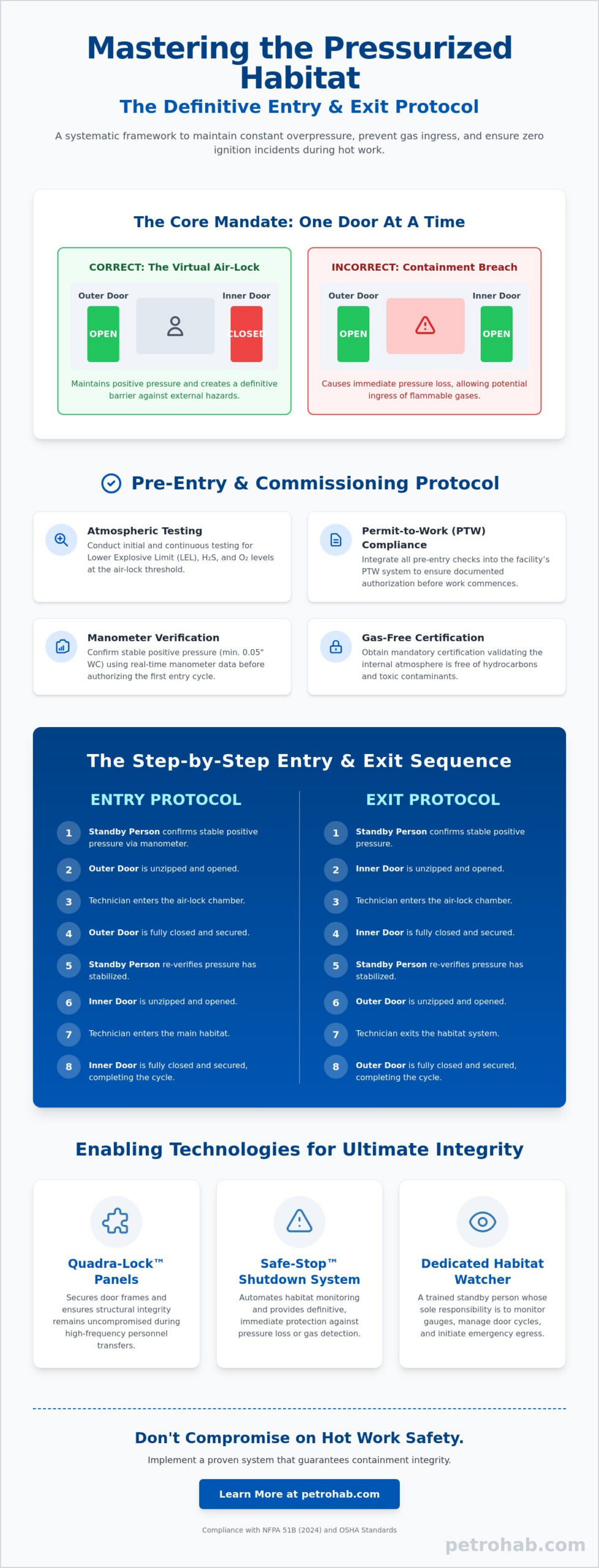
The ‘One-Door-At-A-Time’ rule is the fundamental law of air-lock integrity. It’s a non-negotiable operational mandate that ensures the internal overpressure remains constant during personnel transitions. Unlike general confined spaces where access is simply a matter of entry, a pressurized PetroHab Hot Work Safety Enclosure (HWSE) relies on a mechanical transition zone. Opening both doors simultaneously causes an immediate collapse of the pressure barrier, inviting the ingress of external flammable gases. Every technician must treat the door cycle as a high-precision maneuver, relying on empirical data rather than intuition.
Visual and audible cues provide the necessary verification before any door is unlatched. Technicians must consult the external manometer or the Safe-Stop Automatic Shutdown System display to confirm the internal atmosphere is stable. A reading below 0.05 inches of water column indicates a potential breach or system failure; in such cases, the safe habitat entry and exit protocol must be suspended until pressure is restored. Managing tools and equipment requires similar discipline. Large items should be staged in the air-lock chamber first, ensuring the outer seal is restored before the inner door is ever engaged.
The Entry Sequence
- Step 1: Verify internal pressure via the external manometer or Safe-Stop display to ensure the habitat is within safe operating parameters.
- Step 2: Open the outer door, enter the air-lock chamber, and secure the outer door completely. Confirm the latch is fully engaged.
- Step 3: Wait for the air-lock chamber to pressurize. Confirm this via the internal indicator or the change in acoustic environment.
- Step 4: Open the inner door and enter the main work area. Secure the inner door behind you immediately to restore the 100% integrity of the Quadra-Lock panels.
The Exit Sequence
Egress begins with the cessation of all hot work. All ignition sources must be deactivated and secured before the exit sequence is initiated. The reverse air-lock procedure mirrors the entry steps; the inner door must be sealed and verified before the outer door is cracked. This prevents a sudden pressure drop that could trigger an automatic shutdown of the ventilation system. Upon successful egress, the technician must report immediately to the Safety Standby. This update to the personnel log ensures that the ‘T-Card’ system accurately reflects the current occupancy of the Petro-Habitat, maintaining total site accountability.
Post-entry verification is the final safeguard. Once the entrant is inside, the Safety Standby must confirm that the manometer has returned to its target setpoint. This confirms the seal is restored and the environment is once again isolated from external hazards. Only after this verification should the signal be given to resume hot work activities.
Monitoring Habitat Integrity and Emergency Egress Procedures
Modern hot work safety systems eliminate the risks associated with human error by providing continuous, automated oversight of the enclosure’s integrity. While the safe habitat entry and exit protocol provides the procedural framework, the Safe-Stop Automatic Shutdown System acts as the final arbiter of safety. It monitors the internal atmosphere and pressure levels in real-time, ensuring that any breach of the physical barrier leads to an immediate cessation of hazardous activities. This technological integration transforms the habitat from a simple enclosure into an active safety guardian.
Identifying an alarm state is critical for the Safety Standby. A sudden pressure drop during a door cycle isn’t always an emergency, but it requires a calculated response. The system is engineered to distinguish between expected fluctuations and a critical loss of containment. If the pressure falls below the calibrated threshold and fails to recover within a specific window, the Safe-Stop system triggers an automatic power isolation. This ensures that the ignition source is neutralized before any external flammable gas can reach the welding arc or cutting flame. Protect your assets by integrating the Safe-Stop Automatic Shutdown System into your next project.
Safe-Stop Automatic Shutdown Logic
The differential pressure transmitter is the primary sensor for monitoring high-traffic periods. During the safe habitat entry and exit protocol, the system employs a 30-second rule. This logic allows for temporary pressure dips as the air-lock chamber equalizes, preventing nuisance shutdowns that disrupt productivity. However, if the pressure does not return to the mandatory 0.05 inches of water column within this timeframe, the system escalates from a ‘Warning’ state to a ‘Critical Breach.’ Visual and audio alarms provide immediate feedback to the standby, who must then halt all transitions and investigate the cause of the pressure loss.
Emergency Egress Protocols
Emergency exit procedures differ fundamentally from standard egress. In a high-threat scenario, such as a fire or gas detection at the air intake, personnel must bypass the air-lock mechanics for immediate evacuation. Modular HWSE configurations include primary and secondary escape routes to ensure multiple paths to safety. These exits utilize quick-release fasteners that allow technicians to breach the Quadra-Lock panels instantly without navigating the standard door sequence. Once outside, all personnel must follow established muster procedures. The habitat then requires a full re-certification and atmospheric test before hot work can resume, ensuring the site’s safety remains uncompromised.
Optimizing Habitat Safety with Quadra-Lock Technology and Expert Supervision
Structural integrity is the physical foundation of any safe habitat entry and exit protocol. While procedural discipline is vital, the hardware must withstand the mechanical stresses of continuous overpressure and frequent personnel transitions. A habitat that warps or develops gaps around the door frame during heavy use renders even the most rigorous protocol ineffective. PetroHab addresses this risk through superior engineering, ensuring that the physical barrier remains as disciplined as the personnel operating within it. This structural reliability is what separates an average enclosure from a definitive safety system.
The Quadra-Lock Advantage
The Quadra-Lock panel system provides the structural rigidity necessary for high-traffic hot work environments. Unlike traditional panels that may separate under pressure, Quadra-Lock technology utilizes a proprietary interlocking mechanism to ensure a 100% seal. This design is specifically engineered to eliminate weak points around the door frame, where mechanical stress is most concentrated during entry and exit cycles. Even after hundreds of cycles, these panels maintain their alignment, preventing the atmospheric bypass that leads to shutdown events. The resistance to warping ensures that the air-lock doors always seat correctly, which is a critical requirement for maintaining the mandatory 0.05 inches of water column overpressure.
Professional Training and Supervision
Technical expertise is the final component of a secure enclosure. PetroHab provides on-site supervision to ensure that rig-specific entry protocols are executed with technical precision. This is particularly valuable for high-risk offshore hot work where space is limited and egress paths are complex. Our technicians assist in customizing habitat footprints to accommodate specific site requirements, ensuring that emergency exit routes remain unobstructed and compliant with local safety regulations. Utilizing certified personnel to manage pressurized welding habitats significantly reduces the likelihood of procedural drift and human error.
For site managers, maintaining the integrity of the safe habitat entry and exit protocol requires a final verification phase. Before every shift, a checklist should be completed to confirm the following:
- Seal integrity of all Quadra-Lock panels, especially around the air-lock transition zone.
- Calibration and function of the Safe-Stop Automatic Shutdown System sensors.
- Confirmation of clear communication between the Safety Standby and internal personnel.
- Verification that all entrants have completed the rig-specific pre-entry briefing.
By combining advanced panel technology with professional oversight, industrial sites can achieve a state of operational excellence where safety is a constant, not a variable. This integrated approach ensures that every person and asset is protected by the most resilient systems available in the energy sector today. It’s about creating an environment where risk is managed through engineering excellence and procedural rigor.
Advancing Operational Integrity in Hazardous Environments
Maintaining 100% habitat integrity requires more than just high-quality equipment; it demands an uncompromising commitment to procedural discipline. By integrating a rigorous safe habitat entry and exit protocol with automated safety systems, operators effectively eliminate the risk of flammable gas ingress during hot work. This approach ensures that every door cycle is a calculated, controlled event rather than a site vulnerability. Consistency in these procedures is what protects your personnel and high-value assets from catastrophic failure.
PetroHab’s patented Quadra-Lock technology provides the structural foundation for these procedures, while ATEX and IECEx certified components ensure technical reliability in the world’s most demanding industrial sites. Our global track record in high-hazard environments demonstrates that zero ignition incidents are achievable through technical precision and superior engineering. Don’t leave your site safety to chance. Request a technical consultation on PetroHab HWSE and Safe-Stop systems to fortify your containment strategy. We’re ready to help you achieve operational excellence on your next project.
Frequently Asked Questions
What is the ‘one-door’ rule in habitat entry protocols?
The ‘one-door’ rule dictates that the inner and outer doors of an air-lock must never be open simultaneously. This mechanical restriction prevents a direct atmospheric bypass between the hazardous external environment and the controlled internal workspace. By ensuring one door remains sealed at all times, the system maintains the pressure differential required to prevent the ingress of flammable or toxic gases.
How much pressure must be maintained inside the habitat during entry?
Industry standards require a minimum overpressure of 0.05 inches of water column (12.5 Pa) to be maintained throughout the safe habitat entry and exit protocol. This specific pressure level ensures that airflow is always directed outward from the enclosure. Maintaining this benchmark is critical for creating a virtual barrier that isolates ignition sources from the surrounding explosive atmosphere.
Can tools be brought through the air-lock during active hot work?
Tools and equipment can be transferred through the air-lock while hot work is active if the transition follows the established staging procedure. Personnel must place equipment in the air-lock chamber and secure the outer door before opening the inner door. This staged movement preserves the habitat’s integrity and prevents sudden pressure drops that could trigger an automatic system shutdown.
What happens if the Safe-Stop system detects a pressure loss during exit?
The Safe-Stop system initiates an immediate power isolation of all ignition sources if pressure remains below the safety threshold for more than 30 seconds. This automatic shutdown logic ensures that if habitat integrity is breached during a transition, the risk of fire or explosion is neutralized. The system also activates visual and audible alarms to alert the Safety Standby of the critical breach.
Is a dedicated standby person required for every habitat entry?
A dedicated Safety Standby or Habitat Watcher is mandatory for every entry and exit cycle according to OSHA 1910.146 and NFPA 51B standards. This individual’s primary responsibility is to monitor manometer readings and manage the air-lock sequence. They serve as the final procedural check to ensure that personnel transfers don’t compromise the atmospheric isolation provided by the PetroHab HWSE.
How do Quadra-Lock panels improve the safety of the entry point?
Quadra-Lock panels utilize a patented interlocking mechanism that provides superior structural rigidity compared to traditional fabric or bolted systems. This technology eliminates gaps and prevents the door frame from warping under the mechanical stress of frequent personnel movement. By maintaining a 100% airtight seal, Quadra-Lock panels ensure that the safe habitat entry and exit protocol remains physically supported by a durable barrier.
What are the requirements for emergency lighting at habitat exit points?
Emergency exit points must be equipped with explosion-proof, battery-powered lighting that activates automatically during a power failure. These systems must provide sufficient illumination for personnel to identify quick-release fasteners and navigate egress paths without delay. This requirement is fundamental for ensuring safe evacuation during a site-wide emergency or a localized habitat failure.
How often should the entry protocol be reviewed with the work crew?
Entry protocols should be reviewed during the pre-shift toolbox talk and whenever site conditions or personnel change. Regular reviews ensure that the work crew remains disciplined and understands the technical nuances of the air-lock system. This frequency prevents procedural drift and reinforces the standard operating procedures required to maintain a zero-incident hot work environment.