Blog Posts
7 Critical Pressurized Habitat Mistakes That Compromise Hot Work Safety in 2026
A pressurized habitat is not a passive enclosure; it’s a dynamic engineering control that requires constant vigilance to prevent catastrophic ignition. Many safety managers rely on outdated manual monitoring, yet a single 50 Pascal pressure drop can trigger an immediate shutdown and cost thousands in unplanned refinery downtime. To maintain operational integrity throughout hot work, your team must utilize a comprehensive pressurized habitat inspection checklist that accounts for the rigorous demands of Zone 1 environments.
You understand that refinery turnarounds leave no room for error, especially when BSEE regulations and the 2024 edition of NFPA 51B demand absolute precision. This article identifies seven critical mistakes that compromise hot work safety and provides the technical solutions needed to maintain 100% compliance with ATEX and IECEx standards. We’ll examine why traditional closures fail and how implementing Quadra-Lock technology alongside Safe-Stop automated shutdown systems ensures habitat integrity. By the end of this guide, you’ll have a clear strategy to eliminate ignition risks and protect your high-value assets from the consequences of pressure loss.
Key Takeaways
- Distinguish between basic fire-retardant barriers and engineered Hot Work Safety Enclosures (HWSE) to ensure complete environmental isolation.
- Identify the critical failure points of traditional zip and velcro closures that compromise habitat integrity and pressure retention.
- Implement a 5-step pressurized habitat inspection checklist to verify that all systems meet the technical requirements for Zone 1 compliance.
- Eliminate the hazards of human latency by transitioning from manual monitoring to Safe-Stop automated shutdown systems.
- Align operational protocols with the latest NFPA 51B and IEC standards to achieve zero-ignition incidents during high-stakes hot work.
The ‘Welding Tent’ Fallacy: Why Treating HWSE as Basic Containment is a Fatal Error
Calling a Hot Work Safety Enclosure (HWSE) a “welding tent” is more than a linguistic error; it’s a dangerous operational failure. A tent implies simple shelter or a fire-retardant canopy. In contrast, an HWSE is a sophisticated technical instrument designed for total environmental isolation in potentially explosive atmospheres. When safety personnel adopt a “tent” mindset, assembly protocols often become lax and oversight diminishes. They forget that the system’s primary function isn’t just to block sparks; it’s to manage a life-critical pressure differential that prevents disaster.
Effective risk mitigation begins with a robust pressurized habitat inspection checklist. This documentation ensures the system transitions from a collection of modular panels into a certified safety barrier. Treating the habitat as a temporary structure leads to improper sealing and inadequate sensor calibration. Every component must be verified to ensure it functions as an active guardian of the site. Failure to treat the HWSE as an engineered system leads to inadequate monitoring and catastrophic ignition risks during refinery turnarounds.
To better understand the technical assembly required for these systems, watch this helpful video:
The Physics of Positive Pressure and Ignition Prevention
A Positive pressure enclosure relies on a constant pressure differential to keep hydrocarbon gases out. Regulatory standards for Zone 1 compliance require a minimum internal pressure of 50 Pascals (Pa) relative to the external atmosphere. This specific threshold ensures that even if a small leak occurs, air flows out of the habitat rather than allowing flammable gases in. Differential pressure is the primary physical barrier that prevents gas ingress into the hot work area. Your pressurized habitat inspection checklist must prioritize the verification of this 50 Pa threshold before any hot work commences. This constant airflow also manages air exchange rates, which prevents the dangerous accumulation of toxic welding fumes and heat.
Material Integrity: Fire-Resistance vs. Fire-Proofing
The industry often confuses “fire-proof” with “fire-resistant.” In high-stakes industrial environments, the term “fire-proof” is a misnomer. PetroHab engineers its Quadra-Lock panels for superior fire resistance, acknowledging that materials must withstand extreme thermal stress while maintaining an airtight seal. These modular panels are designed to manage 1,500°F molten slag without losing structural integrity or compromising the internal environment. Unlike traditional systems that rely on flammable zips or velcro closures, the Quadra-Lock interface provides a secure, mechanical seal. This engineering ensures the enclosure remains a definitive barrier against both thermal hazards and pressure loss throughout the duration of the hot work.
Mistake #1: Ignoring the ‘Sealing Paradox’ in Modular Panel Interfaces
The ‘Sealing Paradox’ describes a critical vulnerability in modular habitat construction: as the size of the enclosure increases to accommodate larger work areas, the risk of failure rises exponentially. Every additional panel introduces a new interface, and in traditional systems, these interfaces are the primary points of pressure loss. Conventional habitats rely on zippers, velcro, or makeshift tape closures that degrade quickly in harsh industrial environments. These materials are prone to mechanical failure and environmental wear, creating micro-gaps that are often invisible to the naked eye but large enough to allow hazardous gas ingress.
Adhering to OSHA hot work regulations requires a definitive, verifiable barrier between the ignition source and the external atmosphere. If your pressurized habitat inspection checklist doesn’t mandate a rigorous physical assessment of every panel junction, you’re leaving the safety of your personnel to chance. Micro-gaps at these modular interfaces allow for the silent accumulation of flammable gases, which can reach lower explosive limits (LEL) before detection if the pressure differential isn’t perfectly maintained. Relying on outdated closure methods is a technical compromise that modern safety standards no longer permit.
The Quadra-Lock Solution for Panel Interfacing
PetroHab addresses the Sealing Paradox through patented Quadra-Lock technology. Unlike zippers that can jam or velcro that loses adhesion when contaminated with grit, Quadra-Lock panels utilize a mechanical, interlocking design. This engineering creates a rigid, structural frame that remains stable even under high-wind loads or internal pressure fluctuations. These panels effectively eliminate the micro-gaps found in standard enclosures, ensuring a 100% reliable seal at every interface. This system significantly reduces assembly time while providing the structural integrity required for Zone 1 compliance. Safety managers often find that the PetroHab Hot Work Safety Enclosure provides the most consistent results during rigorous safety audits.
Penetration Management for Pipes and Cables
Structural penetrations for pipes, scaffolding, and electrical cables represent the most common failure points in habitat integrity. Makeshift seals using fire blankets and duct tape are insufficient because they cannot withstand the constant 50 Pascal pressure differential required for safety. These improvised solutions often shift during work, leading to immediate pressure loss and system shutdown. Maintaining a 100% airtight environment requires specialized sleeves and seals designed specifically for high-pressure retention. Utilizing PetroHab Air Ducting in conjunction with these seals ensures that atmospheric control is maintained precisely around these penetrations, preventing any potential for gas ingress or heat escape. A comprehensive pressurized habitat inspection checklist must include a dedicated verification step for every penetration seal to ensure zero-leak performance throughout the hot work duration.
The Fallacy of Manual Oversight: Why Automated Systems are Non-Negotiable
Human monitoring introduces a dangerous level of latency into high-stakes environments. In the seconds it takes for a human fire watch to notice a pressure drop or gas alarm, an ignition event can already be in progress. Statistics from across the energy sector show that 85% of industrial safety incidents are traced back to human error during the initial setup or monitoring of safety equipment. While OSHA hot work regulations mandate human oversight, the industry is shifting toward 100% automated ignition source control as the primary engineering defense. The cost of an automated shutdown system is negligible when compared to the catastrophic financial and human costs of a refinery explosion or the massive fines associated with non-compliance.
Safe-Stop: The Technical Anatomy of a Shutdown
The Safe-Stop Automatic Shutdown System provides a definitive solution to human latency. This system acts as an active guardian, monitoring gas levels and internal pressure in real-time. If the internal pressure falls below the mandatory 50 Pascal threshold, the system triggers an immediate power isolation of all welding equipment and tools. This mechanism ensures that the ignition source is eliminated before flammable gases can reach the work area. To maintain transparency, the system integrates manometers for pressurized habitats, offering a constant visual verification for site supervisors. Including these verification steps in your pressurized habitat inspection checklist ensures that the automated controls are fully operational before work begins.
Sensor Placement and Calibration Failures
Technical failure often stems from the improper positioning of gas sensors. Sensors placed too high will fail to detect heavier-than-air gases like propane, while sensors placed too low might miss lighter methane pockets. Your pressurized habitat inspection checklist must mandate that sensor placement is tailored to the specific gas profile of the environment. Relying on annual calibration is a risk in high-frequency hot work environments. Sensors require regular bump tests and calibration checks to ensure accuracy. Implementing sensor redundancy is also non-negotiable. Using multiple sensors prevents a single faulty unit from causing operational delays through false positives or, worse, failing to detect a legitimate hazard. This layered approach to detection ensures that the safety barrier remains uncompromising throughout the turnaround.
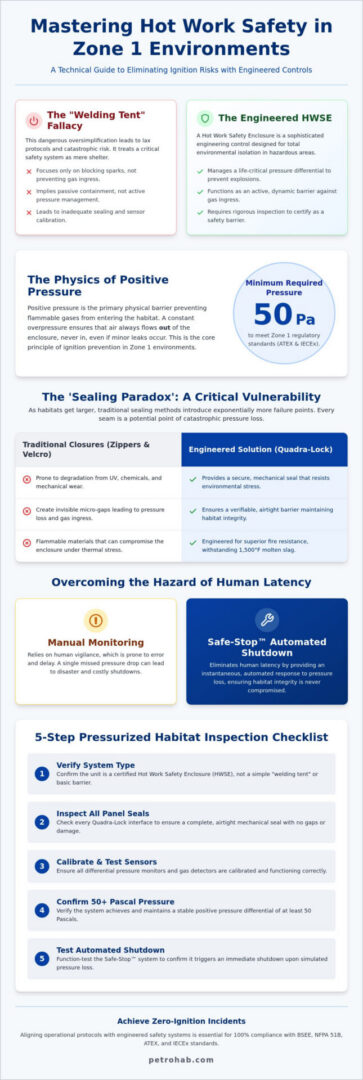
A 5-Step Pressurized Habitat Inspection Checklist for Operational Integrity
A rigorous pressurized habitat inspection checklist serves as the final barrier between operational readiness and catastrophic failure. Precision is mandatory. The Permit-to-Work (PTW) system must align perfectly with habitat deployment to ensure all administrative and engineering controls are active and verified. Safety managers must recognize that the first 30 minutes of a pressurized habitat’s operation represent the most critical phase. This window allows for thermal equilibrium to be reached, pressure stabilization to be confirmed, and sensor baseline adjustments to occur under active working conditions. If the system remains stable during this initial period, the probability of a mid-shift breach decreases significantly.
Phase 1: Designated Safety Perimeter Survey and Atmospheric Testing
Designated work areas require a comprehensive survey before a single Quadra-Lock panel is positioned. This survey identifies potential gas migration paths and thermal hazards that could compromise the enclosure. Baseline atmospheric testing is non-negotiable. Technicians must identify pre-existing gas concentrations to distinguish between ambient environmental levels and potential leaks from the work area. Determining the optimal placement for the HWSE involves analyzing the proximity to wellheads, production headers, and vent stacks. Proper positioning ensures the intake air for the pressurization unit remains clean and uncontaminated, maintaining a breathable and safe environment for personnel inside the habitat.
Phase 2: Pressure Buffer Management and Monitoring
Pressure buffer management requires constant adjustment to account for external variables, particularly wind velocity on offshore platforms. The initial pressure must be set high enough to maintain the 50 Pascal threshold even during sudden gusts that create external low-pressure pockets. Active monitoring of the pressure differential during welding ensures that the integrity of the seal remains intact despite the physical movement of workers and equipment. If a breach occurs or power fails, procedures for re-establishing pressure must be executed immediately. This includes the cessation of all hot work and the isolation of ignition sources until the pressure buffer is verified and stable.
Integrating PetroHab’s Safe-Stop into these protocols provides a technological redundancy that manual oversight cannot match. This system automates the response to pressure loss, ensuring that the human factor does not delay critical safety actions. By integrating a pressurized habitat inspection checklist into your daily safety briefings, you establish a culture of meticulous verification and technical excellence. Ensure your next turnaround meets the highest safety standards by deploying the PetroHab Hot Work Safety Enclosure.
Engineering Zero-Ignition: Achieving Compliance with PetroHab Systems
PetroHab hardware provides a definitive technological remedy for the operational failures that often plague industrial sites. By replacing unreliable manual monitoring with the Safe-Stop Automatic Shutdown System, operators move from a reactive posture to an engineered state of protection. This transition is essential for maintaining strict compliance with 2026 ATEX and IECEx Zone 1 standards. These international benchmarks serve as linguistic and technical anchors for safety excellence, ensuring that every Hot Work Safety Enclosure (HWSE) functions as a rigorous barrier against ignition. Reliable, fail-safe technology doesn’t just protect personnel; it significantly reduces refinery turnaround downtime by preventing the unplanned shutdowns triggered by inferior containment systems.
Choosing an engineered solution ensures long-term asset protection. While makeshift habitats might seem cost-effective initially, they lack the durability required to withstand the high-stakes environment of heavy industry. A final review of your pressurized habitat inspection checklist confirms that every technical safeguard, from the 50 Pascal pressure threshold to sensor redundancy, is fully operational. This meticulous approach to safety management instills absolute confidence in safety managers and engineers, positioning PetroHab as an active guardian of high-value industrial assets.
Modular Scalability Without Safety Compromise
Offshore platforms present complex geometries that traditional habitats can’t easily accommodate. PetroHab utilizes patented Quadra-Lock panels to adapt to these challenging environments without compromising the enclosure’s integrity. As the habitat size increases to fit around large production headers or wellheads, the safety integrity remains constant. The mechanical, interlocking design of the Quadra-Lock system ensures that the pressure buffer is maintained even in high-wind conditions. For a detailed analysis of how these systems scale to meet specific project requirements, consult the Pressurized Welding Habitats Guide. This modularity allows for rapid deployment while ensuring that the safety barrier remains uncompromising.
Expert Supervision and Training
Technological superiority must be paired with operational competence. PetroHab requires certified technicians for the initial setup and commissioning of every HWSE to ensure the system is correctly integrated into site-specific protocols. These experts don’t just assemble the habitat; they train site personnel to recognize early warning signs of potential failure, such as subtle pressure fluctuations or sensor drift. This on-site supervision acts as a critical safety partner, drastically reducing the risk of human-error incidents during the most hazardous phases of hot work. By blending safety advocacy with elite engineering, PetroHab ensures that your pressurized habitat inspection checklist is more than just a document; it’s a verifiable roadmap to zero-ignition performance.
Securing the Future of Hot Work Safety
The evolution of industrial safety in 2026 demands a transition from manual oversight to engineered certainty. You’ve learned that treating a habitat as a simple tent or ignoring the ‘Sealing Paradox’ creates unacceptable risks. Integrating a rigorous pressurized habitat inspection checklist into your daily operations is the only way to ensure that every seal and sensor meets the 50 Pascal threshold required for Zone 1 environments. By utilizing patented Quadra-Lock panel technology and Safe-Stop automated shutdown systems, you eliminate the latency inherent in human fire watches.
PetroHab remains an active guardian of your personnel and high-value assets. Our ATEX and IECEx Zone 1 compliant systems provide the reliability required for the most hazardous refinery turnarounds. With global support and on-site supervision, we ensure your safety barrier remains uncompromising from commissioning to completion. It’s time to elevate your site standards and achieve zero-ignition performance. We’re ready to partner with you to maintain total operational control.
Request a technical consultation for your HWSE requirements today.
Frequently Asked Questions
What is the minimum pressure required for a pressurized welding habitat?
A pressurized welding habitat must maintain a minimum internal pressure of 50 Pascals, which is equivalent to 0.1 inches of water column. This specific threshold ensures that clean air constantly flows out of the enclosure, preventing the ingress of flammable gases. Verifying this pressure differential is a critical step in any pressurized habitat inspection checklist. Maintaining this buffer is essential for meeting ATEX and IECEx Zone 1 standards during high-stakes hot work in refinery environments.
Can I use a pressurized habitat in a Zone 0 hazardous environment?
No, pressurized habitats are not designed for use in Zone 0 environments where explosive atmospheres are present continuously. These systems are engineered for Zone 1 and Zone 2 areas to provide a safe working environment by isolating ignition sources. Hot work should never be performed in Zone 0. The HWSE acts as an engineering control to manage risks in areas where hazardous gases are likely to occur occasionally during normal operations.
How often should the Safe-Stop automatic shutdown system be tested?
The Safe-Stop automatic shutdown system requires testing before the commencement of every work shift. Technicians must perform a functional bump test to verify that sensors accurately detect gas and that the power isolation mechanism triggers immediately upon pressure loss. Documenting these tests within your pressurized habitat inspection checklist ensures a verifiable audit trail. Regular testing eliminates the risk of human latency and confirms that the automated safety barriers are fully operational.
What is the difference between fire-resistant and fire-proof habitat materials?
Fire-resistant materials, such as Quadra-Lock panels, are engineered to withstand extreme thermal stress and molten slag up to 1,500°F without losing structural integrity. The term fire-proof is technically inaccurate in industrial safety because no material is entirely immune to all fire conditions. PetroHab focuses on fire resistance to ensure the habitat remains a definitive barrier. This engineering prevents the enclosure from becoming a fuel source while protecting the surrounding high-value assets from hot work sparks.
How do I manage penetrations for pipes and cables in a modular HWSE?
Managing penetrations requires the use of specialized sleeves and seals designed for high-pressure retention. Improvised solutions like fire blankets or duct tape are insufficient and often lead to immediate pressure loss. Each penetration point must be sealed to maintain the 50 Pascal differential. Technicians use modular Quadra-Lock components to fit around complex geometries, ensuring a 100% airtight environment. Every seal should be inspected daily to prevent hazardous gas ingress through micro-gaps.
Is a manual fire watch required if I have an automated shutdown system?
Yes, a manual fire watch remains a regulatory requirement under NFPA 51B and OSHA standards. While the Safe-Stop system provides a critical technological redundancy by automating power isolation, it doesn’t replace human oversight. The fire watch must remain on-site during operations and for at least 60 minutes after hot work is completed. Automated systems supplement the human element to provide a layered defense, ensuring zero-ignition incidents even if human error occurs during monitoring.
What happens if the pressure differential drops below 50 Pascals?
If the internal pressure drops below the 50 Pascal threshold, the Safe-Stop system triggers an immediate shutdown of all ignition sources. This rapid response prevents flammable gases from entering the work area through the breach. Work cannot resume until the cause of the pressure loss is identified and rectified. This fail-safe mechanism is a core component of engineered HWSE solutions, protecting personnel from the catastrophic consequences of a compromised safety barrier in hazardous zones.
Are PetroHab systems compatible with digital Permit-to-Work (PTW) platforms?
PetroHab systems are fully compatible with modern digital Permit-to-Work (PTW) platforms. Our technology supports the industry trend toward digital documentation and tamper-proof safety management. This integration allows for real-time data logging of pressure levels and gas detection events, creating a verifiable audit trail for safety audits. By aligning HWSE operations with digital PTW systems, refinery managers can maintain 100% compliance with international standards while reducing the administrative burden of manual permit tracking.