Blog Posts
Understanding Pressurized Welding Habitat Cost: A 2026 Financial & Operational Guide
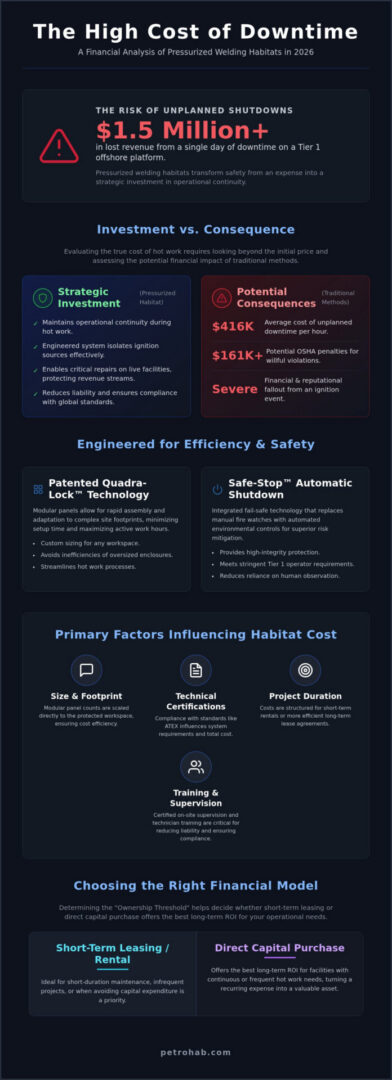
A single day of unplanned production downtime on a Tier 1 offshore platform can result in over $1.5 million in lost revenue. This staggering figure transforms safety procurement from a line-item expense into a critical strategic investment. You understand that maintaining operational continuity during hot work is essential. However, calculating the exact pressurized welding habitat cost often feels impossible because of opaque pricing and complex logistics. It’s difficult to justify safety spend when hidden training fees or mobilization costs aren’t clearly defined.
This 2026 guide analyzes the variables, ROI, and long-term financial benefits of pressurized habitats to help you make an informed procurement decision. We provide a clear framework for habitat budgeting. We also compare the modularity of Quadra-Lock panels against traditional systems and evaluate the Safe-Stop automatic shutdown system’s role in risk mitigation. You’ll gain a technical understanding of rental versus purchase costs to ensure your facility remains compliant and productive. This analysis moves beyond simple price points to focus on operational excellence and the protection of high-value assets.
Key Takeaways
- Evaluate the investment by contrasting the operational expense against the potential $1.5 million in daily revenue loss from unplanned production shutdowns.
- Identify how modular panel counts and technical certifications like ATEX influence the total pressurized welding habitat cost for your specific site footprint.
- Determine the financial “Ownership Threshold” to decide whether short-term equipment leasing or direct capital purchase offers the best long-term ROI.
- Factor in the critical role of certified on-site supervision and technician training in reducing liability and ensuring compliance with global hazardous environment standards.
- Learn how patented Quadra-Lock technology and Safe-Stop integration streamline hot work processes by replacing manual fire watches with automated environmental controls.
The Economics of Hot Work: Habitat Cost vs. Production Downtime
A pressurized welding habitat is a sophisticated Positive Pressure Enclosure designed to isolate ignition sources from hazardous atmospheres. Within the energy sector, these systems serve as essential financial tools for maintaining operational continuity. While procurement teams often focus on the upfront pressurized welding habitat cost, the true value lies in the avoidance of production interruptions. For a Tier 1 offshore platform, a single day of unplanned downtime can result in over $1.5 million in lost revenue. This makes the enclosure a strategic investment in asset protection rather than a simple operational expense.
Safety managers often face a zero-sum game. They must balance the urgent need for hot work maintenance against the risk of igniting flammable gases. Utilizing hot work safety enclosures resolves this conflict. These systems allow critical repairs to proceed on live facilities, ensuring that production targets are met without compromising the safety of personnel or equipment.
The Hidden Costs of Traditional Hot Work Methods
Traditional methods like fire blankets and manual fire watches are inherently passive. They rely on human observation and physical barriers that don’t prevent gas ingress. When sensors detect a hazard, work must stop immediately. These frequent, unscheduled work stoppages create logistical bottlenecks and drive up labor costs. Beyond operational delays, the regulatory landscape is increasingly punitive. As of 2026, OSHA penalties for willful violations related to hot work safety can exceed $161,000. The most significant risk, however, is an ignition event. The financial and reputational fallout from a single accident can exceed the cost of professional safety equipment by several orders of magnitude.
Uptime as the Primary KPI for Procurement
Effective procurement strategies prioritize uptime over the lowest initial bid. Calculating the breakeven point is simple when considering that the average cost of unplanned downtime in the offshore sector is $416,000 per hour. The total pressurized welding habitat cost is often negligible compared to the revenue lost during a single hour of production stoppage. PetroHab’s modular Quadra-Lock panels provide a distinct advantage in this area. Their design allows for rapid assembly and adaptation to complex site footprints, which minimizes setup time and maximizes active welding hours. Tier 1 operators recognize that engineered integrity is the only way to ensure reliable protection in Zone 1 and Zone 2 environments.
Primary Factors Influencing Pressurized Habitat Pricing
Determining the total pressurized welding habitat cost requires a rigorous assessment of operational variables rather than a fixed price list. Each project presents unique hazardous conditions that dictate the technical requirements of the system. The primary financial drivers include the physical scale of the enclosure, the level of integrated automation, and the duration of the deployment on-site. For safety managers, understanding these components is essential for building a defensible budget that prioritizes risk mitigation.
The configuration of the enclosure significantly impacts the final invoice. Utilizing patented Quadra-Lock panels allows for a modular approach where the number of panels correlates directly with the footprint of the protected workspace. Beyond the panels, the inclusion of advanced hot work safety systems, such as the Safe-Stop automatic shutdown system, adds a layer of fail-safe technology. These systems are often required to meet the high-integrity demands of Tier 1 operators and global regulatory bodies. Project duration also plays a role; while daily rental rates apply to short-term maintenance, long-term lease agreements for major turnarounds typically offer a more efficient cost structure for extended operations.
Size and Footprint Considerations
The modularity of the Quadra-Lock system ensures that you only pay for the containment volume necessary for the task. This design avoids the inefficiencies of oversized, static enclosures.
- Custom Sizing: Modular panels adapt to tight offshore spaces or complex onshore piping arrangements.
- Protected Workspace: Cost efficiency is often measured by the volume of the environment maintained under positive pressure.
- Scalability: A single set of panels can be reconfigured from a small repair enclosure to a large-scale habitation for multiple welding points.
Precision in sizing directly reduces the volume of air required for pressurization, which lowers the demand on ventilation equipment.
Site Location and Mobilization Logistics
Mobilization fees represent a critical portion of the total budget. Transporting equipment to remote offshore platforms involves different logistical challenges and costs than local onshore refinery projects. PetroHab maintains a global presence with operations in Houston, the UK, and Brazil to minimize lead times and shipping expenses. Adherence to OSHA Hot Work Safety Standards or international equivalents like ATEX and IECEx requires meticulous documentation and certification. These administrative and compliance layers ensure the equipment is legally and technically fit for service in specific hazardous zones. To optimize your mobilization strategy, it is often beneficial to consult with a PetroHab specialist during the early planning phases of your project.
Rental vs. Purchase: Choosing the Right Financial Model
Deciding how to acquire industrial safety equipment requires a precise evaluation of project frequency and fiscal strategy. The total pressurized welding habitat cost is influenced heavily by the choice between leasing and direct procurement. Safety managers must determine if the enclosure is a temporary tool for a specific turnaround or a permanent component of the facility’s risk mitigation infrastructure. This decision impacts both the balance sheet and the site’s emergency response capabilities.
From a financial perspective, leasing falls under operational expenditure (OPEX). This model preserves capital for other critical infrastructure projects while providing access to the most advanced environmental containment technology. Conversely, direct purchase is a capital expenditure (CAPEX) that offers long-term depreciation benefits and immediate asset availability. Each model has distinct advantages depending on the “Ownership Threshold.” This is the point where the cumulative cost of rental exceeds the purchase price and the ongoing technical maintenance of the system.
When to Choose Equipment Leasing
Leasing is the optimal choice for short-duration projects lasting one to four weeks or for seasonal maintenance cycles. It eliminates the logistical burden of long-term storage and the technical requirement for internal teams to manage the equipment. By renting, facilities ensure they always deploy the latest, most compliant technology. This is vital as regulatory standards, such as NFPA 51B, undergo periodic updates. Leasing also lowers the upfront capital requirement. It allows smaller safety budgets to accommodate high-integrity protection without a major financial commitment.
The Argument for Direct Equipment Sales
For facilities with consistent maintenance schedules, permanent ownership often proves more cost-effective over a five-year horizon. Owning a system ensures immediate availability for emergency repairs. This removes the lead times associated with mobilization from global logistics hubs. Owners can also customize their assets with specific Quadra-Lock Panels to fit fixed structures permanently. However, owners must account for the hidden costs of ownership. These include humidity-controlled storage for fabric components and the periodic recalibration of Safe-Stop automatic shutdown systems to maintain ATEX or IECEx certification. When these operational costs are factored into the pressurized welding habitat cost, the decision becomes a matter of long-term frequency versus short-term flexibility.
Beyond the Enclosure: Estimating Training, Logistics, and Supervision Fees
The total pressurized welding habitat cost includes critical service components that ensure the system functions as a reliable safety barrier. While the physical panels and shutdown systems are the foundation, the human element determines the ultimate efficacy of the containment. Certified on-site supervision and rigorous personnel training are not optional extras; they’re technical requirements for maintaining hazardous environment standards. Skipping these services creates a false economy that increases the risk of catastrophic failure and regulatory intervention.
Professional supervision ensures that every component performs according to its engineered specifications. PetroHab technicians provide a dedicated layer of oversight that manual fire watches cannot match. Their daily rates reflect a high level of specialized expertise in environmental containment and ignition prevention. This investment pays for itself by preventing the costly work stoppages that occur when safety protocols aren’t meticulously followed.
On-site Supervision: A Mandatory Safety Investment
Deploying a PetroHab technician provides a dedicated expert to manage the technical complexities of environmental control. This supervisor is responsible for monitoring differential pressure levels and ensuring the integrity of the Quadra-Lock panels throughout the hot work duration. They also manage the Safe-Stop automatic shutdown system, performing the necessary function tests to verify ignition prevention. Experts on-site significantly accelerate the Permit-to-Work (PTW) approval process. Their presence provides Facility Management with the technical assurance needed to authorize work in Zone 1 or Zone 2 areas. Professional setup also prevents improper handling of equipment. This care extends the operational life of the habitat and reduces the long-term cost of panel replacement.
Personnel Training and Certification
Investing in internal competency is a strategic move for long-term facility operators. PetroHab offers comprehensive training programs designed to certify client personnel in the safe operation of our systems. This training covers the granular details of habitat assembly, pressure maintenance, and emergency protocols.
- Reduced Setup Time: Trained crews assemble the modular enclosures faster, which decreases labor costs on recurring maintenance projects.
- Compliance Validity: Certification ensures your team meets the latest global safety benchmarks, reducing liability in the event of an audit.
- Operational Readiness: Competent internal teams can respond to minor maintenance needs without waiting for external technicians to arrive.
While there’s an initial cost for these programs, the reduction in setup time and operational risk provides a clear return on investment. To ensure your team is prepared for the next turnaround, contact PetroHab to schedule a certified training session.
Maximizing ROI with PetroHab: Engineering Efficiency into the Budget
Selecting a safety partner is a decision that impacts the entire project lifecycle. PetroHab systems are engineered to optimize the pressurized welding habitat cost by reducing operational overhead and maximizing equipment lifespan. While some industry narratives focus on historical claims, we prioritize the technical precision of our patented technologies to deliver measurable ROI. Every design choice, from panel material to automated sensor logic, serves to protect personnel and high-value assets with absolute reliability. We act as a critical safety partner for facilities that cannot afford the risk of failure.
Quadra-Lock: Cost Efficiency Through Superior Engineering
Precision engineering begins with the enclosure’s physical integrity. It is vital to clarify a common industry inaccuracy; there is no such thing as a “Petro-Wall.” The industry benchmark for panel integrity is the patented Quadra-Lock interlocking system. This engineering choice creates a superior airtight seal that traditional velcro-based systems cannot replicate. The Quadra-Lock seal significantly reduces the demand on air ducting systems. By maintaining a more consistent internal environment, the system requires less compressor fuel to sustain the necessary overpressure. The interlocking mechanism also allows for faster assembly. This reduced labor requirement translates directly into more active welding hours and lower mobilization costs per project.
Safe-Stop: Automating Safety to Protect the Bottom Line
The Safe-Stop automatic shutdown system is a critical component of modern risk mitigation. Manual fire watches are labor-intensive and inherently subject to human error. Safe-Stop provides a definitive technological remedy that terminates power to welding equipment immediately upon gas detection or loss of pressure. This automation protects the facility from the catastrophic financial fallout of an ignition event. Underwriters often offer reduced insurance premiums for sites that utilize standardized, certified ignition control technology. Our global support network, with hubs in Houston, the UK, and Brazil, ensures that technical assistance is always available to maintain these systems. This proximity minimizes downtime and ensures that equipment is ready for immediate deployment.
PetroHab remains the active guardian of industrial sites worldwide. Our commitment to safety excellence is reflected in the durability and reuse of our fire-resistant materials. By choosing a system defined by competence and meticulousness, safety managers secure a partner that understands the granular details of industrial hazards. Contact PetroHab for a customized quote on pressurized welding habitat rental or purchase to secure your facility’s operational future.
Securing Operational Continuity Through Strategic Safety Investment
Managing a facility in 2026 requires a shift from reactive safety measures to engineered environmental control. The true pressurized welding habitat cost is best understood as a safeguard against the $1.5 million daily revenue loss associated with unplanned production shutdowns. By integrating patented Quadra-Lock panel technology and Safe-Stop automatic shutdown systems, safety managers eliminate the variables that lead to catastrophic ignition events. These systems replace manual fire watches with automated precision; they ensure that hot work remains a controlled process rather than a liability.
PetroHab maintains a global presence with operational hubs in Houston, the UK, and Brazil to support your most complex maintenance turnarounds. Our technicians and training programs provide the technical foundation necessary for absolute site integrity. You can protect your personnel and high-value assets by choosing a partner defined by technical meticulousness and a sense of duty. Take the next step in optimizing your safety budget and reducing long-term risk. Request a Specialized Quote for Your Hot Work Project to ensure your facility remains a benchmark for industrial excellence.
Frequently Asked Questions
How is the daily rental rate for a welding habitat calculated?
The daily rental rate for a welding habitat is calculated based on the total number of modular panels required and the specific technical requirements of the environment. Factors include the complexity of the site footprint and the inclusion of active safety systems. While standard industry rates for 4×4 meter habitats exist, the final pressurized welding habitat cost is dictated by the level of environmental containment needed for Zone 1 or Zone 2 hazardous areas.
Does the habitat cost include the automatic shutdown system?
Most high-integrity procurement packages include the Safe-Stop automatic shutdown system as a standard component. This system is essential for maintaining compliance with global safety standards. While some basic enclosures might be quoted as passive barriers, Tier 1 operators require active ignition control. Factoring this technology into the initial quote ensures that your facility meets fail-safe requirements without encountering hidden equipment fees during the mobilization phase of the project.
What is the typical lead time for mobilizing a habitat to an offshore site?
Lead times for mobilization vary significantly based on the proximity of the facility to our global operations in Houston, the UK, or Brazil. Onshore projects often see equipment arrival within a few days. Offshore mobilization depends on vessel availability and customs clearance for trans-border projects. Early engagement during the planning phase of a turnaround allows for the strategic positioning of assets, ensuring that the necessary Quadra-Lock panels are on-site before the scheduled hot work begins.
Are there additional costs for ATEX or IECEx certified components?
ATEX and IECEx certified components involve higher engineering and testing standards, which are reflected in the total pressurized welding habitat cost. These certifications act as linguistic anchors for quality, ensuring that every sensor and electrical component is safe for use in explosive atmospheres. While non-certified alternatives might appear cheaper, they fail to meet the rigorous regulatory requirements of the energy sector. Investing in certified equipment is a mandatory step for mitigating long-term liability.
Is it more cost-effective to train our own staff or hire a PetroHab supervisor?
Hiring a certified PetroHab supervisor is the most cost-effective solution for short-term projects or infrequent maintenance cycles. A supervisor ensures immediate compliance and reduces the risk of equipment damage. For facilities with ongoing hot work requirements, investing in internal personnel training offers a superior long-term ROI. Trained internal crews reduce setup times and eliminate recurring supervision fees. The decision depends on your facility’s operational frequency and the available safety budget for personnel development.
How do Quadra-Lock panels compare to traditional modular systems in terms of labor cost?
Quadra-Lock panels utilize a patented interlocking system that is significantly faster to assemble than traditional velcro-based modular enclosures. This superior engineering reduces the total man-hours required for setup and decommissioning. Lower labor costs on-site allow for more active welding time within the project window. The precision fit of the interlocking panels also creates a more reliable airtight seal, which minimizes the technical effort needed to maintain the required positive pressure differential during operations.
What factors increase the logistics cost for international projects?
Logistics costs for international projects are driven by trans-border shipping fees, customs duties, and the administrative requirements of local regulatory bodies. Shipping specialized safety equipment from global hubs like Houston or Brazil requires meticulous documentation to ensure compliance with international hazardous zone classifications. Remote site locations often necessitate specialized transport, such as helicopter or supply vessel transfers. These variables are calculated during the procurement phase to provide a transparent overview of the total logistical investment.
Does PetroHab offer discounts for long-term lease agreements?
PetroHab provides structured discounts for long-term lease agreements, typically for projects exceeding 30 days. These volume-based incentives make permanent or semi-permanent habitat deployment more financially viable for major facility turnarounds or multi-year maintenance contracts. Long-term leasing shifts the equipment cost from a capital expenditure to an operational expense, which can offer tax advantages for some industrial operators. We work as a critical safety partner to align our leasing structures with your specific financial objectives.