Blog Posts
Welding Habitat Pressure Monitoring Systems: The Definitive Guide to Ignition Control
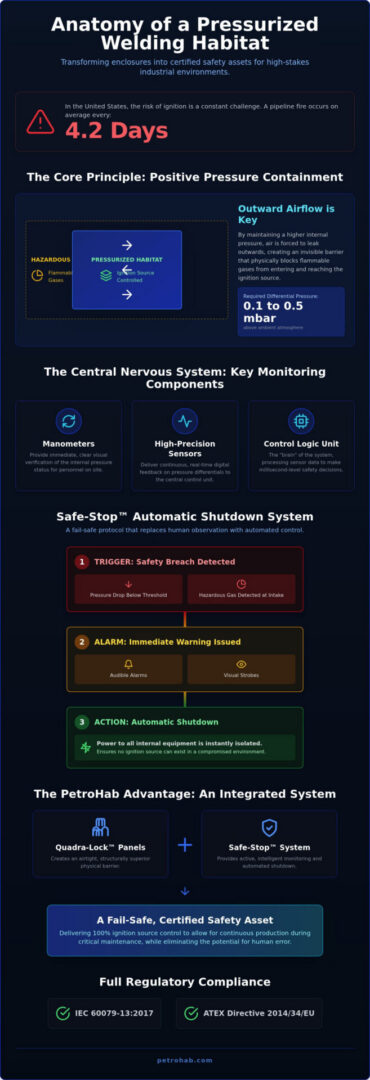
In the United States, a pipeline fire occurs on average every 4.2 days. For safety managers and engineers operating in hydrocarbon-rich environments, this statistic represents a constant, high-stakes challenge to personnel safety and asset integrity. You recognize that traditional hot work protocols often lead to costly, unplanned production downtime because the risk of ignition is too high to manage through manual observation alone. A robust welding habitat pressure monitoring system is not a mere gauge. It is the definitive technological remedy that transforms a simple enclosure into a certified safety asset capable of protecting high-value infrastructure.
This guide explains how advanced pressure monitoring and automatic shutdown systems maintain habitat integrity to prevent industrial disasters in hazardous environments. You’ll learn how the integration of the Safe-Stop system and patented Quadra-Lock panels ensures 100% ignition source control while maintaining full compliance with IEC 60079-13:2017 and ATEX Directive 2014/34/EU. We’ll analyze the technical mechanics of positive pressure containment and the specific threshold protocols that allow for continuous production during critical maintenance. This examination provides the technical data needed to implement a fail-safe, millisecond-level response that eliminates the potential for human error.
Key Takeaways
- Understand how a welding habitat pressure monitoring system functions as the central control for hot work safety by maintaining positive pressure to exclude external flammable gases.
- Identify the critical roles of the Safe-Stop™ system in providing a dual-sensor response to hazardous gas concentrations and pressure loss.
- Learn the regulatory requirements for IEC 60079-13 and ATEX standards to ensure your pressurized enclosures are fully compliant in hazardous environments.
- Master operational best practices for site surveys and air ducting to prevent leak points and ensure uniform pressure distribution.
- See how integrating Quadra-Lock panels with automated shutdown systems creates an airtight, fail-safe environment for high-stakes industrial maintenance.
The Mechanics of a Welding Habitat Pressure Monitoring System
A welding habitat pressure monitoring system serves as the central nervous system of a Hot Work Safety Enclosure (HWSE). It’s far more than a passive monitoring tool. It’s an active guardian that transforms a physical barrier into a sophisticated safety asset. Without this system, an enclosure is merely a tent. With it, the habitat becomes a pressurized environment that isolates ignition sources from potentially explosive atmospheres. The core objective is simple but uncompromising. Hot work must only be possible when the internal atmosphere is verified as gas-free and maintained at a higher pressure than the external environment.
Primary components of these systems include manometers for visual verification, high-precision electronic pressure sensors for digital feedback, and control logic units that manage the operational state of the equipment. These elements work in unison to ensure that the risk of hydrocarbon ingress is neutralized before welding, grinding, or cutting begins. It provides the engineered certainty required for high-stakes industrial environments.
Positive Pressure vs. Ambient Atmosphere
The fundamental safety principle relies on the physics of airflow. Air naturally moves from high-pressure zones to low-pressure zones. By utilizing high-capacity air blowers, the system creates a Positive pressure enclosure. This overpressure environment physically blocks flammable gases from entering the workspace by ensuring the internal pressure remains higher than the surrounding ambient atmosphere.
Safety protocols require a specific differential, typically maintained between 0.1 and 0.5 mbar. This pressure barrier ensures that even if a seal is compromised or the enclosure fabric is breached, air will only leak outward. This outward flow prevents hydrocarbons from reaching the ignition source. It’s a definitive technological remedy for the hazards found on offshore platforms and refineries where gas leaks are a constant threat.
The Role of the Control Logic Unit
The control logic unit acts as the intelligence behind the safety protocols. It processes real-time data from both internal and external sensors to make millisecond-level decisions. Unlike periodic manual checks, which leave dangerous gaps in safety coverage, a modern welding habitat pressure monitoring system provides continuous surveillance. It never blinks.
If the pressure drops below the programmed threshold or if hazardous gas is detected at the intake, the control logic unit immediately isolates power to the welding equipment. This integration often extends to the main facility safety systems. This connectivity ensures that the habitat is not an isolated bubble, but a fully integrated component of the site’s emergency response architecture. This systematic approach replaces human observation with reliable, automated control.
Technical Architecture of the Safe-Stop™ Automatic Shutdown System
The Safe-Stop™ Automatic Shutdown System represents the definitive ignition control remedy for hazardous zone operations. While a physical enclosure provides the necessary barrier, this system provides the active intelligence required to manage ignition sources. It functions as the logic center for the welding habitat pressure monitoring system, employing a dual-sensor architecture that monitors both differential pressure and gas concentrations simultaneously. This ensures that the environment is constantly validated against rigorous safety parameters.
The system’s primary function is the automatic isolation of power. If sensors detect a breach in safety thresholds, the system immediately terminates the electrical supply to all welding machines and power tools within the habitat. This fail-safe mechanism ensures that no ignition source can exist if the environment becomes compromised. Before reaching a critical shutdown state, the system initiates audible and visual alarm protocols. These warnings provide technicians with the necessary time to secure their work and prepare for a controlled cessation of activities, preventing sudden equipment failure during critical welds.
Pressure Differential Sensors and Thresholds
High-precision sensors continuously measure the pressure difference between the internal enclosure and the external ambient atmosphere. These devices detect minute drops in pressure that indicate a breach in the integrity of the habitat walls or a failure in the air supply. The system utilizes a tiered logic approach. A warning level alerts operators to minor pressure fluctuations, while a shutdown level triggers the automatic power isolation. The Safe-Stop system is engineered to complete a full shutdown of ignition sources in less than 5 seconds upon detecting a critical pressure loss.
Gas Detection Integration
Integration with ATEX certified gas detectors is essential for comprehensive risk mitigation. The system monitors for flammable gases and toxic gases like Hydrogen Sulfide (H2S) at multiple points. Specifically, it analyzes air at the intake to ensure only clean air enters the habitat and monitors the internal atmosphere for any localized leaks. If gas concentrations reach 10% of the Lower Explosive Limit (LEL), the system activates its isolation sequence. This ensures that the habitat remains a protected environment even when external hazards are present. For organizations seeking to implement these rigorous standards, the Safe-Stop Automatic Shutdown System provides the necessary technical reliability for continuous offshore operations.
Compliance with IEC 60079-13 and ATEX Standards
Adherence to international safety standards is not a matter of preference. It is a rigorous legal and operational mandate. For any welding habitat pressure monitoring system, the primary benchmark is IEC 60079-13:2017. This standard governs the design, construction, and testing of pressurized rooms used in explosive atmospheres. By maintaining a specific overpressure, these systems ensure that the internal environment remains non-hazardous, even when situated in high-risk locations. Failure to meet these requirements exposes offshore operators to severe legal liabilities and often invalidates industrial insurance policies.
The standard distinguishes between different levels of protection, primarily Type px and Type pz pressurization. Type px pressurization is required when the area outside the enclosure is classified as Zone 1. It reduces the classification within the habitat from Zone 1 to non-hazardous. This requires the system to automatically isolate power to all non-certified equipment if pressure is lost. Type pz pressurization applies to Zone 2 environments, reducing the internal classification to non-hazardous but with different redundancy requirements. Both types demand that the monitoring system provides definitive proof of a gas-free environment before power is restored.
Zone 1 vs. Zone 2 Monitoring Requirements
Operating in Zone 1 environments requires a higher degree of system redundancy and automated control compared to Zone 2. In Zone 1, the risk of a flammable atmosphere is likely to occur during normal operations, necessitating an immediate and automated response to any breach in integrity. The Safe-Stop system exceeds these tiered requirements by providing continuous, dual-layered monitoring of both pressure and gas levels. For a more comprehensive look at these regulations, see Hazardous Environment Standards: The 2026 Guide to Global Compliance and Hot Work Safety. This guide details how tiered compliance affects hot work permits and site safety protocols.
The Importance of Third-Party Certification
Self-certification is insufficient for Tier 1 offshore platforms and refineries. High-stakes environments demand verification from independent Notified Bodies that audit both pressure monitoring hardware and the underlying software logic. Compliance with ATEX Directive 2014/34/EU ensures that the equipment is fit for its intended purpose in potentially explosive atmospheres. PetroHab maintains this compliance through rigorous testing of its Quadra-Lock panels and Safe-Stop systems. This uncompromising approach to certification ensures that every component functions as a reliable guardian of personnel and high-value assets.
Operational Best Practices for Maintaining Pressure Integrity
Operational success depends on meticulous preparation. A welding habitat pressure monitoring system is only as effective as the physical integrity of the containment it monitors. Before activation, technicians must conduct a comprehensive pre-work site survey. This process involves identifying every potential leak point where the enclosure interface meets existing infrastructure, such as structural beams, pipes, or electrical conduits. Addressing these gaps during the initial assembly phase prevents persistent low-pressure alarms that can halt production. Proper sealing at these junctions ensures that the overpressure environment remains stable throughout the project lifecycle.
Maintaining pressure integrity also requires disciplined personnel management. Entry and exit through designated airlocks are mandatory to minimize pressure fluctuations. If doors are left open or seals are bypassed, the system will detect the drop and trigger a shutdown. Additionally, routine calibration of manometers and gas sensors is essential. Even the most advanced sensors can drift over time in harsh offshore environments. Regular verification against known standards ensures that the Safe-Stop system receives accurate data for its logic processing. This technical diligence protects both personnel and high-value assets.
Optimizing Air Intake and Ducting
The configuration of the air supply significantly impacts the system’s ability to maintain a constant differential. Air intakes must be positioned in verified non-hazardous areas to ensure only clean, breathable air is pressurized into the habitat. Technicians must account for the impact of duct length and diameter. Longer runs or narrow diameters increase friction and reduce the volume of air reaching the enclosure. Utilizing high-performance PetroHab Air Ducting allows for efficient ventilation and uniform pressure distribution. This setup ensures that every corner of the enclosure remains overpressured, leaving no dead zones where gas could potentially accumulate.
Troubleshooting Common Pressure Loss Issues
When the system signals a pressure loss, technicians must distinguish between mechanical failures and environmental factors. Panel seal failures are often the result of improper installation or wear, whereas blower malfunctions may indicate power supply issues. In offshore environments, high wind speeds can create localized low-pressure zones on the leeward side of the habitat, potentially triggering false alarms. Correcting these issues requires specialized knowledge. The importance of on-site supervision and training cannot be overstated. Skilled supervisors can quickly identify the root cause of a breach and implement a remedy without extended downtime. To ensure your site meets these rigorous operational standards, consult with PetroHab for a custom HWSE configuration tailored to your specific environment.
The PetroHab Advantage: Quadra-Lock™ and Safe-Stop™ Integration
The efficacy of any welding habitat pressure monitoring system depends entirely on the quality of the physical barrier it protects. PetroHab provides a synergistic solution by integrating patented Quadra-Lock technology with the Safe-Stop automatic shutdown system. This combination ensures that the structural integrity of the enclosure supports the digital precision of the monitoring hardware. Unlike traditional systems that rely on overlapping fabrics or tape, the modularity of Quadra-Lock panels allows for an airtight seal around complex piping geometries and structural obstructions. This precision reduces the risk of pressure drops that lead to costly work stoppages. This engineering excellence positions PetroHab as the preferred partner for pressurized welding habitats that minimize operational downtime and protect high-value assets.
Engineered for Airtight Integrity with Quadra-Lock
The patented Quadra-Lock panel design represents a fundamental shift in enclosure technology. By utilizing a specialized interlocking system that eliminates gaps, these panels create a superior airtight seal that traditional hook-and-loop or zip-tie methods cannot match. This structural integrity directly enhances the performance of the monitoring system. A better seal leads to significantly lower air blower demand, which reduces the strain on site utilities while maintaining higher safety margins. These panels are constructed from high-grade, fire-resistant materials designed to withstand extreme industrial conditions, including high winds and corrosive offshore environments. This durability ensures the enclosure remains a resilient guardian of personnel during extended maintenance cycles while the modular design allows for rapid reconfiguration on-site.
Maximizing ROI with Advanced Shutdown Systems
Industrial maintenance projects often face the threat of unplanned production loss. The integration of advanced shutdown systems maximizes return on investment by providing reliable, data-driven monitoring that prevents false shutdowns. Inaccurate sensors or leaky enclosures lead to frequent system interruptions that stall progress and frustrate labor teams. A reliable welding habitat pressure monitoring system ensures that safety thresholds are respected without causing unnecessary operational delays. By ensuring a stable overpressure environment, the Safe-Stop system allows hot work to continue safely while the rest of the facility remains operational. The economic impact is significant. Avoiding a full facility shutdown for minor repairs can save operators hundreds of thousands of dollars in daily revenue. This proactive approach to safety turns a regulatory requirement into a strategic operational advantage. To secure your site and optimize your maintenance schedule, Request a technical consultation for your next hot work project.
Advancing Industrial Safety Through Integrated Ignition Control
Effective hot work in hazardous zones requires more than just a physical barrier. It demands a sophisticated welding habitat pressure monitoring system that actively manages environmental risks through automated logic and real-time data processing. By integrating patented Quadra-Lock technology for airtight containment with the Safe-Stop automatic shutdown system, operators achieve a dual-layered defense against accidental ignition. This systematic approach ensures full global ATEX/IECEx compliance while protecting personnel and high-value assets from hydrocarbon-rich atmospheres. These technologies work in unison to replace manual observation with engineered certainty.
Implementing these advanced solutions eliminates the potential for human error and prevents the catastrophic financial impact of unplanned production downtime. It’s now possible to move forward with critical maintenance projects knowing that your safety protocols meet the most rigorous international standards. Our commitment to technical precision ensures that your site remains operational and your workforce remains protected even in the most volatile environments. Contact PetroHab for Advanced Pressure Monitoring Solutions to secure your next offshore or onshore project. We are ready to serve as your trusted safety partner in the field.
Frequently Asked Questions
How does a welding habitat maintain positive pressure?
A welding habitat maintains positive pressure by utilizing high-capacity air blowers to pump clean air from a verified non-hazardous location into the enclosure. This volume of air exceeds the rate of escape through the Quadra-Lock panel seals, creating a pressure differential of 0.1 to 0.5 mbar. This overpressure environment physically blocks flammable gases from entering the workspace. It ensures that air only flows outward, maintaining an isolated, gas-free atmosphere for hot work.
What happens if the pressure monitoring system detects a leak?
If the welding habitat pressure monitoring system detects a leak that causes pressure to drop below the safety threshold, it initiates a tiered response protocol. First, audible and visual alarms notify technicians of the integrity breach. If the pressure doesn’t stabilize within programmed parameters, the Safe-Stop system automatically isolates power to all welding equipment. This fail-safe mechanism happens in less than 5 seconds to prevent ignition sources from existing in a compromised environment.
Are these systems certified for use in ATEX Zone 1 environments?
Yes, these systems are specifically engineered and certified for use in ATEX Zone 1 and Zone 2 environments. The Safe-Stop system complies with the IEC 60079-13:2017 standard, which governs pressurized rooms in explosive atmospheres. Third-party certification from Notified Bodies verifies that the hardware and software logic meet the redundancy requirements for high-risk areas. This compliance is essential for meeting the legal and insurance mandates required by Tier 1 offshore operators.
Can the Safe-Stop system detect gases other than hydrocarbons?
The Safe-Stop system is designed to detect a range of hazardous gases beyond standard hydrocarbons. While it primarily monitors for flammable gases reaching 10% of the Lower Explosive Limit (LEL), it also integrates sensors for toxic gases such as Hydrogen Sulfide (H2S). This multi-gas detection capability ensures that the habitat remains safe from both ignition risks and respiratory hazards. The system monitors air at the intake and inside the enclosure to provide comprehensive atmospheric surveillance.
How often do the pressure sensors need to be calibrated?
Pressure sensors and gas detectors should be calibrated at the start of every project and verified at regular intervals throughout the work lifecycle. In harsh offshore environments, sensors can experience drift due to humidity, salt spray, or extreme temperature fluctuations. Routine bump tests and calibration checks ensure the welding habitat pressure monitoring system provides accurate data. Following the manufacturer’s specific maintenance schedule is critical for maintaining the integrity of the automatic shutdown logic.
Is a pressure monitoring system required by OSHA or BSEE?
Regulatory bodies like OSHA and BSEE require rigorous ignition control measures for hot work in potentially explosive atmospheres. While they may not name a specific brand, they mandate the use of engineered controls to prevent fire and explosions. Utilizing a certified pressurized habitat with an automatic shutdown system fulfills these requirements. It provides the documented safety evidence needed during site inspections and ensures compliance with federal safety standards for offshore and onshore facilities.
Can the system be integrated into an existing facility shutdown loop?
The Safe-Stop system can be integrated into an existing facility emergency shutdown (ESD) loop. This connectivity allows the habitat’s monitoring system to communicate directly with the site’s central safety architecture. If the facility detects a platform-wide emergency, it can trigger the habitat’s power isolation. Conversely, the habitat system can signal the facility control room if it detects a localized gas breach. This integration creates a unified safety response across the entire industrial site.
What is the maximum temperature the habitat panels can withstand?
Quadra-Lock panels are engineered to meet ANSI/FM 4950 standards for welding blankets and curtains used in hot work. These fire-resistant materials can withstand the high temperatures and molten splatter associated with heavy welding and grinding operations. While the panels are designed for extreme thermal resistance, the internal habitat temperature is managed through continuous air exchange. This ensures the environment remains within safe operational limits for both the personnel and the structural integrity of the enclosure.