Blog Posts
Welding Habitat Technician Certification: The 2026 Industry Standard
In a high-pressure hazardous environment, the difference between a secure site and a catastrophic ignition event often rests on a single technician’s ability to interpret a pressure differential reading correctly. Deploying advanced hardware like Quadra-Lock panels or a Safe-Stop Automatic Shutdown System is only half of the safety equation. You likely recognize that even the most sophisticated pressurized welding enclosures become liabilities when managed by personnel who lack formal, system-wide training. Reliance on component-level knowledge rather than integrated expertise leads to permit delays and unacceptable operational risks.
This article provides the definitive roadmap for obtaining a welding habitat technician certification to meet the rigorous 2026 industry standards. You’ll master the technical requirements and international benchmarks necessary to maintain environmental containment in volatile atmospheres. We’ll examine the specific competency pathways that bridge the gap between basic equipment assembly and professional system oversight. By the end of this guide, you’ll understand how to align your team with the latest safety protocols to protect both personnel and high-value assets during hot work operations.
Key Takeaways
- Understand the 2026 regulatory shift toward IEC 60079-13:2017 and why a welding habitat technician certification is now the mandatory benchmark for risk mitigation.
- Identify the Compliance Trap by ensuring your pressurized welding enclosures possess system-wide certification rather than relying on individual certified components.
- Master the four distinct levels of technical competency required to transition from basic equipment assembly to lead technician status.
- Integrate certified personnel into the Permit-to-Work ecosystem to provide continuous monitoring and expert technical guidance during active hot work.
- Learn how professional training programs and Quadra-Lock panels establish an uncompromising standard for environmental containment and ignition prevention.
The 2026 Regulatory Landscape for Welding Habitat Technician Certification
The welding habitat technician acts as the primary guardian of the pressurized environment. This role isn’t merely mechanical; it’s a specialized safety function focused on maintaining the integrity of environmental containment. In hazardous areas where flammable gases are present, the technician ensures that the internal pressure remains high enough to prevent ingress. They’re responsible for monitoring the Safe-Stop Automatic Shutdown System and reacting to any pressure loss within seconds. Achieving a welding habitat technician certification demonstrates that an individual understands the complex relationship between airflow, pressure differentials, and ignition prevention.
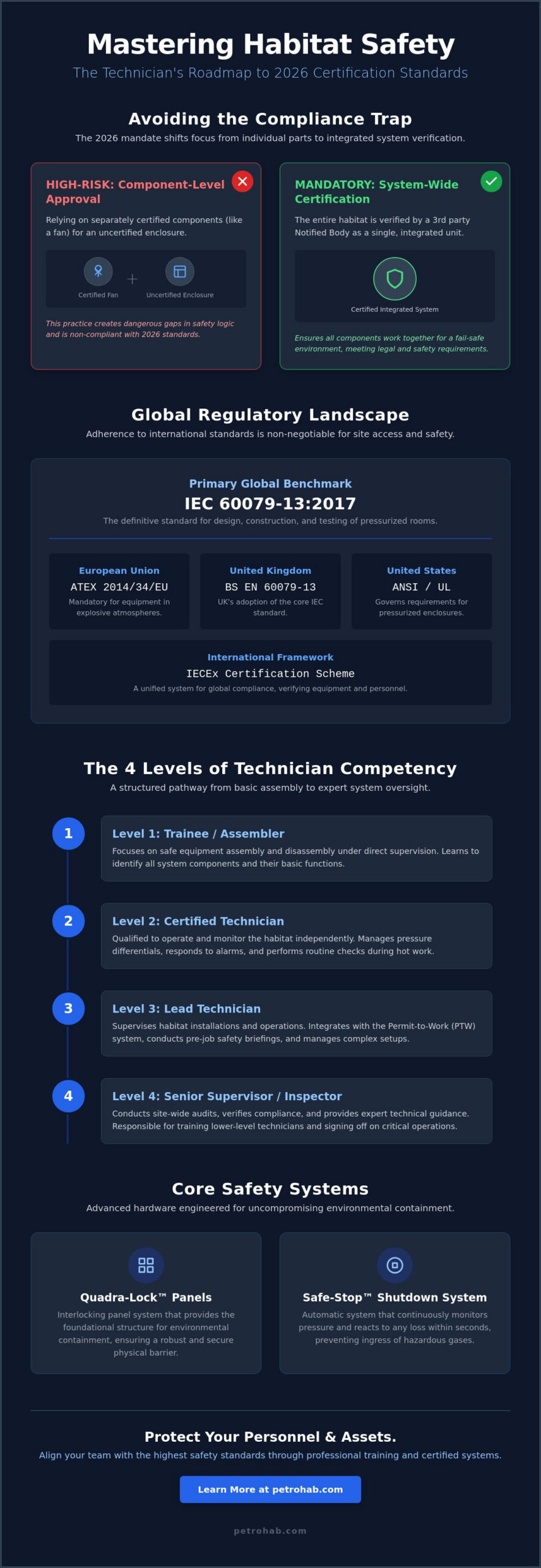
Integrating a welding habitat into a Zone 1 or Zone 2 area requires strict adherence to international safety protocols. IEC 60079-13:2017 stands as the definitive global benchmark for pressurized rooms. This standard governs the design, construction, and testing of enclosures, ensuring they can withstand the rigors of heavy industry. For European operations, the ATEX Directive 2014/34/EU remains a mandatory legal requirement that dictates how equipment must be certified for use in explosive atmospheres.
To better understand this concept, watch this helpful video:
The IECEx certification scheme provides a unified framework for international compliance. It allows safety managers to verify that their systems meet a single, rigorous standard recognized across global jurisdictions. This alignment reduces confusion and streamlines the mobilization process for offshore and onshore projects. The scheme ensures that the certification covers both the equipment and the personnel operating it. Without this unified approach, equipment would require redundant testing for every new region, leading to significant project delays and increased costs. It ensures that safety is never compromised for the sake of administrative convenience.
Global Regulatory Variations: BS EN, ANSI, and CSA
Regional standards often adopt IEC 60079-13 with specific local prefixes. In the United Kingdom, this is recognized as BS EN 60079-13. In the United States, ANSI/UL standards dictate the requirements for pressurized enclosures. While the engineering fundamentals remain identical, these regional prefixes are critical for local legal compliance. Safety managers must ensure their EU Declaration of Conformity is valid for Zone 1 habitats to meet the highest safety tier. Failure to align with these regional nuances can result in immediate site shutdowns during audits.
The 2026 Shift Toward Mandatory System-Wide Certification
The industry landscape in 2026 marks a definitive shift away from component-level approvals. Previously, some operators attempted to bypass rigorous safety checks by using certified fans on uncertified enclosures. This practice created dangerous gaps in safety logic. Regulatory bodies now mandate 3rd party verification for the entire system to eliminate these vulnerabilities. Notified Bodies play a vital role in this process by issuing Type Examination Certificates that cover the habitat as a single, integrated unit. This ensures that every part of the habitat, including the Quadra-Lock panels and the Safe-Stop Automatic Shutdown System, works together to provide a fail-safe environment. Compliance isn’t optional. Only system-wide certification provides the legal and physical protection required for modern industrial sites.
The Four Levels of Habitat Technician Competency
Competency in hazardous environments requires a structured, tiered approach. A welding habitat technician certification signifies that an individual has passed rigorous theoretical and practical assessments designed to test their response to critical system failures. These evaluations include real-world simulations of pressure loss and gas ingress. For offshore personnel, this data is tracked via a “Training Passport,” providing a verifiable record of their current qualifications. To maintain the integrity of these standards, certifications must be renewed every 2 to 3 years. This ensures technicians stay updated on evolving safety protocols and technological advancements within the energy sector.
Professional development at these levels transforms a standard crew into an elite safety unit. You can explore our professional training programs to ensure your team is prepared for the demands of the 2026 industry standards.
Level 1 & 2: Awareness and Basic Operation
Level 1 provides essential awareness for all personnel working adjacent to the Hot Work Safety Enclosure (HWSE). It’s the baseline of site safety. Level 2 introduces basic operational duties. This curriculum covers the correct assembly of Quadra-Lock panels and the fundamentals of pressure monitoring. Technicians at this level are trained to execute precise alarm responses. Their primary focus is preventing hydrocarbon ingress by maintaining a consistent pressure differential. This training ensures compliance with the ventilation requirements outlined in OSHA’s welding safety regulations.
Level 3 & 4: Advanced Technician and Lead Supervisor
Level 3 mastery involves deep technical troubleshooting. These technicians are responsible for the Safe-Stop Automatic Shutdown System and the calibration of gas detection sensors. They possess the skills to diagnose system fluctuations before they escalate into safety incidents. Obtaining this advanced welding habitat technician certification ensures they can manage complex hardware integrations. Level 4 represents the lead supervisor status. This individual acts as the final authority for the HWSE sign-off before any hot work commences. They manage complex emergency shutdown protocols and serve as the technical liaison for site safety managers. Their oversight is the final layer of protection for high-value assets and personnel.
System-Wide vs. Component Certification: Avoiding the Compliance Trap
Many procurement teams fall into the “Compliance Trap” when evaluating hot work safety enclosures. This occurs when manufacturers present certificates for individual components, such as a certified fan motor or a specific sensor, to mask the fact that the enclosure itself lacks holistic validation. A habitat is only as safe as its weakest uncertified component. If the enclosure panels or the seal interfaces haven’t been tested as part of an integrated system, the integrity of the entire pressurized environment remains unproven. System-wide certification is the holistic validation of the entire pressurized room as a single, functional unit.
Professional standards require more than just high-quality hardware. While technical knowledge is essential, a recognized welding habitat technician certification ensures the operator can distinguish between partial approvals and full system compliance. This expertise mirrors the rigor found in American Welding Society certification programs, where individual skill is validated against comprehensive industry benchmarks. Without system-level oversight, uncertified panels can compromise the Safe-Stop automatic shutdown system, leading to delayed responses during gas detection events.
The Technical Vulnerabilities of Component-Only Approval
Air leakage rates represent a critical safety metric that component-level testing simply cannot address. These rates are only verified through exhaustive system-level testing of the fully assembled enclosure. When gas detection units aren’t natively integrated with the enclosure control unit, the risk of ignition increases significantly. Insurance providers recognize these technical gaps and often deny claims involving habitats that lack system-wide certification. They view component-only approval as an unacceptable deviation from established safety protocols. Relying on Quadra-Lock panels within a non-certified framework creates a false sense of security that doesn’t hold up under professional scrutiny.
Verification Checklist for Safety Managers
Verifying a welding habitat technician certification is just the first step in a robust safety audit. Safety managers must also scrutinize the equipment’s IECEx certificate for specific markings that denote system-wide approval. This involves cross-referencing technician credentials with the equipment’s Notified Body to ensure consistency. Use this technical checklist for your next site inspection:
- Confirm the IECEx certificate covers the entire assembly, not just the motor or fan.
- Verify that the Safe-Stop automatic shutdown system is listed as an integrated safety feature.
- Check that the Quadra-Lock panels are documented as part of the certified enclosure design.
- Match the serial numbers on the control units with the official Type Examination Certificate.
For more detailed guidance on selecting compliant vendors, consult our guide on Choosing the Right Hot Work Safety Enclosure Suppliers for procurement best practices.
Integrating Certified Personnel into the Permit-to-Work (PTW) Ecosystem
Certified technicians serve as the technical bridge between hazardous hot work and the Permit-to-Work (PTW) Authority. They don’t just set up equipment; they act as primary advisors who validate that the conditions for safe ignition prevention are met. A welding habitat technician certification ensures the operator can provide real-time data on pressure differentials and gas levels to the site supervisor. This technical clarity allows the PTW Authority to issue permits with absolute confidence. Continuous monitoring remains a mandatory requirement during active hot work. The technician maintains constant vigilance over the system indicators, ensuring the habitat remains a controlled environment throughout the shift.
Expertise in habitat management significantly reduces downtime during refinery turnarounds. Unplanned delays often stem from permit rejections or safety stand-downs caused by incompetent setup. A certified technician streamlines the mobilization process by ensuring all equipment meets the 2026 industry benchmarks. This proactive approach eliminates the friction often found between safety departments and operational teams. When a technician identifies a “Red Flag” scenario, such as a breach in the Quadra-Lock panels or a Safe-Stop sensor malfunction, they hold the authority to halt operations immediately. This intervention occurs regardless of the existing permit status, prioritizing site integrity over production schedules.
Risk Mitigation and Liability Management
Certified supervision directly reduces the “human factor” that contributes to the majority of industrial accidents. When an organization utilizes uncertified personnel, it assumes immense corporate liability in the event of a safety failure. Insurance providers and regulatory bodies increasingly view the lack of a welding habitat technician certification as a sign of negligence. Professional competency is the most effective tool for managing legal and operational risks. For a deeper understanding of these requirements, review the Hazardous Environment Standards guide to ensure your site remains compliant.
Mastering the Safe-Stop and Quadra-Lock Interface
Technicians must undergo specific training on the assembly of Quadra-Lock panels to guarantee a gas-tight seal. Even minor gaps in the enclosure can lead to pressure loss and potential ignition ingress. The technician’s role includes performing a full diagnostic test of the Safe-Stop automatic shutdown system before every work shift. This proprietary technology training prevents common setup errors that lead to system failures. By mastering these specific interfaces, technicians ensure that the protection systems function as intended. Secure your project’s safety by hiring certified PetroHab LLC habitat technicians for your next scheduled maintenance.
PetroHab LLC On-site Supervision and Professional Training Programs
PetroHab LLC provides global on-site supervision to ensure high-stakes projects meet the most stringent safety benchmarks. This service isn’t just about oversight; it’s about active risk mitigation in volatile atmospheres. Our welding habitat technician certification programs transform client personnel into expert safety guardians who understand the granular details of environmental containment. We don’t just act as a manufacturer of equipment. PetroHab LLC serves as a long-term safety partner for safety managers and engineers, providing the technical support necessary to protect high-value assets and personnel. Our supervisors remain on the ground to ensure that every hot work operation remains within the strict parameters of the safety permit.
The training curriculum focuses on the technical precision required for modern industrial sites. We integrate our patented Quadra-Lock technology into every training module to ensure technicians can execute a perfect setup every time. This training addresses the technical superiority of our panel locking system, which is engineered to eliminate the leakage points found in inferior enclosures. Understanding the mechanical integrity of Quadra-Lock panels is a prerequisite for any technician managing a pressurized environment. The course covers everything from basic assembly to the complex troubleshooting of the Safe-Stop Automatic Shutdown System, ensuring a fail-safe response to any gas detection event.
Customized Training for Global Operations
PetroHab LLC delivers customized training programs across major energy hubs, including the USA, Brazil, and the UK. Each session is tailored to the specific challenges of the local environment. We address the unique hazards of offshore platforms in the North Sea as well as the logistical complexities of onshore refineries. We ensure that your personnel understand the nuances of local regulatory requirements alongside international standards like IEC 60079-13. This specialized approach ensures that the welding habitat technician certification your team receives is relevant to their specific operational theater. You can request a quote for pressurized welding habitat rental and professional supervision to secure your next project’s operational excellence.
The PetroHab LLC Advantage: Reliability and Precision
Our certified technicians represent the industry benchmark for reliability and precision. They possess the specialized knowledge necessary to manage gas detection systems and pressure differentials under extreme conditions. A certification from PetroHab LLC signifies a commitment to the highest tiers of industrial safety and uncompromising risk management. For those seeking deep hardware knowledge to complement their technical training, we recommend consulting the Definitive Guide to Hot Work Safety Enclosures. This resource provides a comprehensive overview of 2026 hardware standards and environmental containment strategies. Secure your site integrity with PetroHab LLC’s certified expertise today.
Securing the Future of Hazardous Hot Work
The industrial landscape of 2026 demands a shift from fragmented component approvals to comprehensive, system-wide verification. You’ve seen how a welding habitat technician certification acts as the definitive safeguard against ignition risks by ensuring expert oversight of pressurized environments. Integrating these certified professionals into your Permit-to-Work ecosystem doesn’t just mitigate corporate liability; it optimizes operational efficiency by preventing the technical delays that often stall major turnarounds. Reliability in high-stakes environments is built on the combination of rigorous training and superior engineering.
PetroHab LLC provides the necessary bridge between advanced safety theory and field execution. With our patented Quadra-Lock technology and full IEC 60079-13 and ATEX compliance, we remain the industry benchmark for environmental containment. Our global presence in Houston, Brazil, and the UK allows us to deploy safety expertise wherever your assets are located. Ensure your projects meet the 2026 industry standard—contact PetroHab LLC for certified on-site supervision. We look forward to partnering with your team to maintain an uncompromising standard of safety and excellence.
Frequently Asked Questions
What is the primary international standard for welding habitat technician certification?
IEC 60079-13:2017 is the primary international standard governing the design and operation of pressurized rooms. It provides the technical framework for environmental containment and ignition prevention in explosive atmospheres. This standard is the global benchmark used to evaluate the competency of personnel seeking a welding habitat technician certification. Compliance ensures that technicians can maintain positive pressure and manage safety systems according to recognized engineering principles.
Can a certified industrial electrician operate a pressurized habitat without specific training?
No, an industrial electrician doesn’t have the authorization to operate a pressurized habitat without specialized training. While electrical expertise is valuable, habitat operations require a specific understanding of pressure differentials, airflow dynamics, and gas detection integration. Technicians must be trained to manage the Safe-Stop Automatic Shutdown System and the structural integrity of Quadra-Lock panels. Without this specific competency, the electrician cannot prevent hydrocarbon ingress.
How often do welding habitat technicians need to be recertified?
Technicians must undergo recertification every 2 to 3 years to maintain their valid status. This frequency ensures that personnel remain updated on evolving industry standards and new technological advancements. Regular assessments prevent competency decay and ensure that lead technicians can still execute critical safety procedures under pressure. Continuous training is essential for maintaining the high-stakes safety protocols required in hazardous industrial environments.
What is the difference between Level 2 and Level 3 habitat competency?
Level 2 competency focuses on basic assembly, pressure monitoring, and alarm response. Technicians at this level are responsible for the physical setup of the enclosure. Level 3 represents an advanced tier where technicians master the troubleshooting of Safe-Stop systems and the calibration of gas detection sensors. A Level 3 professional manages the technical logic of the environment, while a Level 2 operator focuses on maintaining the structural seal of the Quadra-Lock panels.
Is component-level ATEX certification enough for legal operation in Zone 1?
No, component-level ATEX certification isn’t sufficient for legal operation in Zone 1 environments. Regulatory bodies mandate system-wide certification to ensure that the entire pressurized room functions as a single, integrated safety unit. Relying on individual certified components like fans or motors creates a “Compliance Trap” where the overall integrity of the enclosure remains unverified. Only a full Type Examination Certificate provides the legal protection required for high-risk zones.
How does a certified technician improve the Permit-to-Work (PTW) process?
A certified technician improves the PTW process by acting as a technical advisor to the Permit Authority. They provide real-time data on pressure differentials and gas levels, which allows for the confident issuance of hot work permits. This specialized expertise reduces the risk of permit rejections and safety stand-downs. By ensuring the equipment meets 2026 industry standards, the technician eliminates the administrative friction that often causes project delays.
What specific training is required for PetroHab LLC’s Quadra-Lock technology?
Training for Quadra-Lock technology focuses on the precise assembly of the interlocking panels to ensure a gas-tight seal. Technicians learn to identify and eliminate potential leakage points that could compromise the pressurized environment. This training is a core component of the welding habitat technician certification curriculum overseen by PetroHab LLC. It ensures that every operator understands the mechanical superiority of the system and can maintain the structural integrity of the enclosure throughout the work shift.
Are there different certifications for offshore vs. onshore habitat operations?
While the core technical standards remain consistent, training is often tailored to the specific hazards of offshore or onshore environments. Offshore operations require additional knowledge regarding platform safety protocols and limited evacuation routes. Onshore training may focus more on refinery turnaround logistics and large-scale facility integration. Regardless of the location, the technician must hold a valid certification that demonstrates mastery of the fundamental principles of environmental containment.