Blog Posts
Business Case for Hot Work Safety Enclosures: How to Secure Operations Manager Buy-In
What if the enclosure that strengthens your hot work controls also helps protect the work schedule? Building a business case for hot work safety enclosures means assessing both the safety and operational implications against the conditions of your project, rather than relying on a generic argument.
It’s reasonable to ask whether an enclosure will affect access, work sequencing, or planned maintenance, and whether leasing or purchasing makes more sense. Answering those questions requires project-specific evidence. The recommendation should account for work scope, exposure, duration, site constraints, and the potential costs of interruption, alongside the controls required for the job.
This article sets out a practical way to compare risk controls, work continuity, and lifecycle costs so you can present an evidence-led recommendation to operations managers. It identifies the project information and stakeholders needed to assess implementation, including pressure and monitoring requirements, supervision, and training. PetroHab offers equipment for lease or purchase, so project duration and ownership plans can inform the evaluation. The aim is a decision grounded in operating conditions, with clear assumptions and a defensible comparison of options.
Key Takeaways
- Build the business case for hot work safety enclosures around the specific task, site hazards, operating constraints, and decision the project requires.
- Compare enclosure and alternative options using consistent work assumptions and an evaluation period, including access, staffing, monitoring, training, and schedule interfaces.
- Separate confirmed facts, estimates, and open questions so operations managers can evaluate the recommendation and its supporting evidence.
- Assess leasing and purchasing against project duration and ownership plans, using verified project-specific cost and downtime inputs.
- Turn approval conditions into clear responsibilities, then confirm configuration and site interfaces with the relevant qualified parties.
Why Build a Business Case for a Hot Work Safety Enclosure?
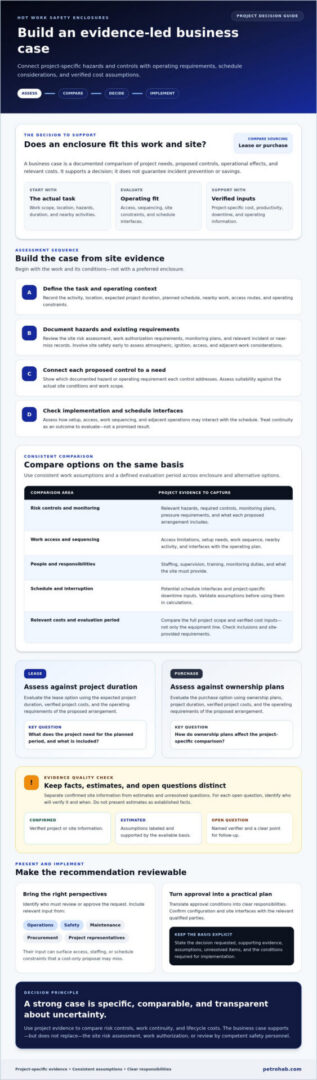
A business case for hot work safety enclosures is a documented comparison of a project’s needs, proposed controls, operational effects, and relevant costs. It gives decision-makers a structured basis for assessing whether an enclosure fits the work, site, and operating plan. It doesn’t guarantee that incidents will be prevented or savings achieved.
Project context matters. The task, location, hazards, duration, nearby activities, access routes, and operating constraints can differ from one job to the next. Use verified project information, identify assumptions, and show how each option addresses the actual work. A business case supports, but doesn’t replace, the site risk assessment, work authorization, or review by competent safety personnel. For background, the Hot work overview introduces the activity and related safety concepts.
The USCSB video below presents “Simultaneous Tragedy: Fire at Evergreen Packaging,” a reminder to treat hot work decisions with due care.
What decision does the business case need to support?
State the requested decision plainly: whether to deploy a hot work safety enclosure and which sourcing route to evaluate, such as leasing or purchasing. Identify who must review or approve the request, including operations, safety, maintenance, procurement, and project representatives. Their input can reveal access, staffing, or schedule constraints that a cost-only proposal may miss.
Separate confirmed site facts from assumptions that still need validation. Record the task and location, expected project duration, known hazards, access limits, and schedule interfaces. For each unresolved question, name who will verify it and when. Don’t present estimates as established facts.
Why equipment cost alone is an incomplete comparison
Compare the full project scope, not just the equipment line. Depending on the proposed arrangement, questions may include deployment, supervision, training, monitoring, pressure requirements, and other operating needs. Check what each option includes and what the site must provide, and confirm requirements with the relevant qualified parties.
Then assess how setup, access, work sequencing, and adjacent operations could interact with the schedule. Treat continuity as an outcome to evaluate, not a promised result. Use consistent work assumptions and a defined evaluation period when comparing alternatives. Validate productivity, downtime, and financial inputs before using them in calculations. For more background on enclosure types and considerations, see the definitive guide to hot work safety enclosures.
A sound HWSE business case connects project-specific hazards and controls with operational requirements and verified cost assumptions.
How to Assess Project Risk and Operational Need
A defensible assessment starts with the work, not with a preferred enclosure. The business case for hot work safety enclosures should show how each proposed control responds to a documented hazard or operating requirement. An enclosure may be relevant for one task and unsuitable for another. Suitability depends on the documented site conditions and work scope.
Build the assessment from site evidence
Work through the review in sequence. Involve the site safety team early to identify atmospheric, ignition, access, and adjacent-work considerations.
- Define the task: Record the work activity, location, expected duration, and planned schedule.
- Characterize the site: Document surrounding operations, access limitations, nearby work, and relevant operating constraints.
- Document hazards: Review the site risk assessment, work authorization requirements, monitoring plans, and relevant incident or near-miss records.
- Identify controls: Connect each proposed control to a specific hazard or operating need. Note which existing procedures or controls remain necessary.
- Validate requirements: Confirm technical questions with qualified site personnel and current equipment documentation before treating assumptions as facts.
Use applicable site procedures and current requirements as the basis for the review. For U.S. general-industry context, consult the OSHA regulations for hot work alongside the project’s own safety review. A general reference does not resolve site-specific questions.
Match enclosure functions to identified requirements
Assess whether an enclosure configuration, pressurization, gas monitoring, or automatic shutdown addresses a documented project need. Don’t treat any feature as a universal control or assume a system is suitable without confirming operating conditions, interfaces, and procedures with qualified personnel.
For example, PetroHab’s Safe-Stop Automatic Shutdown System monitors gas levels and pressure and supports automatic shutdown. Review its operation against current system documentation and site procedures, including how monitoring and shutdown requirements fit the task. Resolve technical questions before approval. The guide to advanced hot work safety systems provides additional system context.
Keep an evidence trail that links each hazard to the proposed control, its supporting documentation, and the person responsible for validation. This makes gaps visible before the project moves into option comparison. For project-specific enclosure discussions, review PetroHab’s hot work enclosure options.
How to Compare an HWSE With Other Project Options
Hold the project scope, work assumptions, and evaluation period constant across every option. Include an enclosure alongside existing controls or an alternative work plan only if the responsible site team has approved that approach. Compare how each option addresses the documented hazards and operating requirements, not how it performs against a different version of the job.
Use the same criteria for every option. Mark each item as confirmed, estimated, or still requiring review.
| Comparison factor | Questions to document |
|---|---|
| Controls and monitoring | Which hazards and requirements does each option address? What monitoring or shutdown functions are included and verified? |
| Staffing and training | What site personnel, supervision, or training are required for each option? |
| Setup and access | What setup is expected, and how could the configuration affect work access? |
| Schedule interfaces | How does each option fit the planned sequence and surrounding operations? |
| Lifecycle inputs | Which one-time, recurring, or project-specific costs apply over the same evaluation period? |
Lease or purchase: which route fits the project?
Compare expected use, plans for repeat projects, ownership responsibilities, and equipment availability. PetroHab offers equipment leasing and direct sales. Confirm project-specific availability and terms rather than assuming either route is preferable. Include deployment, supervision, training, maintenance, and end-of-use arrangements only when applicable and verified. Use supplier evaluation criteria that reflect the project’s technical requirements, scope, and support needs.
How to structure a transparent cost comparison
Base the comparison on client-approved quotes and project records, not market averages or unsupported estimates. Separate one-time, recurring, project-specific, and uncertain inputs, then record the source and owner for each figure. The U.S. Occupational Safety and Health Administration’s business case for safety and health offers broader context, but it doesn’t replace project-specific evidence.
Test how the comparison changes if the schedule, equipment utilization, or work scope changes. Label these as sensitivity scenarios, not forecasts. Keep verified project costs distinct from assumptions and unquantified risk considerations. This prevents a potential cost exposure from being presented as a guaranteed saving, avoided incident, uninterrupted operation, or compliance outcome.
A sound business case for hot work safety enclosures makes the basis of comparison visible and gives reviewers enough detail to challenge assumptions before a decision is made.
How to Present the Investment Case to an Operations Manager
Lead with the decision you need, not a product description. A concise approval brief should explain the planned work, why the site is evaluating an enclosure, which alternatives were considered, and what evidence supports the recommendation. Keep the request specific, such as approval to proceed with a project review or to evaluate a lease or purchase option.
What should the approval brief contain?
Summarize the work scope, site conditions, risk-review findings, operating constraints, and proposed enclosure requirements. Include supplier inputs, alternatives, cost assumptions, uncertainties, and what could change if the project scope shifts. State who will confirm technical and safety suitability, and identify accountable reviewers across operations, safety, maintenance, procurement, and the project team.
A short evidence register keeps the brief auditable:
| Item | What to show | Owner |
|---|---|---|
| Confirmed fact | Verified site condition, project requirement, or documented supplier input | Source or reviewer |
| Estimate | Basis, assumptions, and range of uncertainty, if available | Estimator |
| Open question | Information still needed before approval or deployment | Named person responsible |
This format helps prevent assumptions from being mistaken for confirmed project facts. The U.S. Occupational Safety and Health Administration’s business case for safety and health provides broader context for presenting safety investments, but the recommendation should rest on evidence relevant to this project.
How to handle questions about disruption and value
An enclosure may be viewed as an added expense or a source of schedule disruption. Address both concerns with project evidence, not generalized assurances. Show what is known about setup, access, sequencing, staffing, and supervision, then identify what still needs validation. Compare complete project options rather than isolating equipment cost from implementation and operating requirements.
Separate measurable schedule or resource impacts from qualitative risk-control considerations. If schedule effects or financial inputs are estimates, label them and state their basis. Don’t present a possible reduction in disruption, an avoided incident, or a compliance outcome as guaranteed. Base the requested decision on the documented work scope, site evidence, and reviewed assumptions.
A defensible investment request connects verified project evidence and clearly labeled uncertainties to a specific decision, without promising an outcome the evidence can’t support. For a project-specific discussion of enclosure requirements, discuss your HWSE requirements with PetroHab.
Turn the Approved Business Case Into a Practical HWSE Plan
Approval is the start of implementation, not the final safety check. Turn each approval condition into an assigned action, a responsible owner, and a review point. This keeps procurement decisions connected to site readiness and makes unresolved requirements visible before mobilization.
What to confirm before deployment
Operations, safety, procurement, the supplier, and equipment users should agree on their responsibilities. Confirm the scope, work location, schedule, enclosure configuration, site interfaces, and required project documentation. Before mobilization, document site-defined acceptance criteria and review points, then check them against current site procedures.
- Operations: Confirm schedule interfaces, access, work sequencing, and operational communications.
- Safety: Validate the risk review, monitoring responsibilities, and applicable project requirements.
- Procurement: Confirm the approved sourcing route, scope, and supplier documentation.
- Supplier and users: Agree who will oversee setup, provide training, and handle equipment operation and communication.
Confirm monitoring and pressure requirements with qualified site personnel and current equipment documentation. If standards or certifications are referenced, verify the claim against current documentation and the requirements applicable to the project. A general product description is not evidence that a particular configuration meets site needs.
How to preserve value through project closeout
Closeout should capture evidence for future decisions. Record actual equipment utilization, schedule impacts, operating observations, and lessons learned. Compare these results with the original assumptions, and document differences without attributing cause prematurely. A schedule change, for example, may have several contributing factors, so retain context rather than drawing conclusions from a single measure.
Update the project record with open issues, scope changes, and recommendations for repeat work. This creates a clearer basis for reviewing future enclosure needs and sourcing decisions. PetroHab offers equipment for lease or purchase, along with on-site supervision and training. Confirm which items apply to the project and include them in the approved scope.
To move from approval to planning, confirm the work scope, site conditions, schedule, and technical questions with the responsible project and safety personnel. Then request a project-specific technical discussion or quote from PetroHab for the relevant enclosure, supervision, or training requirements. A complete business case for hot work safety enclosures becomes actionable when its assumptions, responsibilities, and acceptance criteria carry through to deployment and closeout.
Move From Evidence to a Confident Project Decision
A defensible business case for hot work safety enclosures connects the project’s work scope and site conditions to proposed controls, operational requirements, and verified cost inputs. It gives operations managers a clear basis for comparing options without treating estimates as facts or promising outcomes the evidence can’t support.
Carry that discipline through implementation. Assign owners for technical review, safety coordination, procurement, setup, and training. Confirm the enclosure configuration and site interfaces with qualified parties, then record actual utilization and schedule impacts at closeout to inform future project decisions.
PetroHab manufactures, leases, and sells Hot Work Safety Enclosures. Its offerings include Safe-Stop automatic shutdown systems, Quadra-Lock Panels, and on-site supervision and training. The right scope depends on the project’s documented requirements, so confirm which equipment and support needs apply before proceeding.
Discuss your project-specific HWSE requirements with PetroHab to explore equipment options and request a technical discussion or quote. With clear evidence, defined responsibilities, and an informed review, your team can move forward with a practical plan for the work.
Frequently Asked Questions
What should a business case for a hot work safety enclosure include?
It should document the project scope, site conditions, identified hazards, proposed controls, operating constraints, and a comparison of relevant options. Include equipment and implementation inputs, such as deployment, monitoring, supervision, and training where applicable. Separate verified facts from estimates and open questions, and name who will validate each item. The business case supports the site’s risk assessment and work authorization process; it doesn’t replace competent safety review.
How do I convince an operations manager to invest in hot work safety?
Present a clear decision request supported by project evidence. Explain the work, site-specific hazards, controls under consideration, and how each option could affect access, sequencing, staffing, and schedule. Compare complete project scopes rather than equipment alone, and label assumptions so the manager can assess uncertainty. Avoid promises of savings or uninterrupted work. Involve operations, safety, maintenance, procurement, and project representatives in reviewing the evidence.
Is a hot work safety enclosure worth the investment?
Its value depends on the project’s hazards, work scope, operating constraints, duration, and verified costs. Compare the enclosure option with alternatives approved by the responsible site team, using the same assumptions and evaluation period. Include relevant setup, monitoring, supervision, training, and ownership or lease inputs. Then assess how each option addresses documented requirements. Don’t treat potential savings, reduced disruption, or incident prevention as guaranteed without project-specific evidence.
How do you compare leasing and buying a hot work enclosure?
Compare expected use, project duration, plans for repeat work, ownership responsibilities, and equipment availability. Use project-specific lease and purchase information, and include applicable deployment, supervision, training, maintenance, and end-of-use arrangements. Keep the evaluation period and work assumptions consistent across options. PetroHab manufactures, leases, and sells modular Hot Work Safety Enclosures, so its project-specific equipment information can inform the comparison. Confirm commercial terms directly rather than relying on general estimates.
What information does an operations manager need before approving an HWSE?
An operations manager needs the work scope, location, schedule, relevant site conditions, risk-review findings, and proposed enclosure requirements. Provide a concise comparison of approved options, with controls, access, setup, staffing, monitoring, and schedule interfaces clearly described. Include documented cost inputs and identify estimates, open questions, and their owners. The brief should also state who will confirm technical and safety suitability and what conditions must be met before deployment.
Can an HWSE guarantee that hot work will be incident-free?
No. An enclosure can be considered as part of a project’s risk-control plan, but no equipment should be presented as a guarantee against incidents. Suitability and operation depend on documented site conditions, work scope, configuration, site procedures, monitoring, and competent review. PetroHab’s Safe-Stop Automatic Shutdown System monitors gas levels and pressure and supports automatic shutdown. Confirm system details and operating requirements against current documentation and site procedures.