
Blog Posts
Explosion Proof Modular Enclosures: The 2026 Engineering Guide
What if the physical weight of your safety equipment is the primary factor driving up your operational costs? In the high-stakes environment of offshore energy, the deployment of a traditional explosion proof modular enclosure was once hindered by the logistical burden of heavy cast-iron. We understand that safety managers face a constant battle against complex ATEX and IECEx compliance requirements; especially following the publication of the 6th Edition of the ATEX 2014/34/EU Guidelines in January 2026. You need a solution that functions as a guardian of your site without the typical overhead of rigid, legacy systems.
This 2026 engineering guide demonstrates how modularity provides a definitive technological remedy for hazardous area protection. You’ll discover how these systems protect personnel and high-value assets in high-risk zones while simplifying logistics for offshore deployments. We will analyze the operational capabilities of the PetroHab LLC Hot Work Safety Enclosure, focusing on the patented Quadra-Lock panel technology and the Safe-Stop automatic shutdown system. By the end of this guide, you’ll have a calculated strategy to reduce maintenance downtime and ensure absolute reliability in your containment protocols.
Key Takeaways
- Identify how an explosion proof modular enclosure optimizes deck loading and logistics for offshore rigs without compromising structural integrity.
- Master the application of patented Quadra-Lock technology to eliminate traditional assembly weak points and ensure rapid, secure deployment in hazardous zones.
- Align your safety protocols with the 2026 ATEX and IECEx regulatory updates to maintain 100% compliance across global operations.
- Integrate Safe-Stop automatic shutdown systems with pressurized habitats to provide active ignition prevention and continuous environmental monitoring.
- Compare the operational efficiency of modular HWSE systems against traditional cast-iron enclosures to reduce facility shutdown durations.
Defining Explosion Proof Modular Enclosures in 2026
An explosion proof modular enclosure in 2026 represents a fundamental shift from static containment to dynamic risk mitigation. While legacy engineering often defines enclosures as small, cast-iron junction boxes for electrical components, the modern safety landscape prioritizes scalable protection that encompasses both sensitive instrumentation and personnel. Modularity allows for the rapid assembly of environments that maintain structural integrity while adapting to the irregular geometries of industrial sites. This flexibility is not merely a convenience; it’s a calculated response to the high costs of facility shutdowns and the logistical challenges of transporting heavy equipment to remote locations.
The primary mechanism for safety in these larger modular systems is positive pressure. By maintaining a higher internal pressure relative to the external atmosphere, the enclosure prevents the ingress of flammable gases or vapors. This principle of environmental containment is central to the Safe-Stop automatic shutdown system, which monitors these pressure differentials to ensure the integrity of the ignition-protected area. The January 2026 update to the ATEX 2014/34/EU Guidelines emphasizes the need for reduced logistical footprints and digital compliance, making modularity the industry benchmark for operational excellence.
The Evolution of Industrial Habitats
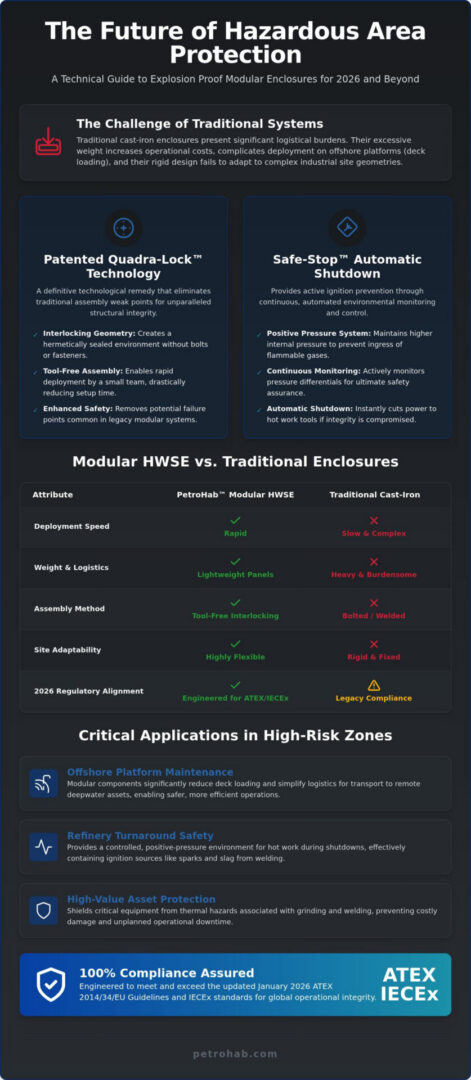
The transition from fixed, heavy containment to the PetroHab LLC Hot Work Safety Enclosure (HWSE) marks a significant advancement in safety engineering. Traditional cast-iron boxes provided protection but lacked the adaptability required for modern maintenance. Today, lightweight, fire-resistant modular panels utilize patented Quadra-Lock technology to create a secure, interlocking structure. This design allows engineers to construct custom configurations around existing piping and structural obstructions, ensuring that protection is never compromised by the complexity of the site layout. For a deeper technical analysis of these systems, consult The Definitive Guide to Hot Work Safety Enclosures (HWSE) in 2026.
Key Applications in Oil, Gas, and Petrochemicals
The deployment of modular enclosures is critical across several high-stakes industrial scenarios. These systems act as active guardians of safety during “live” operations, where the risk of ignition is constant. Key applications include:
- Offshore Platform Maintenance: Utilizing modular components reduces deck loading and simplifies the logistics of transporting equipment to deepwater assets.
- Refinery Turnaround Safety: Modular habitats provide a controlled environment for hot work during scheduled shutdowns, effectively containing ignition sources like sparks and slag.
- Asset Protection: High-value assets are shielded from the thermal hazards associated with welding and grinding operations, preventing costly damage and unplanned downtime.
By prioritizing modularity, safety managers can ensure 100% compliance with hazardous area standards while significantly reducing the time required for assembly and disassembly. This methodical approach to safety ensures that personnel and assets remain protected in the most volatile environments.
Engineering Integrity: The Quadra-Lock Modular System
The structural integrity of an explosion proof modular enclosure depends entirely on the mechanical reliability of its connection points. Legacy modular systems often utilize bolted frames or adhesive seals; both of which introduce potential failure points under high-pressure conditions. The patented Quadra-Lock panel technology addresses these vulnerabilities by employing a specific interlocking geometry that secures the enclosure without the need for traditional fasteners. This engineering approach ensures that the environment remains hermetically sealed, even when subjected to the rigorous ventilation requirements of offshore and petrochemical sites. It’s a definitive technological remedy for complex site geometries.
The Quadra-Lock Advantage
The assembly of a PetroHab LLC HWSE follows a methodical, tool-free process designed for maximum efficiency in the field. Each Quadra-Lock panel interlocks with its neighbor through a series of precision-engineered grooves and ridges. This configuration allows a two-person team to construct a full habitat in a fraction of the time required for rigid metal structures. By eliminating specialized tools and complex bolting patterns, the system mitigates the risk of human error during deployment. It’s fast. It’s reliable. This rapid assembly is particularly critical in remote locations where logistical delays directly translate into increased facility downtime. Engineers can verify the technical specifications of Quadra-Lock systems to understand how this interlocking mechanism maintains structural stability in high-wind and high-vibration environments.
Fire Resistance and Thermal Protection
Modern material science has enabled the transition from heavy metal housings to lightweight, fire-resistant modular fabrics. These materials are engineered to withstand extreme thermal loads, effectively containing sparks and slag generated during pressurized welding operations. The durability of these fabrics is essential in corrosive offshore environments where salt spray and chemical exposure degrade traditional carbon steel. This makes the explosion proof modular enclosure a superior choice for long-term deployments. Every panel undergoes rigorous testing to ensure it meets international safety standards for heat shielding and ignition prevention. To maintain the necessary positive pressure, the enclosure must sustain a constant seal. The Quadra-Lock system ensures that the internal atmosphere remains isolated from external hazardous gases. This commitment to material excellence ensures that the enclosure acts as a durable guardian of both personnel and high-value industrial assets.
Modular Habitats vs. Traditional Enclosures: A Comparison
Traditional rigid enclosures have long served the industry, but their inherent limitations become clear when compared to the agility of an explosion proof modular enclosure. Legacy cast-iron or heavy steel units provide protection through sheer mass. However, this mass introduces significant logistical challenges. On offshore rigs, deck loading limits are a critical engineering constraint. Deploying a traditional fixed enclosure often requires heavy-lift cranes and specialized transport, which increases both cost and risk. Modular systems solve this problem by utilizing lightweight, fire-resistant panels that personnel can handle without heavy machinery. This shift in material science allows for a definitive technological remedy that prioritizes both safety and efficiency.
Installation speed is another area where modularity excels. A fixed unit is often permanent or requires extensive downtime to position and secure. In contrast, modular habitats are assembled on-site in a fraction of the time. For temporary maintenance or short-term repair projects, the ability to lease these systems provides a level of cost-efficiency that permanent hardware cannot match. It allows safety managers to allocate resources effectively, ensuring that high-level protection is active only when and where it’s required. This methodical approach to resource management is essential for maintaining operational excellence in high-stakes environments.
Logistics and Transportability
Shipping a pre-assembled, rigid enclosure is an inefficient use of cargo space. These units are bulky and difficult to maneuver in tight port facilities. Modular panels pack flat, which reduces shipping volumes by a significant margin. This compact profile simplifies mobilization and demobilization, allowing equipment to reach remote sites faster. By reducing the number of transport trips required, modularity also helps lower the carbon footprint of safety operations. It’s a logistical advantage that translates directly into reduced facility downtime and lower overall project costs.
Operational Flexibility in Restricted Spaces
Industrial sites are rarely designed with open spaces for safety equipment. Engineers must often work around complex manifolds, existing piping, and structural obstructions. A rigid, fixed-geometry enclosure can’t adapt to these environments, often leaving gaps in protection or requiring expensive site modifications. An explosion proof modular enclosure provides the flexibility to build around these obstacles. If the scope of a project grows, the system scales accordingly by simply adding more Quadra-Lock panels. This adaptability is a core component of modern safety protocols. You can learn more about these configurations in our guide to Pressurized Welding Habitats: The Definitive Guide to HWSE Technology. By utilizing a scalable architecture, safety teams can ensure that the containment environment remains hermetically sealed regardless of the site’s physical complexity.
Compliance and Deployment in ATEX/IECEx Zones
Compliance is absolute. A system is either certified for the specific risks present or it represents a significant operational liability. The publication of the 6th Edition of the ATEX 2014/34/EU Guidelines in January 2026 has clarified regulations regarding digital documentation, but the core safety laws for an explosion proof modular enclosure remain stringent. Maintaining adherence to ATEX and IECEx standards is the only way to ensure the protection of personnel and high-value assets. Zone 1 environments require equipment that can operate safely where explosive atmospheres are likely to occur during normal operations. Achieving 100% compliance requires a methodical approach to both equipment selection and site-specific deployment.
Before any modular habitat is erected, safety engineers must conduct a comprehensive risk assessment. This process identifies localized hazards, such as gas pockets or potential leaks, and dictates the precise placement of the enclosure. Maintaining the “Ex” rating of the system depends on the ongoing integrity of the environmental seal. While the Quadra-Lock technology provides a robust mechanical connection, regular inspections are necessary to ensure that environmental factors like extreme heat or corrosive salt spray haven’t compromised the positive pressure barrier. This stoic commitment to maintenance prevents the ingress of flammable vapors and ensures the enclosure remains an active guardian of the site.
Navigating Global Safety Standards
The global energy sector operates under two primary regulatory frameworks: the North American Class and Division system and the International Zone system. Following the update to the UK’s designated standards for explosion-protected equipment on March 18, 2026, alignment with international standards remains a priority despite increasing divergence from certain EU directives. Modular components must meet specific fire-resistance and anti-static criteria to prevent the buildup of hazardous charges. For a detailed breakdown of these regulations, refer to our Hazardous Environment Standards: The 2026 Guide to Global Compliance and Hot Work Safety. This knowledge ensures that your safety protocols remain resilient against changing international requirements.
Sourcing and Procurement Strategies
Selecting the right partner for safety equipment is a decision that impacts the long-term reliability of your operations. When evaluating hot work safety enclosure suppliers, engineers should prioritize manufacturers with a proven track record in harsh environments like the North Sea or the Gulf of Mexico. A supplier’s role shouldn’t end at delivery. The inclusion of on-site supervision and technician training during the initial deployment is a hallmark of a critical safety partner. This expert guidance ensures that every Quadra-Lock panel is correctly seated and that the Safe-Stop system is fully integrated with the site’s emergency protocols. You can contact our technical team today to review certification documents and deployment schedules for your next project.
Integrated Safety: Modular Enclosures and Automatic Shutdown
Physical containment via an explosion proof modular enclosure is the first step in risk mitigation, but it isn’t the final one. Passive barriers can’t react to dynamic environmental shifts. In Zone 1 and Zone 2 environments, safety managers must implement active monitoring to detect gas ingress or pressure loss in real-time. The integration of the Safe-Stop automatic shutdown system with the PetroHab HWSE transforms a static habitat into an intelligent safety ecosystem. This synergy ensures that the enclosure doesn’t just contain sparks; it actively prevents ignition by managing the environment.
The system monitors three critical vectors to maintain operational integrity:
- Gas Concentration: Sensors detect flammable vapors at the air intake and within the habitat.
- Pressure Differentials: The system ensures internal pressure remains consistently higher than the external atmosphere.
- Air Flow: Electronic monitoring verifies that ventilation rates meet required exchange standards for personnel.
The Safe-Stop Logic
Safe-Stop logic follows a rigorous problem-solution architecture. If sensors detect a hazard, the system immediately executes a failsafe protocol. This involves the automatic power isolation of all welding equipment and tools. This isolation happens in milliseconds, removing the ignition source before a breach can occur. It’s a calculated response designed to instill absolute confidence in site safety. You’ll find deeper technical data on these protocols in A Comprehensive Guide to Advanced Hot Work Safety Systems in 2026. This methodical approach to safety eliminates the delays inherent in manual shutdown procedures.
Real-World Reliability and Risk Mitigation
Automated triggers significantly reduce the potential for human error during high-stakes operations. In refinery environments where gas levels can fluctuate rapidly, electronic surveillance acts as a constant, stoic observer. Case studies in high-gas environments demonstrate that when external leaks occur, the Safe-Stop system provides the definitive technological remedy by halting work before the internal environment is compromised. The combination of durable Quadra-Lock panels and high-precision electronics creates a resilient shield for personnel and high-value assets. This integrated approach defines the modern benchmark for safety excellence in the energy sector.
Advancing Operational Excellence with Modular Protection
The transition to modular safety systems represents a calculated response to the increasing complexity of offshore and petrochemical environments. By replacing traditional, heavy containment with a lightweight explosion proof modular enclosure, safety managers reduce logistical burdens while maintaining uncompromising protection. Patented Quadra-Lock interlocking technology ensures that physical barriers remain structurally sound and hermetically sealed. When combined with the Safe-Stop automatic shutdown system, these enclosures provide a definitive technological remedy that actively monitors for gas and pressure breaches.
Maintaining global compliance with ATEX and IECEx standards is a critical component of modern risk mitigation. This guide has detailed how modularity scales from individual instruments to complete personnel habitats, ensuring every ignition source is contained. Relying on verified engineering integrity allows you to protect high-value assets and ensure the safety of personnel in volatile zones. Request a Technical Consultation for Your Modular Enclosure Needs to align your site protocols with the latest 2026 safety benchmarks. Your commitment to safety excellence starts with choosing equipment that is as resilient as the teams it protects.
Frequently Asked Questions
What makes a modular enclosure “explosion proof” in hot work?
Protection is achieved through a combination of fire-resistant materials and positive pressure. These systems maintain an internal atmosphere that prevents the ingress of flammable gases. The 2026 standards emphasize that an explosion proof modular enclosure must prevent ignition by isolating sparks from the surrounding hazardous environment. It’s an active containment strategy rather than a passive one, ensuring that the integrity of the work area remains uncompromised during live operations.
Can PetroHab modular enclosures be used in ATEX Zone 1 areas?
Yes, these systems are engineered specifically for deployment in Zone 1 and Zone 2 hazardous locations. Compliance is achieved through rigorous testing against ATEX and IECEx standards. In Zone 1 areas where explosive atmospheres are likely to occur, the enclosure acts as a primary guardian. It utilizes pressurized habitat technology to ensure that any potential ignition sources are hermetically sealed away from external flammable vapors or gases.
How does the Quadra-Lock system ensure pressure integrity?
The system utilizes a patented interlocking panel mechanism that creates a continuous mechanical seal. Unlike traditional bolting or adhesive methods, Quadra-Lock geometry eliminates gaps that could lead to pressure loss. This design allows the habitat to maintain the required positive pressure differential even in high-vibration environments. The structural stability provided by these interlocking ridges ensures that the environmental barrier remains intact throughout the duration of the maintenance project.
What is the difference between an instrument enclosure and a welding habitat?
Scale and functionality are the primary differentiators. An instrument enclosure is typically a smaller unit designed to protect sensitive electronics from environmental hazards. In contrast, a welding habitat, such as the PetroHab HWSE, is a personnel-rated enclosure. It’s large enough to house operators and equipment, providing a controlled environment for hot work. These pressurized habitats require advanced ventilation and gas detection systems to ensure the safety of the workers inside.
How long does it take to assemble a standard modular HWSE?
Assembly times vary based on configuration, but a standard two-person team can typically complete a habitat in a few hours. This efficiency is a direct result of the tool-free Quadra-Lock system. By eliminating the need for specialized fasteners or heavy machinery, mobilization is significantly accelerated. This rapid deployment reduces the duration of facility shutdowns, allowing projects to move from arrival to operation with minimal logistical delay.
Is the Safe-Stop system mandatory for all modular enclosures?
While physical barriers provide containment, the Safe-Stop system is essential for active risk mitigation in high-risk zones. It provides the electronic surveillance needed to detect gas ingress or pressure drops. Most safety protocols for pressurized welding enclosures require an automatic shutdown system to isolate power to tools if a hazard is detected. Integrating this technology ensures that the enclosure functions as an intelligent safety ecosystem rather than just a passive shield.
Are modular safety enclosures available for leasing or only for sale?
PetroHab offers both leasing and sales options to accommodate different project requirements. Leasing is a cost-effective solution for temporary maintenance turnarounds or short-term repairs where permanent equipment isn’t necessary. For long-term offshore deployments or frequent refinery operations, purchasing the system may be more efficient. This flexibility allows safety managers to allocate their budgets according to the specific duration and scope of their industrial applications.
How do modular enclosures handle high-wind conditions on offshore rigs?
Structural stability is maintained through the specific interlocking design of the Quadra-Lock panels. These connections provide a rigid framework that resists deformation even in extreme offshore conditions. When properly secured to the deck, the explosion proof modular enclosure maintains its hermetic seal against high-velocity winds. This resilience ensures that the pressurized environment remains stable, protecting personnel and high-value assets from the volatile weather patterns typical of deepwater energy assets.