Blog Posts
Global Hot Work Enclosure Suppliers: A 2026 Procurement & Technical Guide
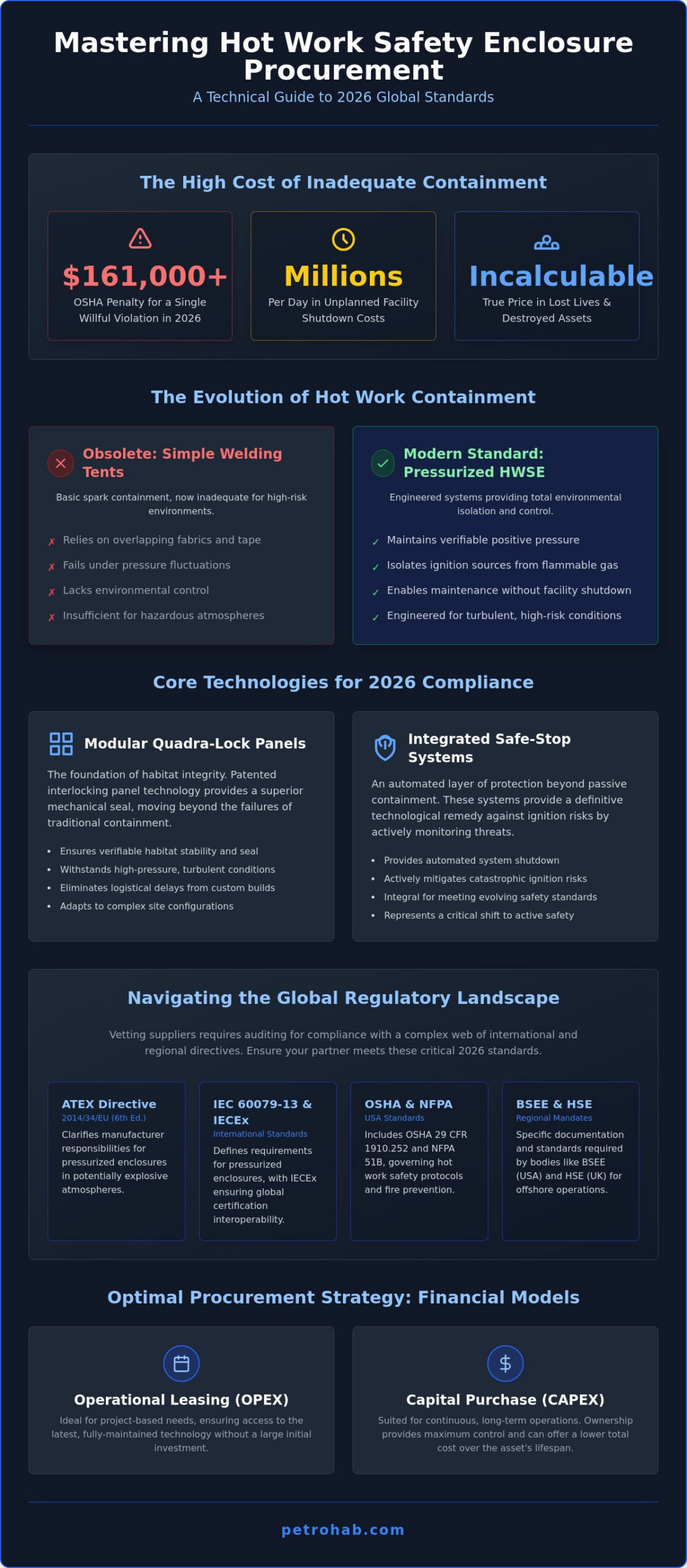
A single willful safety violation in 2026 can cost an operation over $161,000 in OSHA penalties, but the true price of habitat failure is measured in lost lives and destroyed assets. You recognize that maintaining pressurized integrity in hazardous zones requires more than a fire-retardant tarp. It demands a rigorous, engineered solution. Selecting from the landscape of global hot work enclosure suppliers involves navigating the latest 2026 ATEX Directive guidelines and the evolving IEC 60079-13 standards. This guide provides the technical framework you need to master the procurement process and ensure zero-incident hot work operations. We’ll analyze the critical role of modular Quadra-Lock panels in maintaining habitat stability and explore how integrated Safe-Stop systems provide a definitive technological remedy for ignition risks. You’ll gain a clear roadmap for deploying modular systems that adapt to your specific site configurations while maintaining full regulatory compliance across your global portfolio. By prioritizing patented interlocking technology over basic containment, you can eliminate logistical delays and secure the total cost of safety for your high-value projects.
Key Takeaways
- Identify the rigorous technical and regulatory benchmarks required to vet global hot work enclosure suppliers against 2026 industrial safety standards.
- Learn to prioritize modular Quadra-Lock technology over generic containment to ensure absolute pressurized integrity in hazardous environments.
- Understand the operational necessity of integrating automated shutdown systems like Safe-Stop to mitigate catastrophic ignition risks.
- Determine the optimal procurement strategy by evaluating the financial trade-offs between capital equipment purchase and operational leasing models.
- Master the compliance requirements for international deployments by aligning with the latest ATEX and IECEx technical directives.
The Global Landscape of Hot Work Enclosure Supply in 2026
The industrial sector’s approach to ignition control has undergone a fundamental transformation. Simple welding tents, once the standard for spark containment, are now obsolete in high-risk environments. They’ve been replaced by sophisticated Hot Work Safety Enclosures (HWSE). This shift is driven by the realization that physical barriers alone aren’t enough; true safety requires environmental control. Leading global hot work enclosure suppliers now provide pressurized habitats that isolate ignition sources from flammable atmospheres. These systems allow for critical maintenance without the need for facility-wide shutdowns.
As global energy demands intensify, the pressure to maintain production in live facilities has never been higher. Operators can’t afford the downtime associated with traditional safety protocols. Pressurized habitats have become essential infrastructure for offshore platforms and petrochemical refineries. These environments require adherence to rigorous global hot work safety standards, including NFPA 51B and OSHA 29 CFR 1910.252. Generic suppliers often fail here because they lack the specialized engineering required to withstand the corrosive and volatile conditions of offshore sites.
To better understand the operational mechanics of these systems, watch this technical overview:
Regulatory Drivers and Global Compliance
Compliance is the cornerstone of industrial safety. In 2026, the 6th edition of the ATEX Directive 2014/34/EU guidelines clarified manufacturer responsibilities for pressurized enclosures. Suppliers must provide equipment that meets both ATEX and IECEx certifications to ensure international interoperability. Regional regulations also dictate specific hardware requirements. For instance, BSEE mandates in the USA or HSE standards in the UK require documentation that generic enclosures can’t provide. Sourcing from global hot work enclosure suppliers with a proven track record in these jurisdictions is a prerequisite for operational licensing.
The High Cost of Inadequate Containment
The financial consequences of a safety breach extend far beyond immediate physical damage. OSHA penalties for willful violations can exceed $161,000 per instance, yet the cost of an unplanned facility shutdown is often measured in millions per day. HWSE integrity serves as the primary technical barrier against catastrophic ignition in hazardous zones. Relying on “good enough” containment is a liability that safety managers can’t justify. High-pressure environments demand modular systems, such as Quadra-Lock panels, that provide a verifiable seal. This level of engineering excellence ensures that personnel and high-value assets remain protected under all operational conditions.
Critical Engineering Standards for Global HWSE Suppliers
Evaluating global hot work enclosure suppliers requires a shift from vendor management to technical auditing. In 2026, the benchmark for a pressurized habitat isn’t just fire resistance; it’s the ability to maintain a verifiable pressure differential in turbulent offshore conditions. Material science and mechanical interlocking have evolved to meet these demands. Procurement teams must look past marketing claims to examine the underlying engineering that prevents gas ingress and ensures personnel safety. High-performance systems now utilize modularity to solve the logistical delays common with custom-built containment solutions.
Adherence to Critical Engineering Standards ensures that every component of a habitat functions as a unified barrier. Traditional welding tents rely on overlapping fabrics and tape, which fail under pressure fluctuations. Modern engineering favors interlocking systems that create a mechanical seal. This shift is essential for meeting the 2026 IEC 60079-13 requirements for pressurized enclosures. When you audit a supplier, you’re looking for evidence that their system can withstand the specific thermal and chemical stressors of your site.
Modular Integrity and the Quadra-Lock Advantage
The core of habitat integrity lies in the connection points. Traditional fastening methods like zippers or hook-and-loop strips don’t provide the airtight seal necessary for consistent positive pressure. This is where the engineering of Quadra-Lock Panels becomes a decisive factor. These panels use a patented interlocking mechanism that physically joins the sections, creating a continuous protective skin. This modularity allows for the enclosure of complex protrusions and intrusions, such as pipes or structural beams, without compromising the habitat’s internal atmosphere. It’s a technical remedy that generic global hot work enclosure suppliers can’t replicate with standard fabrics.
Material Science in Hazardous Environments
Durability in hazardous zones is a function of chemical stability and thermal resistance. Enclosures must withstand UV degradation on offshore decks and resist the corrosive effects of salt spray and industrial chemicals. Material science has advanced to produce fire-resistant fabrics that don’t off-gas or degrade when exposed to sparks. Quadra-Lock panels maintain structural integrity during high-heat welding operations. This resilience ensures that the habitat remains a reliable guardian throughout the project’s duration. If you’re planning a long-term maintenance project, it’s vital to consult with an expert to verify that your chosen material specs align with your environmental hazards.
Integrated Safety Systems: Beyond Physical Containment
A physical barrier is only the first layer of a robust safety protocol. While high-quality panels provide the necessary containment, they’re static components that can’t respond to dynamic environmental changes. True protection in high-risk zones requires active intelligence. When evaluating global hot work enclosure suppliers, the hardware’s ability to communicate with automated safety loops is a non-negotiable procurement criterion. This proactive approach is mandated by OSHA’s hot work safety standards, which require a comprehensive hazard assessment that includes active mitigation strategies.
The primary risk in any live facility is the sudden ingress of flammable gases. Integrating advanced hot work safety systems transforms a passive enclosure into a reactive safety ecosystem. These systems use a combination of gas detection and pressure monitoring to maintain a protective environment for personnel. If the system detects a breach or an external hazard, it must terminate the ignition source immediately. This level of automation removes human error from the safety equation, ensuring that hot work only proceeds when conditions are strictly within safe parameters.
Safe-Stop: The Benchmark for Automatic Shutdown
The Safe-Stop Automatic Shutdown System serves as the definitive technological remedy for ignition risks. It’s an Automatic Shutdown System (ASDS) designed to interface directly with welding machines and other hot work equipment. The mechanism is straightforward but rigorous. If sensors detect hydrocarbons at a concentration as low as 10% of the Lower Explosive Limit (LEL), the system triggers an instantaneous shutdown. It doesn’t just sound an alarm; it cuts the power. This fail-safe logic is reinforced by the integration of both pneumatic and electrical controls. This dual-loop architecture ensures that even if one control source is compromised, the system’s ability to terminate the hot work remains intact. It’s a critical safeguard that provides safety managers with absolute confidence during high-stakes maintenance operations.
Gas Detection and Environmental Monitoring
Continuous environmental monitoring is the only way to verify positive pressure habitat integrity. Sourcing ATEX-certified gas detectors is essential for habitat integration, as these devices are engineered to operate reliably in the very hazardous zones they monitor. These detectors work in tandem with manometers that measure the pressure differential between the habitat’s interior and the external atmosphere. A consistent positive pressure, typically maintained at 50 pascals, prevents gas ingress. Real-time data logging has become a standard requirement for 2026 safety audits. It provides a verifiable record of the habitat’s environment throughout the project. Without this data, a supplier can’t prove that the habitat functioned as intended, leaving the operator vulnerable to both physical risks and regulatory scrutiny.
Global Sourcing Strategies: Leasing vs. Purchasing HWSE
Procurement teams must determine whether a capital expenditure or an operational leasing model best aligns with their safety objectives. The choice between purchasing and renting equipment from global hot work enclosure suppliers depends on project duration, frequency, and internal maintenance capabilities. While buying provides long-term control, leasing offers the flexibility to scale operations without the burden of asset management. Every decision must prioritize the continuous availability of certified equipment to prevent project delays. Choosing a supplier that offers both models allows for a hybrid approach tailored to specific facility needs.
The Buy vs. Lease Decision Matrix
Purchasing a PetroHab Hot Work Safety Enclosure is a strategic investment for facilities with ongoing maintenance requirements or permanent high-risk zones. The total cost of ownership (TCO) for owned assets includes initial procurement, climate-controlled storage, and mandatory periodic recertification of the Quadra-Lock panels. Conversely, leasing is the preferred strategy for short-term turnarounds, offshore campaigns, and specific shutdowns. Renting ensures immediate access to the most recent iterations of Safe-Stop technology without capital depreciation. It also eliminates the logistical challenge of maintaining specialized hardware between projects. This shifts the technical maintenance responsibility back to the expert supplier, ensuring the equipment is always in peak operational condition.
Managing Global Deployment and Logistics
Mobilizing safety equipment to remote locations like the North Sea or the Pre-salt basins of Brazil requires a supplier with a robust international footprint. Reliable global hot work enclosure suppliers mitigate logistical risks by maintaining regional hubs and navigating the complex customs requirements of cross-border projects. Customs clearance can delay projects by weeks if the ATEX and IECEx certifications aren’t properly documented for the local jurisdiction. Deployment isn’t just about shipping hardware; it’s about ensuring on-site competence. Effective sourcing strategies include provisions for certified on-site supervision and technician training to ensure habitat integrity is maintained throughout the deployment. This approach minimizes the risk of installation errors that could lead to costly safety breaches. If you’re planning an upcoming offshore campaign, you can request a mobilization quote to see how regional support impacts your timeline.
PetroHab: Your Strategic Partner for Global HWSE Excellence
PetroHab stands as the technical benchmark for hot work safety enclosure suppliers. We don’t just manufacture equipment. We engineer definitive safety remedies for the world’s most hazardous environments. Our mission is clear. We eliminate workplace accidents through the application of uncompromising technology. By maintaining operational hubs in the USA, UK, and Brazil, we ensure that our clients receive rapid response and technical support regardless of their location. This global reach makes PetroHab a critical partner for multinational energy firms. You require consistent safety standards across diverse assets. We deliver them through rigorous engineering and meticulous logistical support.
The Quadra-Lock and Safe-Stop Ecosystem
Our safety architecture relies on the integration of physical containment and automated monitoring. The patented Quadra-Lock technology provides the structural integrity needed to maintain positive pressure. Meanwhile, the Safe-Stop system acts as the active guardian of the site. This ecosystem is modular and highly adaptable. We provide customization options that allow our habitats to conform to unique facility footprints. This ensures that even complex pipe configurations or structural obstacles are fully enclosed without compromising the internal atmosphere. PetroHab provides hazardous environment standards compliant solutions worldwide, ensuring your operations meet the most stringent 2026 regulatory demands. This integrated approach removes guesswork from procurement. It replaces it with verifiable safety data and absolute operational control.
Comprehensive Support and Training
Securing a facility requires more than high-quality hardware. It demands a workforce that understands the nuances of habitat integrity. PetroHab supports global clients through a comprehensive suite of services. These include on-site supervision and rigorous technician training programs. We don’t just deliver a Petro-Habitat. We ensure your team is equipped to operate it at peak safety levels. Whether your project dictates a long-term purchase or a short-term operational lease, our maintenance protocols remain uncompromising. Our technicians provide the granular expertise needed to manage the logistical challenges of remote offshore deployments. We handle the technical details so your safety managers can focus on operational excellence.
Choosing between global hot work enclosure suppliers is a decision that directly impacts the safety of your personnel. It also protects the longevity of your high-value assets. PetroHab’s commitment to engineering excellence and global compliance ensures that your hot work operations remain zero-incident. The next step in securing your facility is to align with a partner that understands the high stakes of heavy industry. Contact our technical team today to discuss your specific site configurations and regulatory requirements.
Securing Your 2026 Hot Work Operations
Effective risk mitigation in high-hazard environments requires a transition from basic containment to engineered safety ecosystems. You’ve identified the critical importance of selecting global hot work enclosure suppliers that prioritize technical precision and rigorous regulatory compliance. By integrating patented Quadra-Lock modular technology with Safe-Stop automatic shutdown systems, you establish a definitive technical barrier against ignition risks. These advancements ensure your facility meets the latest ATEX and IECEx standards while maintaining operational continuity during live facility maintenance.
Your procurement strategy must account for the logistical complexities of international deployments. Whether you’re managing a short-term offshore turnaround or a long-term facility upgrade, access to technical support in the USA, UK, and Brazil is essential for project success. PetroHab provides the rigorous engineering and on-site expertise required to eliminate workplace accidents and protect your high-value assets. It’s time to elevate your safety protocols with a partner that understands the granular details of industrial hazards. Request a Technical Consultation for Global HWSE Solutions to secure your next project. We look forward to helping you achieve zero-incident operations through technical excellence.
Frequently Asked Questions
What are the key certifications required for global hot work enclosure suppliers?
Global hot work enclosure suppliers must provide equipment certified to ATEX and IECEx standards to ensure international compliance. These certifications verify that the habitat can operate in hazardous locations without becoming an ignition source. Additionally, adherence to NFPA 51B and OSHA 29 CFR 1910.252 is required for fire prevention and operational safety. Suppliers should also maintain ISO 9001 quality management systems to guarantee consistent manufacturing standards across their global product lines.
How does Quadra-Lock technology improve habitat safety compared to traditional panels?
Quadra-Lock technology utilizes a patented interlocking system that creates a mechanical seal between panels, whereas traditional habitats rely on zippers or tape. This design ensures superior pressurized habitat integrity by preventing air leaks even under high-pressure conditions. The modularity of these panels also allows for precise configuration around complex pipework, maintaining a definitive barrier against flammable gas ingress. It’s a more resilient solution for high-heat welding operations than generic alternatives.
Can pressurized welding habitats be used in ATEX Zone 1 and Zone 2 environments?
Pressurized welding habitats are specifically engineered for use in both ATEX Zone 1 and Zone 2 hazardous environments. By maintaining a constant positive pressure, the enclosure prevents the entry of explosive gases into the workspace. When integrated with an automatic shutdown system, these enclosures provide a safe environment for hot work in areas where flammable atmospheres may occur. This isolation is the primary technical remedy for performing critical maintenance in live facilities.
What is the typical lead time for global deployment of a PetroHab HWSE?
Typical lead times for global deployment vary based on project location, but PetroHab leverages regional hubs in the USA, UK, and Brazil to minimize mobilization delays. Standard configurations can often be dispatched within days for domestic projects. For remote offshore campaigns, our logistical team coordinates customs and transportation to ensure equipment arrives before the scheduled shutdown window begins. This global reach allows us to support urgent maintenance needs across various industrial basins.
Should I lease or purchase a hot work safety enclosure for a 6-month turnaround?
A 6-month turnaround typically favors a leasing model to avoid the capital expenditure and long-term asset maintenance costs associated with purchasing. Leasing from global hot work enclosure suppliers provides access to the latest Safe-Stop technology and ensures the equipment is recertified and ready for immediate use. This approach also eliminates the need for facility storage once the project is completed. It’s a flexible strategy that aligns operational costs with specific project timelines.
How does the Safe-Stop system handle a sudden loss of positive pressure?
The Safe-Stop system triggers an instantaneous shutdown of all hot work equipment if it detects a loss of positive pressure or the presence of hydrocarbons. It doesn’t rely on manual intervention; the system cuts power to the welding or grinding tools immediately. This fail-safe response ensures that ignition sources are neutralized before a flammable atmosphere can penetrate the enclosure’s boundaries. The system continuously monitors the environment to maintain the integrity of the habitat’s internal atmosphere.
Are PetroHab habitats compatible with all standard welding and grinding equipment?
PetroHab habitats are compatible with all standard industrial welding, cutting, and grinding equipment. The Safe-Stop Automatic Shutdown System is designed to interface with various power sources and pneumatic tools to provide centralized control. This ensures that any tool capable of producing sparks or heat is integrated into the habitat’s safety loop for immediate termination if a hazard is detected. It’s a versatile system that adapts to the specific technical requirements of your site.
What training is required for personnel to operate a pressurized habitat safely?
Personnel must complete specialized training covering habitat assembly, pressure testing, and emergency shutdown protocols to operate a pressurized habitat safely. PetroHab provides on-site supervision and certified technician training to ensure all operators understand the technical requirements of the Quadra-Lock system. This training is essential for maintaining the habitat’s integrity and ensuring full compliance with international safety regulations. Competent supervision is a prerequisite for achieving zero-incident hot work operations in hazardous zones.