Blog Posts
Refinery Safety Practices: A Comprehensive Guide to Industrial Risk Mitigation in 2026
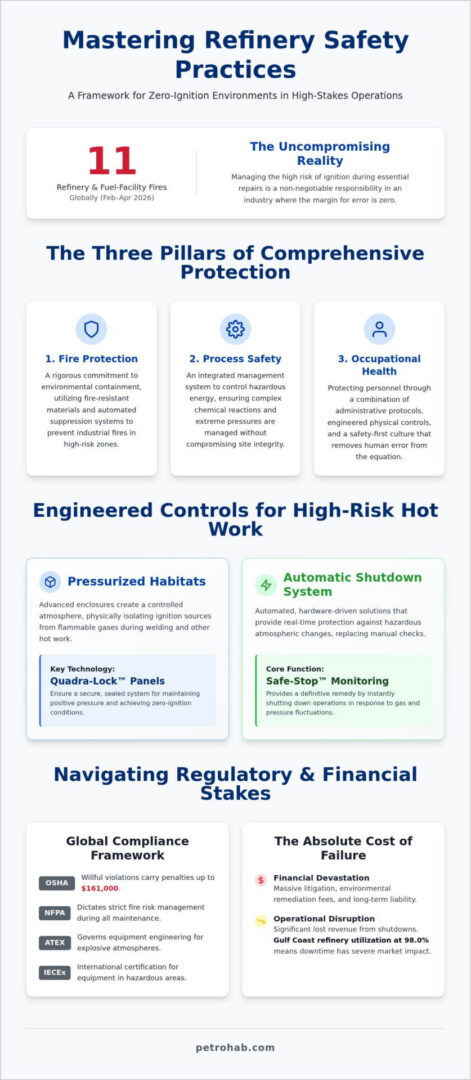
Between February and April 2026, eleven refinery and fuel-facility fires occurred globally across four continents, proving that even the most established operations remain vulnerable to catastrophic ignition. In the United States, significant incidents at facilities operated by major energy leaders highlight the urgent necessity for advanced refinery safety practices. You recognize that managing the high risk of ignition during essential welding repairs is an uncompromising responsibility, where the margin for error is non-existent and the cost of failure is absolute.
We agree that adhering to complex international standards like ATEX, OSHA, and NFPA while minimizing operational downtime is the primary challenge of modern industrial maintenance. This guide promises to help you master the essential protocols and hardware solutions required to maintain zero-ignition environments. We will detail the implementation of pressurized Petro-Habitats and the technical advantages of Quadra-Lock Panels. You’ll also learn how the Safe-Stop Automatic Shutdown System provides a definitive remedy for gas and pressure fluctuations, ensuring full compliance and zero incidents during your next maintenance turnaround.
Key Takeaways
- Implement a multi-layered framework of refinery safety practices to effectively manage the inherent risks of processing volatile hydrocarbons in 2026.
- Master the three pillars of industrial protection—Fire Protection, Process Safety, and Occupational Health—to ensure comprehensive site coverage.
- Deploy pressurized habitats featuring Quadra-Lock panels to maintain zero-ignition environments during high-risk hot work and welding operations.
- Integrate the Safe-Stop Automatic Shutdown System for real-time gas and pressure monitoring, providing a definitive technological remedy to hazardous conditions.
- Develop robust, site-specific safety plans that combine Permit-to-Work systems with engineered containment solutions to minimize operational downtime.
The Landscape of Refinery Safety: Navigating High-Stakes Environments
Industrial risk mitigation in modern downstream facilities requires a multi-layered strategy that transcends basic administrative oversight. Effective refinery safety practices prioritize the physical containment of hazardous energy and the protection of high-value assets. In these high-stakes environments, safety isn’t a peripheral concern; it’s the foundation of operational existence. We define this approach as the seamless integration of engineering controls, rigorous administrative protocols, and advanced hardware solutions designed to eliminate ignition sources.
Processing volatile hydrocarbons in 2026 involves navigating extreme pressures and temperatures. Recent data highlights the persistent danger, with a cluster of eleven refinery and fuel-facility fires occurring globally between February and April 2026. Understanding Oil refinery operations and safety is essential for engineers who must manage these complex chemical reactions without compromising site integrity. The inherent risks of the sector demand a shift from reactive measures to proactive, technology-driven ecosystems.
To better understand the mechanics of disaster prevention in these environments, watch this helpful video:
Modern heavy industry now favors integrated safety-technology ecosystems. These systems replace manual monitoring with automated, hardware-driven solutions that provide real-time protection. A robust safety-first culture relies on these technologies to remove human error from the equation. This ensures that protection remains constant even when production pressure is at its peak, transforming safety from a checklist into a definitive operational capability.
The Cost of Failure in Industrial Environments
The impact of a refinery incident extends far beyond immediate physical damage. Economic consequences include massive litigation costs, environmental remediation fees, and significant lost revenue during unplanned shutdowns. In mid-2026, Gulf Coast refinery utilization reached 98.0%, meaning any disruption has severe market implications. Implementing rigorous refinery safety practices mitigates long-term liability and preserves the operational continuity required to meet global energy demands. Protecting personnel and high-value assets is the only way to ensure sustainable profitability.
Regulatory Frameworks: OSHA, NFPA, and Beyond
Compliance is anchored by strict governing bodies and technical standards. OSHA’s 2026 agenda emphasizes increased enforcement and frequent inspections in the energy sector, with willful violations carrying penalties up to $161,000. Engineers must adhere to the NFPA 51B standard to manage fire risks during maintenance. Additionally, international certifications like ATEX and IECEx dictate the engineering requirements for equipment used in explosive atmospheres. These frameworks provide the linguistic and technical anchors for quality and safety excellence in the global field.
The Three Pillars of Comprehensive Refinery Safety Practices
Refinery safety practices are built upon three critical pillars: Fire Protection, Process Safety, and Occupational Health. Each pillar demands a distinct combination of administrative protocols and engineered physical controls. We don’t view these as isolated disciplines. Instead, they function as an integrated safety management system where each component reinforces the others. Continuous monitoring remains the vital link that maintains the integrity of these pillars during high-pressure operations, ensuring that protection is never compromised by production demands.
Fire Protection and Suppression Strategies
Preventing industrial fires requires a rigorous commitment to environmental containment. Modern refinery safety practices rely on fire-resistant materials and automated suppression systems in high-risk processing zones to act as the final line of defense. However, the most effective strategy is the total exclusion of ignition sources during maintenance. This is achieved by utilizing pressurized enclosures that provide a physical barrier between the work area and the surrounding environment. These systems are designed to contain sparks and heat, preventing them from interacting with volatile hydrocarbon vapors present in the facility.
Process Safety Management (PSM)
Process Safety Management provides the technical framework for preventing the release of highly hazardous chemicals. This discipline focuses on mechanical integrity and quality assurance across all refinery equipment. Adhering to OSHA’s Process Safety Management (PSM) enforcement directives ensures that facilities maintain the highest standards of containment. Because mechanical failures are often the root cause of unplanned shutdowns, rigorous inspection cycles and predictive maintenance are mandatory components of a robust PSM strategy.
Integrated hot work safety systems support PSM goals by allowing welding and grinding to proceed without compromising the safety of the broader facility. These systems utilize advanced hardware, such as Quadra-Lock panels, to ensure enclosure integrity and pressure retention. When maintenance is required near live equipment, these engineered controls provide a definitive technological remedy. For managers seeking to upgrade their site protocols, exploring the latest pressurized habitat technology is a logical step toward achieving zero-incident turnarounds and maintaining mechanical integrity.
Occupational health completes the triad by focusing on the protection of personnel from immediate and long-term hazards. This includes managing heat stress and exposure to toxic substances during maintenance cycles. In 2026, the Total Recordable Injury Rate (TRIR) for the oil and gas industry remains between 0.5 and 1.5 per million hours worked. Maintaining these rates requires a relentless focus on monitoring environmental conditions in real-time. The industry’s move toward digitized safety workflows, which are predicted to reach 78% adoption by the end of 2026, allows for more precise tracking of personnel health and equipment status. This digital integration ensures that every pillar of protection remains functional under the most demanding operational schedules.
Mitigating Hot Work Risks: The Role of Pressurized Enclosures
Hot work is any industrial process that generates open flames, sparks, or significant heat, such as welding, grinding, and torch cutting. In the volatile environment of a modern oil and gas facility, these activities represent the leading cause of ignition events. The presence of hydrocarbon vapors means that a single stray spark can lead to a catastrophic failure. Traditional refinery safety practices often relied on total plant shutdowns to manage these risks, but today’s production pressures require a more sophisticated, engineered solution.
The hot work safety enclosure (HWSE) offers a definitive technological remedy by isolating the ignition source from the hazardous atmosphere. These enclosures operate on the physics of positive pressure. By maintaining an internal air pressure higher than the external environment, the system creates a physical barrier that prevents gas ingress. This methodology aligns with Global best practices for refinery safety, ensuring that essential repairs don’t compromise the integrity of the broader facility.
Engineering a Pressurized Welding Habitat
A pressurized welding habitat is a complex assembly of fire-resistant materials and specialized air-handling hardware. The core of the system is the air ducting, which draws clean, non-hazardous air from a remote location to maintain a constant positive pressure differential. This airflow is meticulously calculated to ensure that even if a seal is momentarily broken, the outward rush of air prevents flammable vapors from entering. Because refinery layouts are often dense and irregular, modularity is a critical requirement. Modular components allow safety managers to construct habitats around existing piping and vessels, providing protection without requiring extensive equipment relocation.
The Integrity of Containment: Quadra-Lock Technology
The effectiveness of any pressurized enclosure depends entirely on the quality of its seal. Quadra-Lock panels represent the industry benchmark for enclosure integrity. Unlike traditional fastening methods that can degrade under thermal stress, Quadra-Lock technology ensures a superior, airtight seal that maintains pressure even in high-wind or high-vibration environments. These panels are engineered for durability in harsh refinery climates, resisting corrosion and UV degradation over extended maintenance cycles. The design also prioritizes rapid deployment. The ease of assembly allows technicians to erect the habitat quickly, minimizing operational downtime while ensuring that safety protocols are strictly met. This technical precision transforms the enclosure into an active guardian of the worksite.
Implementing a Robust Refinery Safety Plan
Developing a site-specific safety plan is the prerequisite for any hazardous work. It transforms abstract refinery safety practices into actionable field directives. A significant failure in traditional planning is the disconnect between administrative Permit-to-Work (PTW) systems and the physical hardware deployed on-site. We bridge this gap by requiring that every permit specifies the exact pressurized containment and monitoring technology required for the task. This integration ensures that on-site supervisors and technicians have a definitive technological remedy rather than just a checklist.
A robust plan also demands specialized training and continuous on-site supervision. It isn’t enough to deploy advanced hardware; the personnel must be proficient in its operation and emergency protocols. This human factor is integrated into the technological ecosystem to ensure that every safety layer remains functional under high-pressure production schedules.
Step-by-Step Risk Assessment for Maintenance
A rigorous risk assessment begins long before the first spark is struck. The process follows a logical sequence to identify and neutralize hazards:
- Hazard Identification: Technicians must locate all potential hydrocarbon release points and ignition sources within a 15-meter radius of the work site.
- Enclosure Specification: Determine the footprint of the Petro-Habitat. This selection depends on the complexity of the piping and the space required for the welding team to operate safely.
- Atmospheric Evaluation: Baseline gas levels are established using calibrated sensors. Work cannot proceed if flammable vapors are detected above established safety thresholds.
Determining the appropriate safety enclosure requires an analysis of the specific task and the surrounding environment. Modular systems are favored here, as they can be adapted to the irregular geometries of refinery vessels and piping, ensuring a superior seal regardless of the site’s physical constraints.
Safe-Stop: The Critical Role of Automatic Shutdown
The Safe-Stop Automatic Shutdown System acts as the active guardian of the maintenance site. It provides real-time monitoring of both gas concentrations and internal pressure differentials. If the system detects hydrocarbon gas at 10% of the Lower Flammable Limit (LFL), it triggers an immediate shutdown of all power to the welding equipment. This prevents the ignition of any vapors that may have entered the vicinity.
Monitoring habitat pressure is equally vital. The Safe-Stop system utilizes manometers to track the positive pressure differential maintained by the air intake units. If the pressure within the enclosure drops below the required threshold, the system halts operations instantly. This automated response removes the risk of human delay during a pressure loss event. For facilities aiming to eliminate the risk of ignition during live operations, implementing a Safe-Stop Automatic Shutdown System is the industry benchmark for hardware-driven protection.
Global Best Practices for Refinery Safety Excellence
Refinery safety practices in 2026 have transitioned from reactive mitigation to proactive prevention. This shift demands a commitment to engineered containment that eliminates the possibility of ignition before it occurs. High-hazard environments don’t allow for second chances. Selecting hot work safety enclosure suppliers with global reach is essential for maintaining consistent standards across international assets. These partners provide the technical expertise and hardware required to protect personnel and high-value assets in diverse climates and regulatory jurisdictions.
The future of industrial protection lies in the integration of AI and remote monitoring. By the end of 2026, 78% of oil and gas operations are predicted to use fully digitized safety workflows. This digital layer enhances physical hardware by providing real-time data on gas levels and enclosure integrity. It allows safety managers to identify operational risks before they escalate into incidents. This proactive stance is the industry benchmark for excellence, ensuring that protection remains constant even when production pressure is at its peak.
Training and Competency: The Human Factor
Hardware alone doesn’t guarantee safety. The human factor remains a critical component of any risk mitigation strategy. Deploying a Petro-Habitat requires certified technicians who understand the granular details of habitat setup and pressure management. Specialized training programs reduce the risk of user error in hazardous zones, ensuring that the enclosure functions as an airtight barrier. PetroHab maintains an unwavering commitment to on-site supervision and support. This ensures that every installation meets rigorous engineering standards and international certifications, providing a definitive technological remedy to the risks of hot work.
Achieving Zero-Incident Maintenance Cycles
Zero-incident maintenance cycles are achievable when you integrate high-quality hardware with intelligent software. The ROI of investing in these systems is clear. It minimizes operational downtime and prevents the catastrophic costs associated with refinery fires. By utilizing Quadra-Lock panels for structural integrity and the Safe-Stop Automatic Shutdown System for real-time monitoring, facilities achieve a level of protection that administrative protocols alone can’t provide. This combination creates a resilient barrier against the inherent hazards of hydrocarbon processing.
Safety managers seeking to eliminate ignition risks and ensure full compliance should prioritize engineered solutions. Our role as an active guardian of industrial sites ensures that your personnel return home safely and your assets remain secure. For those ready to implement these refinery safety practices, contact PetroHab to secure a definitive technological remedy for your next maintenance turnaround.
Securing the Future of Industrial Risk Mitigation
Refinery safety practices in 2026 require more than just compliance; they demand an uncompromising integration of administrative protocols and engineered hardware. We’ve established that the three pillars of fire protection, process safety, and occupational health are only as strong as the physical barriers supporting them. By utilizing pressurized enclosures and real-time monitoring technology, you move beyond reactive suppression and toward proactive prevention. This strategy ensures that high-risk hot work can proceed without compromising the integrity of your volatile hydrocarbon assets or the safety of your personnel.
Your facility’s operational continuity depends on reliable risk mitigation. Implementing patented Quadra-Lock technology ensures a superior seal for every enclosure, while certified Safe-Stop shutdown systems provide a definitive technological remedy for gas detection events. With our global operational support and technician training, you gain a critical safety partner dedicated to eliminating workplace accidents. Contact PetroHab today to secure your refinery with advanced Hot Work Safety Enclosures. We’re ready to help you achieve a zero-incident maintenance cycle during your next turnaround.
Frequently Asked Questions
What are the most common refinery safety practices for hot work?
Common refinery safety practices for hot work involve a combination of rigorous gas testing, the issuance of hot work permits, and the deployment of pressurized enclosures. These protocols ensure that ignition sources like welding sparks are physically isolated from the surrounding atmosphere. By utilizing a PetroHab Hot Work Safety Enclosure (HWSE), facilities can perform essential repairs without halting production, maintaining high safety standards while minimizing operational downtime during critical maintenance turnarounds.
How does a pressurized welding habitat improve refinery safety?
A pressurized welding habitat improves safety by creating a controlled environment where ignition sources are separated from volatile hydrocarbon vapors. The enclosure uses clean air drawn from a non-hazardous location to maintain a higher internal pressure. This physical barrier ensures that sparks and slag are contained within the work area, while simultaneously preventing flammable gases from entering, thereby eliminating the primary risk factors associated with on-site welding and grinding.
What is the difference between administrative and engineering controls in a refinery?
Administrative controls rely on human compliance with procedures, such as safety meetings and permit systems. Engineering controls, however, involve physical hardware designed to eliminate hazards automatically. In the context of refinery safety practices, engineering controls like the Safe-Stop Automatic Shutdown System provide a more reliable layer of protection. These systems don’t depend on human reaction times, as they use sensors to trigger immediate safety actions when hazardous conditions are detected.
Why is NFPA 51B compliance critical for oil and gas maintenance?
NFPA 51B compliance is critical because it establishes the definitive standard for fire prevention during welding, cutting, and other hot work activities. This standard mandates the identification of fire hazards and the implementation of specific safeguards, such as fire watches and containment systems. Adhering to these requirements ensures that maintenance teams follow internationally recognized safety protocols, which is essential for mitigating liability and protecting high-value assets in explosive environments.
How do automatic shutdown systems prevent refinery fires?
Automatic shutdown systems prevent fires by monitoring the environment for gas ingress or pressure loss in real-time. If sensors detect combustible gases or a failure in the enclosure’s positive pressure, the system immediately terminates power to all hot work equipment. This rapid response neutralizes potential ignition sources before a fire can start. The Safe-Stop system acts as an active guardian, ensuring that hardware failure or environmental changes don’t lead to catastrophic events.
What should be included in a refinery safety plan for 2026?
A 2026 safety plan must integrate digital workflows with physical containment hardware. It should include a comprehensive risk assessment, detailed specifications for pressurized habitats, and clear procedures for atmospheric monitoring. The plan must also outline the roles of certified technicians and the use of automated systems like Safe-Stop. By combining administrative permits with hardware-driven remedies, safety managers can ensure full compliance with updated OSHA and NFPA standards while maintaining operational continuity.
How does positive pressure prevent ignition in hazardous zones?
Positive pressure prevents ignition by maintaining an internal environment where the air pressure exceeds that of the surrounding hazardous atmosphere. This pressure differential creates a constant outward airflow through any gaps or seals. If a leak occurs, the higher internal pressure forces air out, which physically blocks flammable hydrocarbon vapors from entering the enclosure. This engineered control is a fundamental component of maintaining a zero-ignition environment during high-risk maintenance activities.
What are the benefits of using modular Quadra-Lock panels for safety enclosures?
Modular Quadra-Lock panels provide superior enclosure integrity through a patented interlocking design that ensures an airtight seal. Unlike traditional materials, these panels are engineered for durability in harsh refinery climates and can resist extreme thermal stress. Their modularity allows for rapid assembly around complex piping and vessel geometries, making them highly effective for diverse refinery layouts. This technical precision ensures that the pressurized environment remains stable and secure throughout the maintenance cycle.