Blog Posts
The True Cost of Unplanned Production Shutdown in Oil and Gas: 2026 Operational Analysis
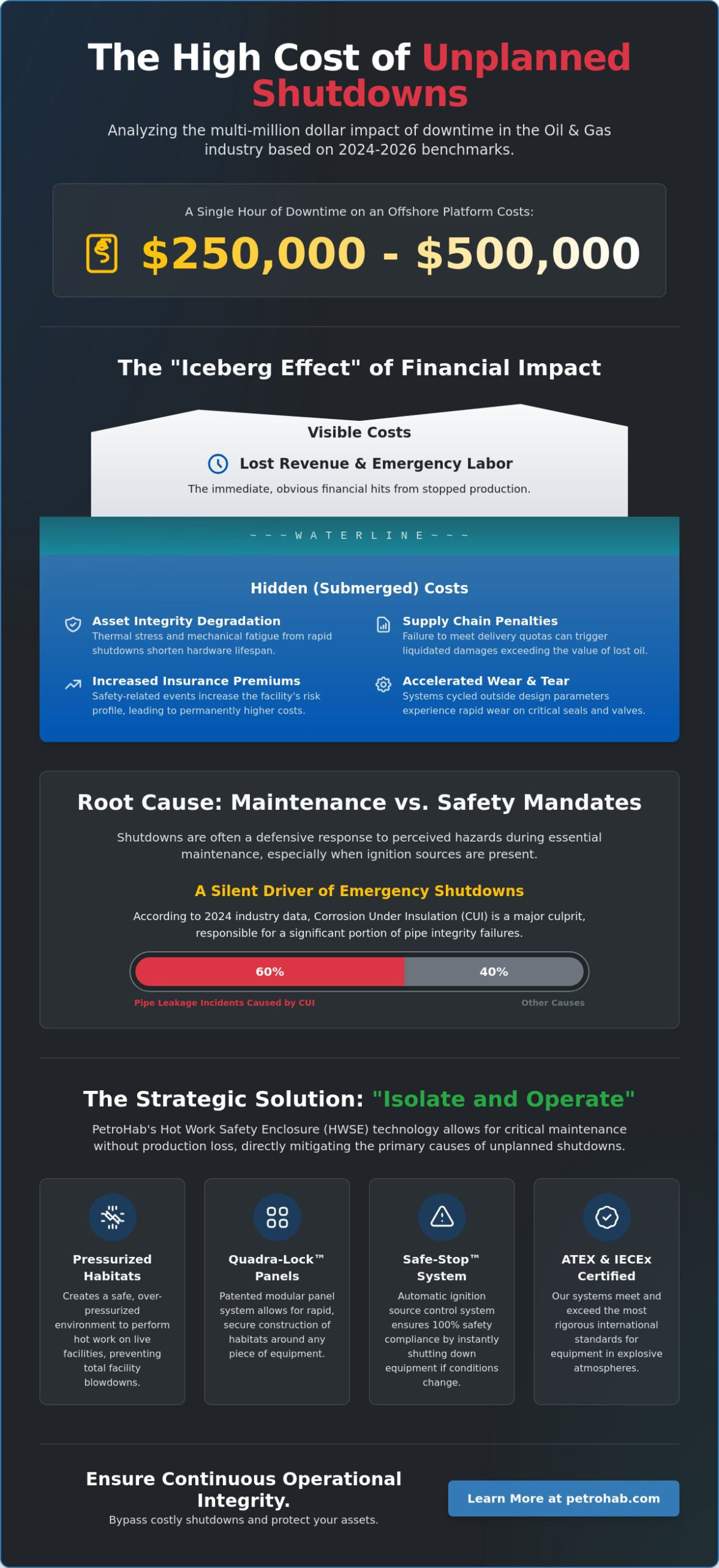
A single hour of downtime on an offshore platform now averages $250,000 in lost revenue, according to 2024 industry benchmarks. You’ve likely felt the pressure of these escalating figures as the cost of unplanned production shutdown in oil and gas reaches new peaks in 2026. Maintaining production quotas while managing emergency repairs is a high-stakes balancing act that safety engineers must navigate daily. It’s a reality where a single uncontrolled ignition source can halt operations for weeks, risking both human life and high-value assets.
This analysis provides an authoritative breakdown of the multi-million dollar impact of unplanned downtime and identifies the technologies that allow maintenance without production loss. We’ll examine how the gold standard in hot work safety, featuring the patented Quadra-Lock modular panel system and Safe-Stop ignition source control, ensures 100% safety compliance during live maintenance. You’ll gain the specific data needed for executive reporting while learning how to preserve facility integrity through pressurized habitats that meet rigorous ATEX and IECEx standards.
Key Takeaways
- Analyze the current $250,000 to $500,000 per hour industry benchmark to understand the full financial magnitude of the “Iceberg Effect” on your operations.
- Utilize our practical calculation framework to determine your asset’s Value per Minute (VPM) and the total cost of unplanned production shutdown in oil and gas.
- Evaluate the regulatory and reputational risks associated with frequent halts, including the impact of offshore governing bodies and mandatory “Stop Work” orders.
- Implement a strategic shift to “Isolate and Operate” methodologies using patented Quadra-Lock technology to perform hot work in pressurized, safe environments.
- Ensure continuous operational integrity by deploying modular safety habitats that mitigate ignition risks and bypass the necessity for total facility blowdowns.
Defining the Magnitude: Financial Impact of Unplanned Shutdowns in 2026
Operators in 2026 navigate a landscape where the cost of unplanned production shutdown in oil and gas has escalated to unprecedented levels. Industry benchmarks now place the financial penalty between $250,000 and $500,000 per hour for major offshore assets. This surge reflects increased operational complexity and the heightened sensitivity of global energy supply disruptions. An unplanned production shutdown is the unexpected cessation of hydrocarbon flow due to technical or safety failures.
To better understand the broader economic context of these disruptions, watch this report:
PetroHab identifies this financial phenomenon as the “Iceberg Effect.” While lost revenue sits visibly above the surface, the submerged operational costs often carry the greater long-term weight. Maintaining system integrity requires rigorous adherence to IECEx and ISO standards. Our Quadra-Lock and Safe-Stop systems provide the modular protection needed to mitigate these risks and ensure ignition source control remains absolute during critical maintenance.
Direct Costs: Revenue Loss and Emergency Labor
Calculating revenue loss starts with lost barrels per day (BPD) measured against 2026 market volatility. A facility producing 50,000 BPD that loses 12 hours of flow incurs millions in immediate top-line deficits. Beyond revenue, operators pay a premium for emergency response. This includes:
- Emergency Mobilization: Specialized contractors often charge 2x standard day rates for immediate deployment to hazardous zones.
- Safety Technicians: The cost of unplanned production shutdown in oil and gas includes the mandatory presence of senior safety supervisors to oversee emergency repairs.
- Hot-shot Logistics: Critical spare parts frequently require dedicated helicopter charters or high-speed supply vessels to reach offshore platforms, bypassing standard supply chain schedules.
Indirect Costs: The Submerged Financial Burden
Submerged financial burdens often manifest months after the initial event. Rapid, emergency shutdowns cause significant thermal stress and mechanical fatigue on high-pressure piping. Asset integrity degradation shortens the lifespan of expensive hardware and necessitates more frequent inspections. Technical data suggests that systems cycled outside design parameters during a trip experience accelerated wear on seals and valves.
Supply chain penalties also apply. Many 2026 supply agreements include liquidated damages for failing to meet quarterly delivery quotas. If a shutdown prevents an operator from fulfilling a contract, the legal penalties can exceed the value of the lost oil itself. Finally, insurance providers frequently escalate premiums after safety-related events. They view the facility as a higher risk profile under ATEX guidelines, leading to a permanent increase in fixed operating costs.
Root Causes: Why Oil and Gas Facilities Face Unexpected Halts
Operational continuity in 2026 requires more than functional machinery. It demands the total elimination of ignition risks. The cost of unplanned production shutdown in oil and gas often stems from a direct collision between maintenance requirements and safety mandates. While mechanical wear remains a factor, safety-mandated halts represent a significant portion of lost uptime. These shutdowns aren’t always the result of a failure. Often, they’re a defensive response to perceived hazards during routine tasks.
Mechanical Integrity and Aging Infrastructure
Corrosion Under Insulation (CUI) remains a silent driver of emergency shutdowns. Industry data from 2024 indicates that CUI accounts for approximately 60% of pipe leakage incidents in offshore environments. These leaks lead to immediate, unplanned halts to prevent catastrophic failure. Rotating equipment also faces high failure rates in midstream and downstream operations. Predictive maintenance algorithms frequently fail to account for sudden seal breaches or localized stress fractures. These technical oversights force engineers to choose between catastrophic risk and immediate production cessation. When integrity is compromised, the facility doesn’t just slow down; it stops.
Safety-Critical Shutdowns (SCS)
The Hot Work Dilemma forces a total facility blowdown when welding or grinding occurs near live process equipment. If flammable gases are present, any ignition source creates an unacceptable risk profile. Operators often resort to precautionary shutdowns during minor maintenance activities to avoid disaster. This practice contributes heavily to the total cost of unplanned production shutdown in oil and gas across the global sector. Utilizing a modular system like the the definitive guide to hot work safety enclosures demonstrates how pressurized isolation prevents SCS. By implementing the Quadra-Lock system, facilities isolate ignition sources from the ambient environment. This ensures that maintenance work doesn’t compromise facility uptime or personnel safety.
Procedural gaps in the Permit-to-Work (PTW) process lead to 15% of all safety-related halts. Inadequate communication between shifts or incomplete isolation manifests as a critical hazard that triggers emergency protocols. Additionally, 2026 facility uptime is increasingly threatened by climate-driven hazards. Extreme thermal fluctuations and high-velocity wind events stress aging structures beyond their original design parameters. This necessitates more frequent, unplanned inspections and emergency repairs. To maintain operational excellence, safety managers must adopt technology that allows for repairs without halting the entire process. You can explore our safety solutions to see how we mitigate these specific risks.
The Regulatory and Reputational Ripple Effect
Regulatory bodies such as OSHA and the Bureau of Safety and Environmental Enforcement (BSEE) track downtime frequency as a primary indicator of asset integrity. An unplanned halt isn’t just a loss of revenue; it’s a red flag for inspectors. Frequent interruptions often trigger comprehensive audits or the issuance of ‘Stop Work’ orders. These mandates can freeze operations for several weeks, compounding the initial financial loss. Operational uptime serves as the definitive metric for a corporation’s safety reputation and its commitment to systematic risk management.
Investor confidence is inextricably linked to operational stability. By 2026, stock valuations are increasingly sensitive to ESG performance and reliability metrics. Frequent failures signal poor maintenance protocols and a lack of technical foresight to institutional investors. This volatility directly increases the cost of unplanned production shutdown in oil and gas, as the financial damage extends beyond the wellhead into equity markets and corporate credit ratings.
Environmental and Social Governance (ESG) Impact
Restarting a facility after an emergency halt requires significant flaring and venting. This process releases massive volumes of methane and CO2 into the atmosphere. Under the 2026 ‘Green Uptime’ industry focus, operators must minimize these emissions to maintain compliance with the EPA’s Methane Emissions Reduction Program. Local communities also experience the intense noise and visual impact of emergency blowdowns. These events can damage a company’s social license to operate and lead to increased local government scrutiny.
Workforce Morale and Safety Culture
The ‘Rush Factor’ is a critical hazard during unplanned restarts. Technicians often feel immense pressure to restore production, which increases the probability of secondary accidents by nearly 25 percent during the first 48 hours of a restart. If shutdowns happen too often, top-tier technical talent leaves for more stable environments. This loss of expertise makes the cost of unplanned production shutdown in oil and gas even higher due to the subsequent training requirements for new staff.
Maintaining a ‘Safety First’ culture without sacrificing production continuity requires reliable, certified equipment. PetroHab provides the necessary technological remedies through systems like our Safe-Stop and Quadra-Lock enclosures. These tools ensure that even during urgent, high-pressure repairs, ignition source control remains absolute. Our commitment to ISO and ATEX standards ensures that safety isn’t a casualty of operational urgency. We provide the modular engineering required to protect human life and high-value assets during every phase of the production cycle.
Quantifying the Loss: A Practical Calculation Framework
Accurate financial modeling of an outage requires more than a cursory glance at daily production targets. Asset managers must first establish the Value per Minute (VPM) for the specific facility. For a mid-sized offshore platform producing 40,000 barrels per day at a market price of $75 per barrel, the VPM stands at approximately $2,083. This figure serves as the baseline for all subsequent risk assessments. Every sixty seconds of inactivity represents a direct erosion of the bottom line before considering secondary expenses.
The Downtime Calculation Formula provides a standardized method for determining the cost of unplanned production shutdown in oil and gas. It’s expressed as: (Lost Production x Price) + Labor + Parts + Restart Costs. Labor costs often spike during shutdowns because operators must pay emergency overtime rates to specialized repair crews. Procurement of critical components on a lead-time basis adds significant premiums; sometimes increasing part costs by 200% to ensure overnight delivery to remote sites.
Operational data from 2024 indicates that the “Restart Curve” is the most underestimated factor in these calculations. A mechanical failure that lasts one hour rarely results in only one hour of lost production. Thermal stabilization, pressure equalization, and the recalibration of ignition source control systems are time-intensive. In complex refinery environments, one hour of downtime often equals four hours of lost production. Systemic inertia means that the path back to “steady state” is slow and fraught with technical risk.
Precision monitoring tools like digital manometers play a critical role in downtime post-mortems. These devices provide the granular data necessary to identify the exact millisecond a pressure seal failed or a pressurized habitat lost integrity. By analyzing this telemetry, engineers can implement corrective actions to prevent recurrence, effectively turning a loss into a data-driven safety improvement.
Variable Costs in the Oil and Gas Sector
Upstream assets face significantly higher variable costs than downstream facilities during a halt. Offshore complexity introduces logistics expenses that don’t exist on land. Helicopter transport for a single turbine specialist can cost upwards of $12,000 per flight. If a vessel must remain on standby during the repair, daily rates can exceed $30,000. Integrating data from advanced hot work safety systems into the facility’s central monitoring hub allows for predictive maintenance, which helps avoid these astronomical emergency fees.
Opportunity Cost Analysis
Deferred production isn’t always recoverable. Shutting in a well can alter reservoir dynamics, leading to a permanent loss of 3% to 7% of total recoverable reserves due to water encroachment or pressure drops. Furthermore, technical unavailability during market “peaks” prevents operators from selling at the highest possible margin. Quantifying the ROI of downtime prevention involves weighing the cost of Quadra-Lock modular enclosures and Safe-Stop systems against the multi-million dollar risk of a single day’s failure. These technologies act as a hedge against the volatility of unplanned outages.
Ensure your facility maintains operational continuity with industry-leading hot work safety solutions designed for high-stakes environments.
Strategic Mitigation: Bypassing Shutdowns with HWSE Technology
Historically, facility managers accepted production halts as a necessary cost of maintenance. This “Shutdown and Repair” mindset is becoming obsolete as the industry transitions to an “Isolate and Operate” model. By utilizing Hot Work Safety Enclosures (HWSE), operators can perform critical repairs without halting the flow of hydrocarbons. This shift is essential for controlling the cost of unplanned production shutdown in oil and gas, which often reaches millions of dollars per day in lost revenue.
PetroHab provides a definitive technological remedy through its patented Quadra-Lock panels. These systems create a pressurized, controlled environment that isolates ignition sources from hazardous atmospheres. This allows for welding, grinding, and other hot work to proceed safely while the rest of the facility remains fully operational. Reliability isn’t just a goal; it’s an engineering requirement.
Ignition Source Control via Quadra-Lock
The Quadra-Lock system represents the current gold standard in modular habitat technology. Legacy panel designs often struggle with structural integrity in high-wind offshore environments. Quadra-Lock technology utilizes a specialized interlocking mechanism that ensures the enclosure remains airtight even when subjected to extreme North Sea or Gulf of Mexico conditions. This integrity is vital for maintaining the internal overpressure required for safety.
- Ensures full ATEX and IECEx compliance for Zone 1 and Zone 2 environments.
- Maintains structural stability in wind speeds exceeding 50 knots.
- Allows for rapid modular assembly around complex piping and manifolds.
By replacing inferior modular systems with Quadra-Lock technology, engineers ensure that live hydrocarbon flow doesn’t create an unacceptable risk profile. The system acts as an active guardian, protecting high-value assets and personnel from potential ignition events.
Safe-Stop: The Guardian of Live Production
Production continuity depends on more than just physical barriers. It requires automated, redundant safety systems. The Safe-Stop Automatic Shutdown System serves as the primary intelligence for every enclosure. It monitors gas concentrations and habitat pressure in real time. If the system detects a 10% Lower Explosive Limit (LEL) of flammable gas, it immediately terminates power to all hot work tools. This occurs in less than a second, preventing any possibility of an ignition event.
Safe-Stop doesn’t operate in a vacuum. It integrates seamlessly with facility-wide Emergency Shutdown (ESD) systems. This ensures that if the platform experiences a general alarm, the habitat shuts down instantly. For those seeking technical specifications on hardware integration, PetroHab provides a comprehensive guide on pressurized welding habitats that details these logic-controlled safety protocols.
A recent 2024 deployment on a deepwater platform showcased the efficacy of this approach. Facing a critical pipe repair that would have required a 72-hour total facility outage, the operator opted for modular Quadra-Lock deployment. The repair was completed in 48 hours while production continued at 100% capacity. This single decision prevented a $10.5M loss, proving that the cost of unplanned production shutdown in oil and gas is a risk that can be engineered out of the operational equation.
Securing 2026 Production Targets Through Advanced Risk Mitigation
The year 2026 demands a shift from reactive maintenance to proactive integrity management. As analyzed, the cost of unplanned production shutdown in oil and gas facilities can exceed $1 million per day for offshore platforms according to 2024 industry benchmarks. Operators must account for more than just lost revenue; they must calculate the compound effects of regulatory penalties and damaged market reputation. Implementing a rigorous calculation framework allows safety managers to justify the investment in Hot Work Safety Enclosures that prevent these catastrophic halts.
PetroHab provides the technical solution to bypass these operational risks. Our patented Quadra-Lock technology ensures unrivaled habitat integrity during hot work. We integrate Safe-Stop systems for automated ignition source control, meeting the highest ATEX and ISO standards. With a global footprint spanning Houston, Dundee, and Brazil, we’re positioned to support your assets immediately. Protect your production quotas; request a technical consultation on PetroHab HWSE solutions today. Maintaining continuous operations isn’t just a goal; it’s a measurable outcome of superior safety engineering.
Frequently Asked Questions
What is the average cost per hour of unplanned downtime in the oil and gas industry?
According to the 2023 Siemens True Cost of Downtime report, the average cost of unplanned downtime in the oil and gas sector reached $496,000 per hour. This figure represents a 43% increase compared to 2021 data. These losses stem from lost production revenue, labor costs for emergency repairs, and potential regulatory fines. Reducing the cost of unplanned production shutdown in oil and gas requires proactive maintenance and advanced safety technologies.
How do hot work safety enclosures (HWSE) help prevent production shutdowns?
HWSE prevent production shutdowns by isolating ignition sources from flammable gases, allowing hot work to proceed while the facility remains operational. By creating a controlled environment, these enclosures eliminate the need for complete facility depressurization during minor repairs or modifications. This technology ensures that essential maintenance doesn’t disrupt the primary production stream. It maintains site integrity while protecting high-value assets from thermal hazards.
What are the primary causes of unplanned shutdowns in offshore environments?
Equipment failure accounts for 42% of unplanned shutdowns in offshore environments according to 2024 industry benchmarks. Other primary drivers include process upsets at 28% and environmental factors or safety incidents at 15%. Corroded piping and faulty valves often necessitate immediate intervention. Utilizing pressurized habitats allows technicians to address these mechanical failures immediately without halting the entire production flow for the duration of the repair.
Is it safe to perform welding on a live oil and gas facility?
It’s safe to perform welding on a live facility only when using an ATEX-certified pressurized habitat that provides 100% ignition source control. These systems use positive pressure to keep hydrocarbon gases out of the work area. When integrated with an automatic shutdown system, the habitat provides a redundant safety layer. This approach mitigates the risk of fire or explosion, making live-site hot work a standard industry practice for 2026 operations.
How does PetroHab’s Quadra-Lock technology differ from standard welding blankets?
Quadra-Lock technology utilizes a patented interlocking panel system that creates a gas-tight seal, whereas standard welding blankets only provide thermal protection. These panels are constructed from high-grade silicone-coated fiberglass that withstands temperatures up to 1,000 degrees Celsius. Unlike loose blankets that leave gaps, the Quadra-Lock system ensures structural integrity and prevents sparks from escaping the enclosure. It’s the gold standard in hot work safety for high-risk environments.
What is the role of a Safe-Stop system in preventing unplanned events?
The Safe-Stop system serves as the central control unit that automatically shuts down power and gas flow to the work area if it detects a safety breach. It monitors internal pressure and gas concentrations in real-time. If the pressure drops below 50 Pascals or gas is detected at 10% of the Lower Explosive Limit, the system triggers an immediate shutdown. This automated response prevents human error from escalating into a catastrophic incident.
How long does it take to deploy a pressurized habitat during an emergency repair?
A standard 2×2 meter pressurized habitat can be fully deployed and certified for use within 4 to 6 hours by a trained two-person team. This rapid response time is critical for minimizing the cost of unplanned production shutdown in oil and gas when emergency repairs are required. The modular nature of the Quadra-Lock panels allows for quick assembly around complex piping configurations. This efficiency ensures that maintenance teams can start hot work within a single shift.
Can HWSE be used in ATEX Zone 1 and Zone 2 environments?
Yes, PetroHab HWSE systems are specifically engineered and certified for use in both ATEX Zone 1 and Zone 2 hazardous areas. These enclosures meet the rigorous requirements of the IECEx 60079-13 standard for pressurized rooms. By maintaining a constant overpressure, the system ensures that the internal atmosphere remains non-hazardous even in the presence of external flammable gases. This certification provides safety managers with the technical assurance needed for high-stakes offshore operations.